Using Product Demos to Reduce Time-to-Value in SaaS Onboarding
Fast-tracked activations depend on showing outcomes before users do any work.
Onboarding fails at a specific moment: the gap between when someone signs up and when they actually see the product do the thing they signed up for. Most SaaS growth doesn't die from bad pricing or thin features. It dies right there, in that gap, and the fastest way to close it is a demo built to show the outcome before the user has to go build it themselves.
Userpilot's 2024 benchmark across 62 B2B SaaS companies puts average activation at 37.5%. Roughly two in three new signups never reach the core value the product exists to deliver. Average time-to-value sits around 1 day, 12 hours, and 23 minutes, per that same benchmark, but B2B buyers expect ROI evidence inside the first two weeks. Slow onboarding is widely cited as a dealbreaker, and every failed activation burns the acquisition spend already sunk into that seat. At the three-month mark, the retention gap between top-performing products and median ones runs more than sixfold, with early activation as the clearest predictor of which side of that gap a product lands on.
Here's the part most teams get backwards: they pour effort into tooltips, checklists, and email sequences, and skip the one fix that actually moves the number. Show the user the outcome before they've done any work at all. Everything else is decoration around a gap that's still open.
What "time-to-value" actually means and where demos fit in the path to it
Time-to-value gets confused with time-to-setup, time-to-login, even "time until the user finished filling out their profile." Each one looks like a reasonable stand-in until you check it against real usage data and notice most teams are tracking the wrong number, then wondering why activation stays flat for a year straight. TTV is the time to a user's first meaningful outcome: the specific moment the product proves it was worth choosing.
That's different from feature discovery. A user clicking around and finding a settings menu hasn't activated anything. Activation is the "aha moment," the point where the product's core value stops being a claim on a landing page and becomes something the user just watched happen.
The distance between signup and that moment is where things go wrong. Configuration screens, unfamiliar interfaces, unclear next steps, no visible payoff on the horizon: this is friction, and friction left alone compounds until the user just leaves.
Demos step in right there. A good demo shows the finished state before the user has to build it themselves, closing the distance between "I just signed up" and "I can see exactly how this solves my problem." Demos anchor the onboarding flow; they don't replace it. A user who has already seen the destination puts up with setup friction far better than one wandering through configuration screens with no idea what's waiting on the other side.
Two demo moments matter here, and teams mix them up constantly. The pre-signup demo builds confidence and narrows a shortlist. The in-onboarding demo drives activation and starts building habits. Cutting the sales demo down and reusing it as the welcome video, treating one asset as both jobs, is one of the more reliable ways to weaken both at once.
How the pre-signup demo shapes who actually reaches onboarding ready to engage
Many B2B buyers arrive at a vendor's site already narrowing their options. The demo embedded in the web experience does its shortlist work before a salesperson ever gets on a call.
Interactive demos placed directly on the site let a prospect poke around the product on their own terms, at their own pace, with nobody watching over their shoulder. That self-directed exploration builds a mental model of value before onboarding even starts. Users who arrive already understanding what they're working toward activate faster, because they've done part of the thinking already, before they ever created an account.
There's a practical wrinkle too. Enterprise buying committees run six to ten stakeholders deep, and not all of them sit through a live demo call. A shareable, trackable link solves that math directly. Forward it around a committee, and it does the work of six separate sales calls without booking six separate meetings.
Companies that swap traditional demo formats for interactive ones, or run both side by side, report meaningful lifts in qualified pipeline and real cuts to sales cycle length. The mechanism is simple: a prospect who explores the product themselves builds conviction faster than one who watches someone else click through slides.
The real onboarding payoff shows up later, though, because the pre-signup demo filters for intent. Users who reach signup after exploring an interactive demo already believe the product works for their situation. Onboarding starts from a head start for them, not from zero.
The welcome demo as an activation tool inside the onboarding flow
Once someone signs up, the welcome demo has exactly one job: show the user the "aha" they're working toward, before asking them to do a single thing.
Length matters more than most teams assume. A 30 to 90 second welcome video is enough to orient a new user. Anything longer starts losing people before it finishes, and deeper feature modules belong later in the journey, not at the front door. Teams that stretch the welcome video to cover five features instead of one are optimizing for completeness over completion, and completion is the only one of those two that pays rent.
The psychology is straightforward. A user who can see the finished state pushes through setup steps more willingly, because the payoff stops being abstract. It's sitting right there, visible, waiting for them.
Progressive disclosure matters just as much as length. Introduce capabilities in the order a user actually needs them, tied to where they are in their own workflow, not the order that's easiest for a product team to film.
Timing the follow-up matters too, and this is where onboarding sequences go stale fastest. A user who finished step one but stalled on step two doesn't need a generic "Day 3, here's what you're missing" email. They need a short demo of step two, delivered right when they hit the wall. Contextual, behavior-triggered nudges beat scheduled drip campaigns by a wide margin, because they show up exactly when the friction does, not three days after the user already gave up and closed the tab.
Generic product tours lose to role-specific ones every time. A new user who sees their exact workflow demonstrated moves to activation faster than one shown a tour of every feature the product has ever shipped. The pattern is well-documented: companies running personalized onboarding see substantially faster time-to-productivity, with demo personalization as one of the main levers behind that gain.
What separates a demo that activates users from one that doesn't
Research into interactive demo performance has found something worth sitting with: the gap between median and top-performing demos comes down almost entirely to structure, not platform capability. Most teams aren't losing because their tools are weak. They're losing because the demo itself is built backwards, and no amount of better software fixes a sequencing problem.
The fix starts with sequencing. Lead with the outcome, not the feature. Open by showing what the user will be able to do once they're through the demo, then walk back to how they get there. Most demos do the opposite: they start with setup and hope the payoff lands by slide six. It rarely does.
The failure modes repeat across products and industries: too long, too generic, too feature-focused, no clear next action once it ends. A demo that closes without a specific call to action, try this step, open this feature, complete this workflow, leaves users informed but inert. One that closes with a clear next click converts orientation into momentum.
Interactive beats passive video for a structural reason: self-direction. A user clicking through at their own pace retains more of what they saw and walks away more confident than one who sat and watched someone else do it. Video retention data backs this up too. Completion rates drop hard once a video runs past a few minutes, while short segments of two to three minutes, each built around a single focused payoff, consistently beat long walkthroughs.
Watch time and completion rate get treated as metrics, but they're proxies dressed up to look like real ones. What matters is whether the demo produces a user action inside the product session that follows it. That's the actual activation signal, and it's the only one worth putting in front of a VP.
Building the demo library that covers the full activation journey, not just the welcome moment
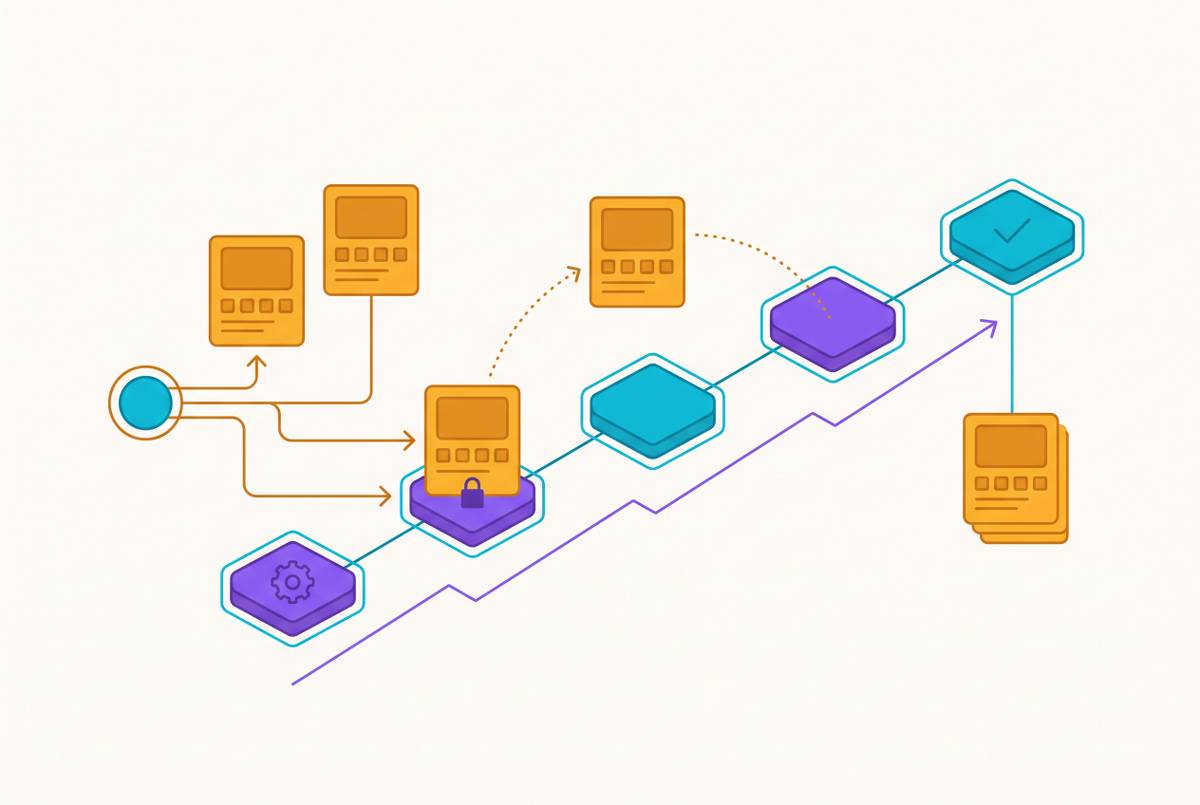
Activation isn't one moment. It's a sequence of inflection points: the welcome, the first key action, the first real value milestone, then expansion into a second use case. Each one needs its own demo, built for where the user actually is, not a single video stretched thin to cover all of it.
A tiered model handles this well. Welcome demos go to every new user. Feature walkthroughs go to users who've already hit their first milestone and are ready to go deeper. Advanced modules serve power users chasing certification or expanded workflows. Collapse those three tiers into one generic library, and most teams end up with content nobody watches past the first ten seconds.
At that scale, a full onboarding library can run into dozens or hundreds of individual videos, and the production approach starts to matter as much as the content strategy itself. Traditional screen-recording-and-edit workflows fall apart here. Planning, recording, editing, voiceover, syncing: even one polished tutorial eats hours of dedicated work, and a library with that many touchpoints just isn't buildable at that pace by a small team on a normal headcount.
AI-powered video production changes the math. Generating voiceover, smart zooms, captions, and matching documentation from a single screen recording session closes the gap between what a team can plan and what it can actually ship. Video and step-by-step documentation should come out of that same process together, run by the same people on the same timeline. A written how-to and a walkthrough video covering the same workflow reinforce each other and serve users who learn differently.
Customer education spend is projected to roughly triple between 2024 and 2026, and most customer education teams are already planning to bring in AI tools in the near term. Teams building their content pipeline now are getting ahead of that shift, not scrambling to catch up to it.
The support cost and retention case for investing in demo-led onboarding
Users who never activate don't churn gradually. They fall off a cliff inside the first two weeks, and most products never recover that group once they've gone quiet.
Support ticket volume is a direct stand-in for onboarding failure, and it's a cheap one to measure. A user who understood what to do from the start doesn't flood the support queue asking basic questions. Effective video education cuts support load substantially, which tracks: a demo answers the question before it ever turns into a ticket.
The math here is simple to run. Multiply the average cost per ticket by monthly ticket volume by customer count, and the savings from deflecting even a modest share of those tickets add up fast at any real scale.
Retention is the bigger lever, though, and it's the one most teams underweight. Amplitude's 2025 data shows a strong correlation between early activation and three-month retention, and a meaningful lift in early retention turns into ARR growth that dwarfs whatever it cost to build the demo library in the first place. Onboarding content is a growth investment, not a support cost line. The ROI case closes faster once TTV improvement gets tied to retention and ARR instead of engagement metrics that don't mean much sitting alone on a dashboard.
The evidence is consistent with what most teams already sense: businesses with smooth onboarding show substantially higher loyalty and much lower churn. The demo is the fastest lever available to move that number, faster than a pricing change, faster than shipping a new feature.
Scaling demo-led onboarding across teams, languages, and product lines
The bottleneck at scale is rarely strategy. Teams that believe in demo-led onboarding, that have the tiered model mapped out and the activation milestones defined, still can't keep content current across product updates, new markets, and shifting personas. Production is the wall, and most teams hit it around the same time their library crosses fifty videos.
Global users aren't a secondary audience, and treating localization as a one-off project for every new language fails in practice, every time. One-click translation built directly into the production workflow is the difference between content that actually reaches global users and content that sits, English-only, while half the customer base works around it in a language they didn't choose.
Ownership needs to spread out too. Customer success, learning and development, product, and sales enablement all need demo content, and all of them should be able to make it themselves, without routing every request through one specialist video team. That kind of dependency is a ceiling on growth. Once the team building the demos becomes the bottleneck, the whole library stalls, no matter how good the strategy looks on a slide.
Organizations that adopt scalable training approaches consistently report substantial cuts to overall training costs. That's not just a time saving. It's a change in cost structure, the kind that compounds the more content a team ships.
Governance holds the whole thing together. Branded templates, a consistent voiceover style, shared libraries: these make sure demos built by four different teams still feel like one product experience, not a patchwork of styles that confuses users more than it helps them.
Keeping demos current matters just as much as making them in the first place. A demo showing last quarter's interface actively erodes trust; a user who clicks through a walkthrough that no longer matches the product starts wondering what else might be out of date. AI-assisted re-production drops the cost of updating content close to zero, which kills the "we'll get to it later" excuse that quietly guts most onboarding libraries within a year of launch.