Product Demo Length Benchmarks for SaaS Sales Cycles
Different deal sizes need different demo lengths, not shorter versions of the same one.
Product demo length is a sales strategy decision, not a production one, and most teams get it backwards. They build one demo, then chop it into different runtimes for different funnel stages, instead of building the right asset for each stage from scratch. Deal size, funnel position, and who's actually in the room all set different clocks, and a demo built for one buyer will misfire on another every time. That mismatch, not pricing, not follow-up cadence, is where a lot of stalled deals actually start.
Sales cycles have stretched, buying committees have gotten bigger, and CFO involvement in software purchases has increased substantially. Every one of those shifts points the same direction: the audience for a given demo has gotten more crowded and more skeptical, not simpler. A blended median across all of B2B SaaS sounds tidy, but it describes no actual deal. An SMB buyer signing off alone in three weeks and an enterprise committee spending six months in procurement aren't running the same process at different speeds. They're running different processes entirely.
How deal size determines the buying process a demo must serve
Deal size sets the clock, and the clock sets what a demo needs to do.
SMB deals, under $15K in annual contract value, close in 14 to 30 days. Usually there's one decision-maker, often self-serve or product-led, and the whole thing comes down to activation speed. Mid-market deals, $15K to $100K, stretch to 30 to 90 days. A buying committee starts to form, security review shows up even if it's light, and legal tends to be the thing that stalls everything at the end. Enterprise, $100K to $500K, runs 90 to 180-plus days with formal procurement, multiple rounds of vendor evaluation, and an executive sponsor who has to be won over separately from the day-to-day users. Strategic deals above $500K can run many months or longer, with board-level visibility and legal negotiations alone eating weeks.
The steepest jump happens at $100K ACV. Cross that line, and the buying process changes shape, not just the price tag attached to it.
An SMB buyer needs to decide fast and move on. An enterprise buyer needs to build consensus across a room full of people who don't share the same priorities. Those are different jobs, and longer is not automatically better once a deal crosses into enterprise territory. Whatever most sales teams assume, more depth doesn't win more trust. It just asks a distracted committee to sit through material meant for someone else in the room. Demos that dump too much depth on a prospect too early are one of the quieter reasons deals stall out, and it's a failure mode sales teams almost never diagnose correctly, because the deal doesn't die in the room. It dies three steps later, when nobody follows up.
Top-of-funnel demos: the case for strict brevity
At the top of the funnel, nobody's committed anything yet, not time, not intent. A demo here competes against every other tab a prospect has open, and it loses that fight the moment it overstays its welcome.
On a homepage, 60 to 90 seconds is the functional ceiling. Push past 90 seconds and the demo risks asking for more attention than an uncommitted prospect is ready to give. In a cold email or a social message, the number drops again, brevity matters even more when attention is at its lowest. The demo's only job at that stage is to earn the next conversation, not to explain the whole product. Trying to make it do both is the single most common mistake in this segment, and it's an easy one to spot: the video runs long, tries to cover three features instead of one, and loses the viewer before it gets to the part that mattered.
Dropbox's early growth story is worth remembering here, not because it proves short always wins, but because it shows execution matters as much as runtime. A roughly three-minute screencast demo drove 75,000 signups to Dropbox's beta waitlist overnight. Years later, a separate 120-second explainer video on the homepage lifted conversions 10% on a page that was already generating thousands of signups a day. Two different lengths, two different jobs, both done well. Neither tried to be the other.
Top-performing top-of-funnel SaaS demos today tend to run 60 to 120 seconds, structured in three beats: the problem, the product solving it, then the result. No feature tour, no edge cases, no pricing talk. Save that for later. That restraint isn't a gap in the strategy. It is the strategy.
Mid-funnel demos: matching depth to the decision a prospect is actively making
By mid-funnel, the prospect clicked through from somewhere, an email, a landing page, an ad. They're evaluating now, not browsing, and the demo has to earn a slightly bigger chunk of attention without overplaying its hand.
Feature or use-case pages call for 2 to 3 minutes, enough to walk through one complete workflow without asking for the kind of commitment a live call requires. A demo video sent directly by a sales rep can run longer and go deeper into what makes the product different. Even then, it should stay scoped to a single pain point or a single persona. Trying to cover everything at once is how these videos lose people halfway through, and it's the mistake that shows up most often once a team starts stretching a mid-funnel asset to double as a late-stage one.
Format matters as much as length here. Interactive, click-through demos offer a different dynamic from passive video by letting the prospect drive their own evaluation instead of sitting through someone else's pacing. Getting the length right is often the difference between a prospect booking a call and quietly closing the tab.
If there's more than one feature cluster worth showing, the answer is a set of separate, focused videos. It's several short, focused ones. Modular beats monolithic almost every time at this stage. Teams that resist splitting the content are usually doing it to save production time, not because one long video actually serves the buyer better, and that's a shortcut that costs more than it saves.
Late-stage and live demos: length is a committee problem, not a content problem
By late-stage, the whole committee is in the room, literally or on the call. Enterprise deals routinely pull in stakeholders across security, finance, IT, and the day-to-day users, and none of them are evaluating the product for the same reason.
Live demos, the walkthrough portion of a discovery or evaluation call, typically occupy only a focused slice of the meeting's total time. Everything else in that meeting goes to questions, objections, and getting people aligned, not more screen time.
The real risk at this stage is over-demonstrating. A rep who fills a 60-minute call with 60 minutes of product walkthrough is optimizing for their own comfort with the material, not for how a committee actually decides. Deals with several engaged stakeholders close at a far higher rate than deals where only one person is involved, and that gap doesn't come from more screen time. It comes from organizing what gets said more tightly, so each stakeholder gets something built for them instead of sitting through the same generic tour twice.
That means splitting the demo by audience. A champion or technical buyer can absorb considerably more feature depth than an executive audience. An executive sponsor or a CFO needs a short, focused segment built entirely around outcome and return on investment, not feature mechanics. A security or IT reviewer needs a narrow walkthrough of exactly the controls they're checking for, nothing more.
A late-stage demo is one touchpoint in a buying journey that runs for months. Its job is to resolve one stakeholder's specific concern, not re-pitch the whole product from scratch. Getting decision-makers involved earlier in that process tends to boost win rates substantially, while delaying their involvement drags win rates down. Timing the right demo to the right person matters as much as how long it runs. Maybe more.
What average video length data actually tells you about attention, and where it stops being useful
Average video length across the industry has shrunk hard over the past decade. That's not a passing trend. It's a real shift in what audiences expect before they'll sit still for anything.
The completion curve, though, is shallower than that headline number suggests. Videos under a minute hold the highest engagement, one-to-three-minute videos come in just behind, and three-to-five-minute videos trail only slightly. The real cliff shows up once videos run noticeably long, where completion falls off sharply. So the useful read is that shorter wins only in certain conditions. It's that there's a wide plateau from under a minute out to about five, and then a hard wall.
What that data can't say is whether the people who finished a 60-second demo actually bought anything, or whether a 4-minute demo watched by a late-stage buyer closed the deal faster than a shorter one would have. Completion is a proxy for attention. On its own, it says nothing about sales impact. The sharper question asks what content earns the watch and what length fits this buyer's decision stage right now. Every benchmark mentioned so far is a ceiling, not a target to hit exactly.
Demo videos lift conversion meaningfully on the pages that carry them, but that lift shrinks fast when the demo runs too long for where it's placed, or too generic for who's watching it. Tracking drop-off by placement and by buying stage tells a sharper story than tracking average watch time alone. A 60-second homepage demo and a 60-second cold-email demo with identical completion rates are not the same success. What happens after someone finishes watching matters more than the completion number itself.
Producing the right demo for each stage without rebuilding from scratch every time
Everything above implies a demo library, not a single video, and it should include a 60-90 second homepage cut, a 2-3 minute feature demo, a 3-5 minute sales outreach clip, and tailored late-stage walkthroughs split by stakeholder. These are separate assets built for separate jobs, not different edits of the same recording pretending to serve every purpose.
That's a lot to produce and maintain by hand, which is why AI-assisted video workflows have picked up so fast. Manual production can't keep pace with a demo library that needs four or five versions of the same core content, each one trimmed and reframed for a different buyer.
The core workflow looks roughly the same across platforms: record a screen capture once, then let AI rewrite the script for a shorter cut, add voiceover, apply zoom and captions, and spin out a companion step-by-step guide from the same footage. One recording, several finished assets, without reshooting anything.
A few platforms stand out for different reasons. HeyGen handles AI avatar video, voice cloning, and translation with lip-syncing built in, aimed at teams that need a polished narrated cut without booking a studio. InVideo AI has pursued integrations with leading AI video generation models inside one workflow, useful for teams generating a high volume of short-form cuts. For teams that need buyers clicking through a product rather than watching passively, interactive demo platforms fill that specific gap in the funnel. Several of these tools also generate written documentation, step-by-step guides and knowledge base articles, straight from the same screen recording used for the video, which matters when a sales team needs a leave-behind document alongside the demo itself.
Format choice affects outcomes as directly as length does. One beehiiv case study found that swapping a hero video for an interactive product demo lifted free-to-paid conversion by 50%, a reminder that format itself is a variable worth testing, not just runtime.
The production principle underneath all of this is to record once, at full depth, then let AI handle the cuts, producing the 60-second homepage version, the 2-3 minute feature version, and the tailored late-stage cut for each stakeholder. Speed and quality stop being a tradeoff once the workflow gets built around reuse instead of one-off production. Translation support across dozens of languages, available on several platforms, means a demo calibrated for the right stage and length can go global without turning into a separate production project.
A practical length decision framework by stage and deal size
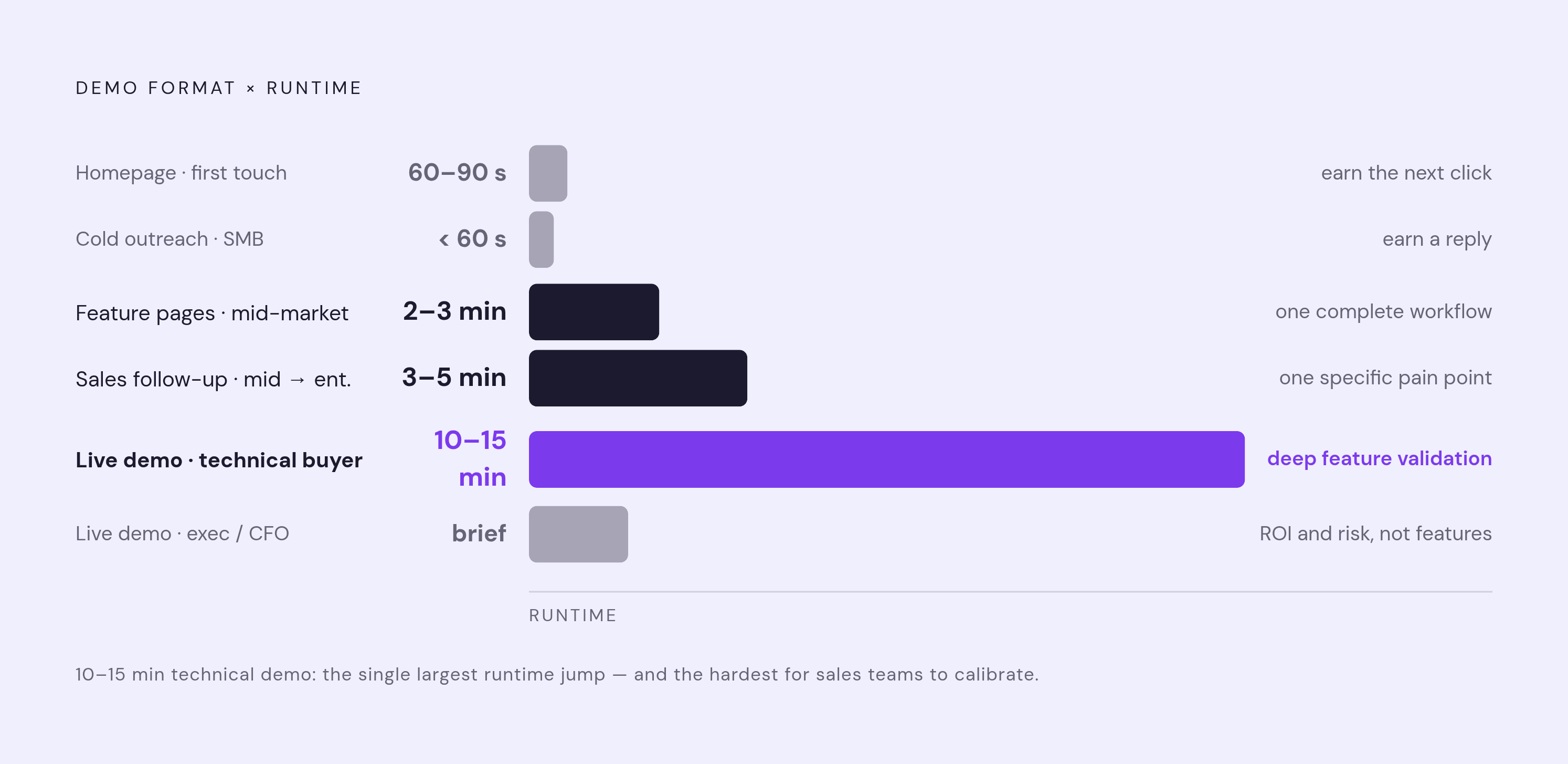
Here's how it maps out, stage by stage.
Homepage or first touch, across every segment: 60 to 90 seconds, polished video, job is earning the next click. Cold outreach to SMB and mid-market prospects: under 60 seconds, a personalized clip, job is earning a reply. Feature or use-case pages for mid-market buyers: 2 to 3 minutes, screencast or AI-generated walkthrough, job is showing one complete workflow start to finish.
Sales outreach follow-up, mid-market through enterprise: 3 to 5 minutes, narrated screen recording or interactive demo, job is addressing one specific pain point, not the whole product. Live demo for a champion or technical buyer in enterprise deals: 10 to 15 minutes of walkthrough inside a longer call, job is deep feature validation. Live demo for an executive or CFO in enterprise and strategic deals: keep it brief and outcome-focused, job is justifying ROI and managing risk, not touring features.
Post-sale onboarding and training runs on its own scale entirely: quick tips at 30 to 90 seconds, tutorial walkthroughs at 2 to 5 minutes, comprehensive training modules at 5 to 10 minutes, matched to how complex the task is, not how deep the product goes.
Every row in that framework runs on the same logic. Match the demo's length to the decision the buyer is actually making right now, not to what looks impressive in a deck, and not to what the seller feels like showing.