Champion-Centric Demo Narratives in Complex B2B Deals
Most B2B deals happen in rooms your rep will never enter.

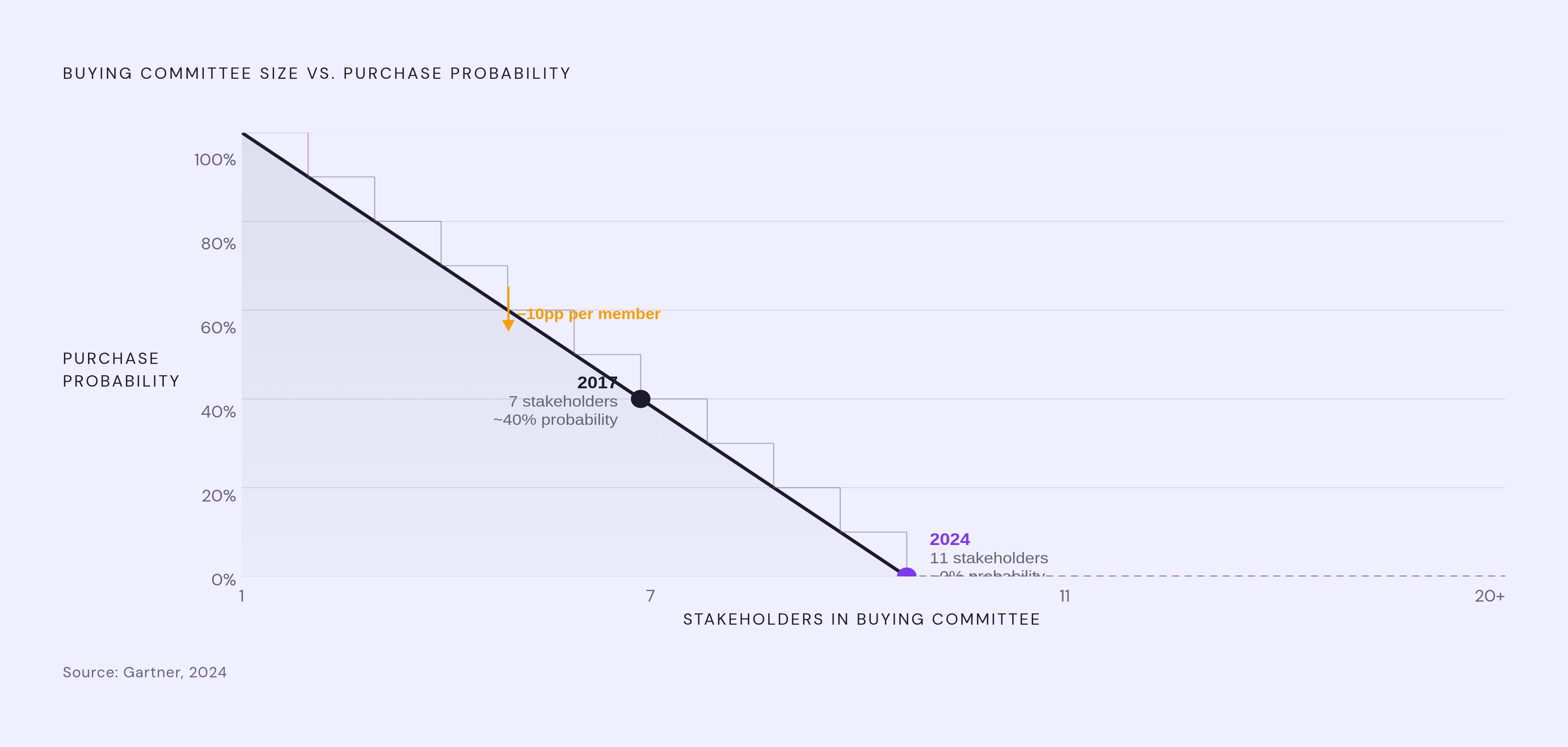
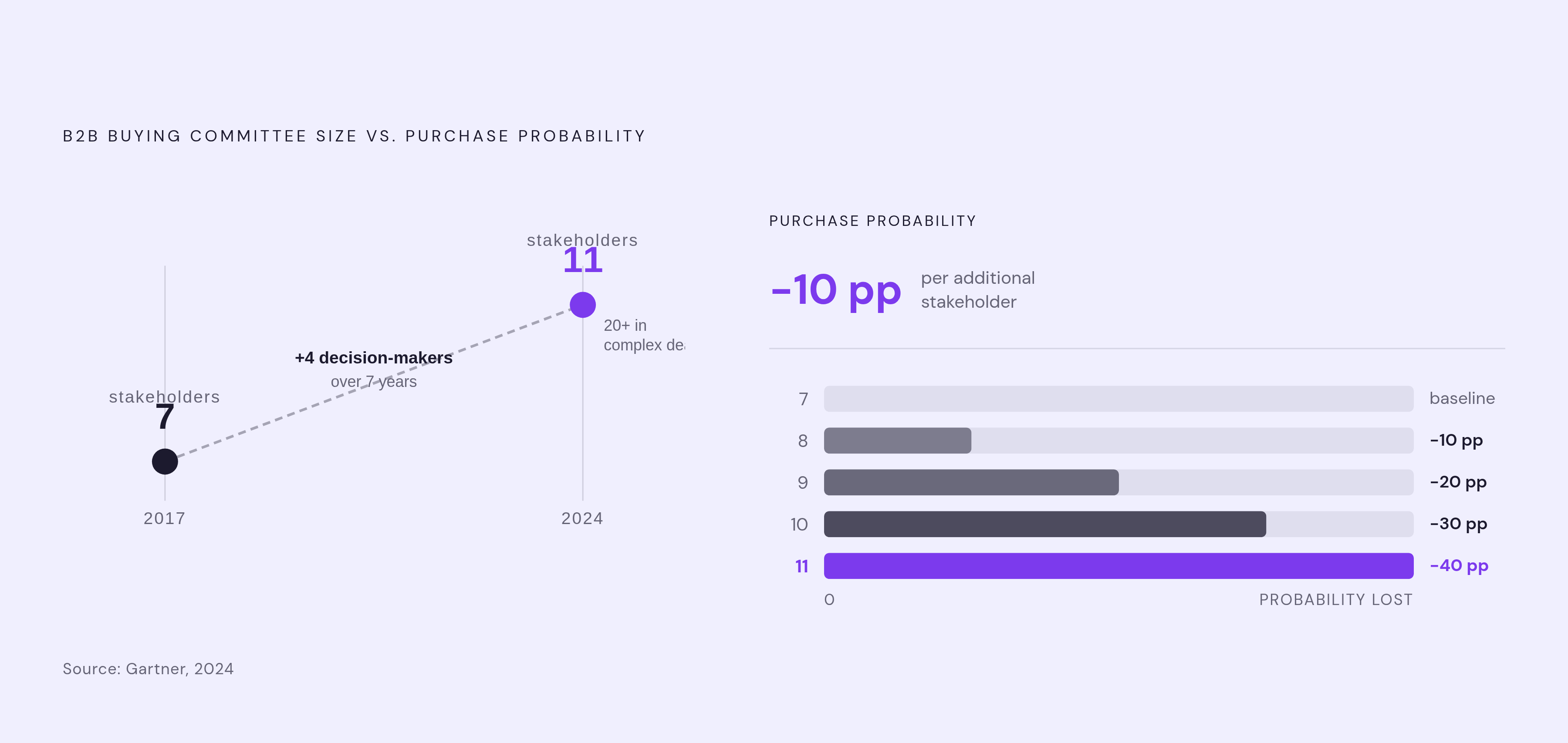
Gartner's 2024 numbers put the average enterprise buying committee at 11 stakeholders, up from 7 in 2017, and complex purchases can pull in 20 or more. Every extra decision-maker cuts purchase probability by roughly 10 percentage points. That's the whole problem in one sentence: the rep pitches once, the committee decides eleven times, and ten of those conversations happen with nobody from the vendor side in the room.
Forrester's 2024 State of Business Buying found the average deal now touches 13 stakeholders, with close to 89% of purchase decisions crossing multiple departments. So the demo a rep delivers is the first of many deliveries, not the whole sales motion. The second, third, and fourth deliveries happen through the champion, in meetings the rep will never see, against objections the rep will never hear raised. And buyers walk into that first call more prepared than they used to be: Highspot's 2024 analysis found 43% of sellers now see buyers show up with AI-generated vendor comparisons already in hand, and Gartner's 2025 data shows buyers using generative AI are 2.3 times more likely to lock in a shortlist before talking to a vendor at all. If most of the deliberation happens without the rep, the artifact that survives contact with the committee, and the champion's ability to retell it, is the actual product being sold here: the story, carried in place of the software itself.
What a champion actually is — and what the role can and cannot bear
MEDDICC's definition is precise for a reason: a champion has power, influence, and credibility inside the buying organization, and is both willing and able to help move the deal. Able is the word that gets skipped over. Plenty of champions are willing. Fewer are structurally positioned to actually do anything with that willingness.
The classic failure looks like this: the champion sits through every demo, nods along, asks sharp questions, seems fully bought in. Then they go quiet. Emails stop getting answered. The deal slips a quarter, sometimes two, and nobody on the vendor side can point to a single moment where it broke. What broke is that the champion never had the internal case built for them. They were sold. They just couldn't resell it without the rep standing next to them, and the rep wasn't invited to the meeting where it mattered.
There's a useful piece of dissent worth naming here. Bold & Sharp's review of more than 400 won opportunities found champions rarely rank in the top three reasons a deal was won, and none of the champions studied displayed every attribute the standard qualification frameworks assign them. That's a case for treating the champion as a mechanism rather than a silver bullet. Gartner's 2025 survey of 632 B2B buyers found that buying groups reaching internal consensus were 2.5 times more likely to report a high-quality deal. Consensus is the outcome; the champion is how you get there.
So the posture matters: champion enablement over champion dependency. The job is to give one person, who already has standing inside the building, a story simple enough to carry and specific enough to survive contact with finance, IT, and a skeptical VP who wasn't in the room for any of it.
Why most demos fail to travel beyond the first room
Here's the demo most reps still give: click through every screen, narrate what each button does, hit every feature in the deck. The prospect nods. They don't ask questions, because there's nothing to push back on. It's a tour, not a conversation.
The champion who sits through that tour cannot retell it later, because there's nothing to retell. A catalogue isn't a story. Ask that champion to explain the product to their CFO three weeks later and watch them reach for a features list instead of an argument, because a features list is all they were given.
A demo that travels starts somewhere else entirely: with the specific pain point the buyer named in discovery, and nothing else. It shows, in the fewest possible moves, how the product removes that one problem. No detour through the rest of the platform. The structure that survives retelling has three parts: the problem this specific organization has, why what they're currently doing doesn't solve it, and what changes once the product is in place. That's a shape a person can hold in their head and repeat in a hallway conversation without a script.
Stanford University research from 2024 found that information delivered as a story gets retained up to 22 times better than the same information delivered as isolated facts. That's not a marginal difference. A champion asked to reconstruct a feature list from memory is fighting uphill; a champion retelling a story is just repeating something that already made sense the first time they heard it.
Think of it as the hero's journey, adapted: the buyer's organization is the hero, the unsolved problem is the obstacle, and the product is just the tool that gets them through it. The vendor is never the main character. Keep the champion's organization at the center of the narrative, and the champion has a story about themselves to tell, not an advertisement for someone else's product.
Building a modular narrative architecture that serves every stakeholder
One story, told the same way to everyone, will fail somebody. Finance wants the ROI math. IT wants to know about security and what breaks during integration. The people who'll actually use the thing every day want to know how much of their workflow changes. Executives want to know if it fits where the company is headed in two years. A single monolithic demo trying to hit all four is a demo that satisfies none of them fully.
The fix is modular rather than monolithic: one shared core narrative, the problem and the transformation, wrapped around interchangeable modules built for each stakeholder's actual concern. Research from thestarrconspiracy.com frames this as six buying jobs: problem identification, solution exploration, requirements building, vendor selection, validation, and consensus creation. One asset built for each job means the champion has something ready to deploy at whatever stage the committee happens to be stuck on, instead of trying to force one asset to do six jobs badly.
The payoff for personalizing shows up in the numbers: demos personalized at 50% or higher have been associated with conversion rates above the baseline, and AI-assisted personalization with meaningful sales cycle compression. Modular construction and personalization turn out to be the same lever pulled from two different angles.
This also changes what the champion is actually doing day to day. They're curating, not reconstructing a pitch from memory: picking the IT module for the IT meeting, the finance module for the budget review. Curation is a job almost anyone can do reliably. Reconstruction from memory is not.
Delivery format matters just as much as content. Omnichannel demo strategies have been reported to produce substantially higher purchase rates than single-format approaches. A champion who forwards a short video to the CFO while walking IT through an interactive build isn't doing anything exotic; they're just distributing content the way the committee actually consumes it, one format at a time, matched to the person receiving it.
The champion kit: what to hand over and why each piece exists
A champion kit isn't a folder of PDFs dumped in a shared drive. It's a small, deliberately built set of assets, each one tied to a specific buying job and a specific persona already mapped out before the kit gets assembled.
The components that actually earn their place:
Short, self-contained video walkthroughs, one per persona, so the champion forwards the CFO cut to the CFO and the IT cut to IT without scheduling a single extra live session. A one-page internal business case the champion can present as though they wrote it themselves, with the ROI framing already built in, distinct from a vendor datasheet carrying the vendor's logo. An objection-handling document that names the two or three questions each persona reliably asks, with answers the champion can deliver without stumbling. Procurement and security artifacts, compliance summaries, integration documentation, that clear the IT and legal blockers before they turn into a three-week delay.
Video assets do something extra when built right: they report back. Knowing a CFO re-watched the pricing section three separate times is a live buying signal, not a guess, and video platforms that track watch-time and drop-off make that signal visible to the rep in near real time.
One detail that gets skipped constantly, and shouldn't: label every asset with a version number and a date, right on screen. "v4.2, June 2026" tells the champion and the rep both that a given video isn't stale. A champion forwarding an outdated demo to an already-skeptical CFO does more damage than sending nothing at all.
Producing champion-ready video assets without a production bottleneck
Here's where the plan usually collides with reality. A team running ten active enterprise deals, each one needing multiple persona-specific video modules kept current through every product release, cannot produce that volume through a traditional video pipeline. Editors, scripts, reshoots. The math doesn't work.
AI-driven production has stopped being a differentiator and become table stakes. Allego's 2025 Revenue Enablement Report found that 100% of sales enablement leaders now report AI in active use across their organization, up from 62% just a year before. That's a field that flipped in twelve months.
What that shift makes possible, practically: a screen recording turns into a polished walkthrough with a rewritten script, a natural-sounding voiceover, smart zoom on the parts that matter, and captions, without a video editor touching it. Modules get produced and refreshed on the same cadence as product releases, not once a quarter when someone finally has bandwidth. Persona-specific cuts come from a single master recording instead of a full reshoot for every audience. And the same source recording can generate both a video to forward and a written step-by-step guide to leave behind, so the champion has something to watch and something to reference later.
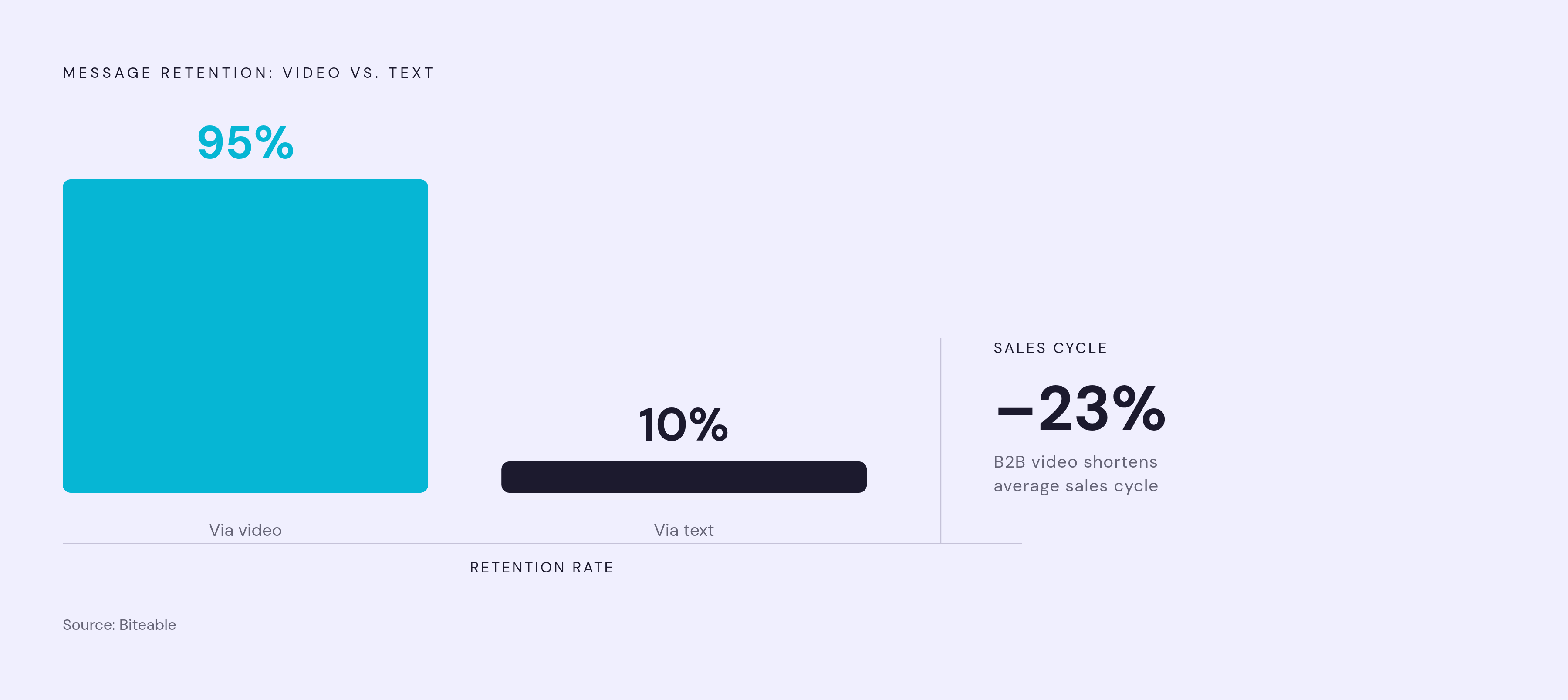
The retention case for video specifically is stark: according to Biteable, people retain roughly 95% of a message delivered as video, against roughly 10% for the same message read as text. That's not just a content-quality argument. B2B video content shortens the average sales cycle by 23%, which means the production investment pays back in deal velocity, not just in a nicer-looking asset.
The tooling landscape reflects this split in purpose. Consensus is built specifically around video-based demos with stakeholder tracking and champion enablement features suited to long, multi-stakeholder cycles. Platforms built for turning raw screen recordings into polished walkthroughs quickly, such as Clueso, serve teams that need fresh, persona-specific content produced from their own product on a fast cadence, without waiting on a production queue.
Making champion narratives work across languages and regions
An 11-person buying committee at a global enterprise rarely speaks one language. A champion forwarding an English-only video to a French procurement lead or a Japanese IT director is distributing half the kit and hoping the other half doesn't matter. It usually does.
The fix belongs at the production layer, not as a cleanup step afterward. One-click translation and voiceover replacement built into the production workflow means every persona module ships in the right language by default, at the moment it's created, instead of going through a separate localization project that takes another two weeks and stalls the deal while it's "in progress."
Translation alone isn't the whole job, either. The ROI argument that lands with a US-based CFO often needs to be reframed entirely for a German procurement officer, where risk reduction carries more weight than growth framing. The hero's journey structure holds across both conversations. The specific pain point and the specific transformation named inside it need to shift by region, because the thing a French finance lead actually worries about isn't identical to what worries their American counterpart.
For the champion operating across a multi-region committee, this isn't a nice-to-have. A regional stakeholder who can actually watch and understand the material the champion sends is friction removed from the champion's plate; a stakeholder squinting through a language they're not fluent in is friction the champion now has to personally manage, meeting by meeting. Treating localization as a one-click step at creation time, rather than a bolt-on project after the fact, is what keeps a global deal moving instead of stalling out while assets sit in a translation queue somewhere.
Measuring whether the champion narrative is actually moving the deal
The measurement question isn't whether the champion received the kit. It's whether the committee actually engaged with it, and whether that engagement lines up with the deal moving forward.
Video-level data answers a good chunk of that directly: who watched, how long they stayed, where they dropped off, whether they came back for a second look. A CFO re-watching the pricing module three times is showing intent a rep can act on that same day. A stakeholder who never opens the link the champion sent is showing something too: a gap in champion coverage that the rep can step in and close before it becomes a lost deal nobody saw coming.
Gartner's 2025 finding that consensus-reaching buying groups are 2.5 times more likely to report a high-quality deal gives this a bigger frame. A champion kit that produces documented engagement across multiple personas, not just one enthusiastic champion clicking through everything alone, is a leading indicator that consensus is actually forming inside the committee. Activity isn't the same as consensus, but visible, spread-out engagement is a reasonable proxy for it.
Library hygiene turns out to be a measurement discipline in its own right. Version-labeled assets tied to release notes let a team audit which modules keep getting forwarded, which ones sit untouched, and which ones have quietly gone stale. The kit is a living program that needs the same maintenance attention as the product it's representing, not something built once and left alone.
And after every deal, won or lost, a short debrief with the champion surfaces what actually landed: which modules got used, which objections the kit didn't prepare them to handle, which persona had no real coverage at all. The next kit gets built from the last one's gaps, not from scratch. That loop is what separates a one-time deliverable from a system.
The demo a rep gives in the room is a performance, over the moment it ends. The champion narrative is the thing built to outlast that room: structured enough to hold together, specific enough to survive eleven different retellings, and measurable enough that nobody has to guess whether it's working. That's the actual difference between a demo and a system built to close a deal without the rep in the room for most of it.