When to Use a Live Demo Versus a Pre-Recorded Video
Pick the format based on where the buyer sits, how complex your software is, and what's at stake.
The choice between a live demo and a pre-recorded video comes down to fit: where the buyer stands, how complex the software is, how many people are watching, and how much rides on the next answer. Most teams get this backwards. They default to whatever format their org grew up on, and that habit costs deals on one end while it burns reps' hours on the other. Sales orgs built on live calls keep booking live calls for everyone, cold lead or closing signature; product-led teams built on recorded video keep sending video links to enterprise buying committees three weeks from signing. Both instincts overlook fit, and fit decides everything else.
The cost shows up on both ends. A live demo wasted on a cold, unqualified lead burns a rep's hour on someone who was never going to buy. A recorded video sent to a seven-person buying committee mid-negotiation gives them nothing when their VP of Engineering asks a question about their own data schema. Buyers spend roughly 17% of their purchasing journey in direct contact with a sales rep. The other 83% runs through some format the buyer consumes alone, and that format needs picking on purpose, not by habit.
Four things decide the right call: where the buyer sits in their journey, how complex the software actually is, how many people are in the room, and how much rides on getting the next answer right. What follows maps those four variables to real decisions, deal by deal.
What separates a live demo from a recorded one at a functional level
A live demo is synchronous. A rep walks a prospect through the product in real time, reads their reactions, answers questions as they come up, and changes course when the conversation calls for it. A recorded demo is asynchronous: fixed sequence, watched on the viewer's own schedule, no way to interrupt or redirect.
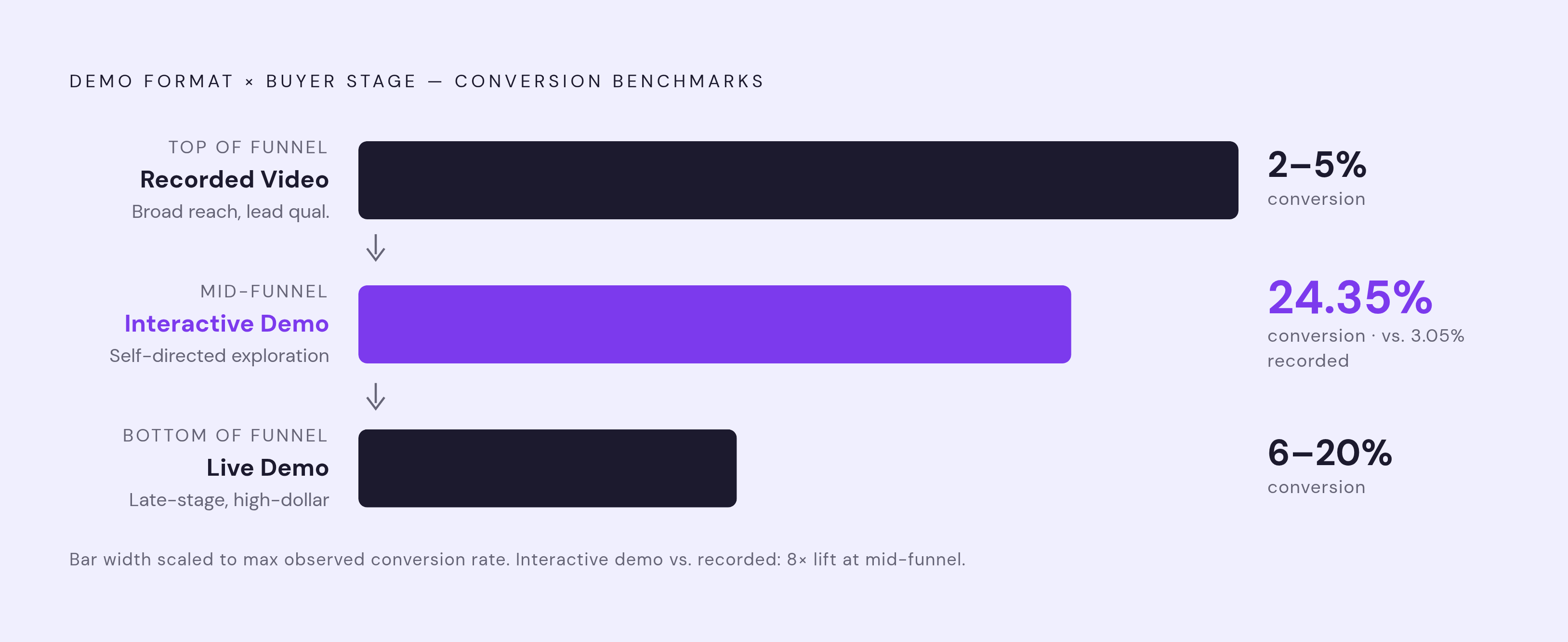
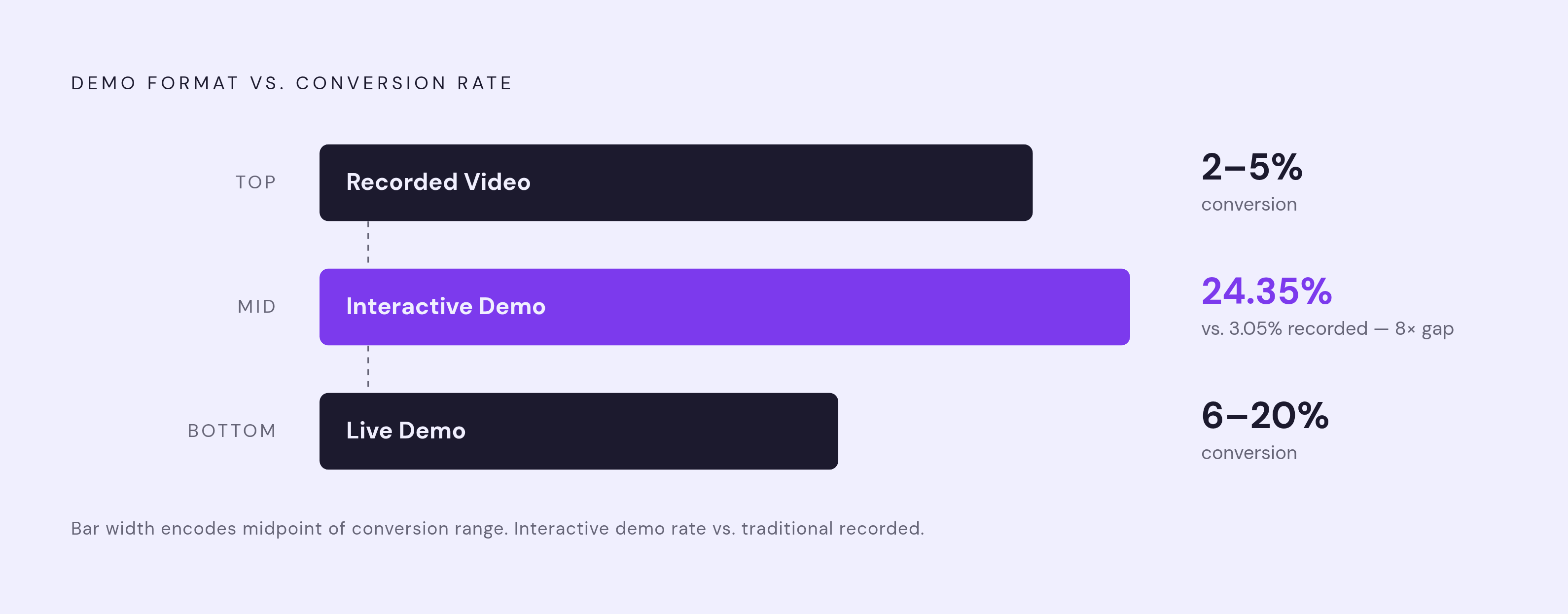
Interactive demos sit in between, and they deserve their own category, not a footnote. They're recorded but branching, so the viewer clicks through the product at their own pace and picks their own path. One 2024 study, analyzing more than 110,000 web sessions and 150 deals, found interactive demos converting at 24.35% against 3.05% for traditional recorded approaches. That's roughly an 8x gap, too large to write off as noise. It's the reason interactive demos count as a real third option here, not a variant of one of the other two.
The dividing line that actually matters is whether the viewer can change what happens next. Production polish and runtime matter less than that single distinction: a gorgeous recorded video is still one-way, while a rough, unscripted live call is still two-way. The sharper question is simpler. Can this thing respond to the person watching it, or not?
Where recorded video earns its place: top-of-funnel reach and self-serve education
Someone lands on a website wanting an answer now, not a calendar invite for Thursday. A recorded demo embedded on that page skips the scheduling step entirely, so the visitor can judge fit before anyone's time gets spent on either side.
Most B2B buyers say they'd rather interact remotely or digitally than sit through another call. Recorded video meets them exactly there, at 11pm in their own time zone, with no rep waiting on the other end for them to show up. It scales in a way live sessions structurally can't: one recorded video reaches a large buying committee without a separate meeting for every stakeholder. Every stakeholder sees the same walkthrough, hears the same explanation, gets the same depth. No variance between what Rep A emphasized on Tuesday and what Rep B glossed over on Friday.
Recorded is the right call for:
- Lead qualification, filtering real interest before a rep's calendar gets touched
- Product launch announcements going out to a broad, unfiltered list
- Feature walkthroughs sitting inside onboarding flows or a help center
- A leave-behind after a live call, something the prospect can replay and forward
Here's the catch teams keep missing: view counts aren't comprehension. A recorded demo tells you someone pressed play and how far they got, not whether they understood what they saw or whether it moved them closer to buying. Treating a view as a strong signal is how teams end up chasing warm-looking leads that were never actually warm. If the deal desk is reporting pipeline health off play-through rate alone, that number is lying to them.
Where live demos earn their place: late-stage deals, high stakes, and complex software
Live demos convert at 6-20%, against 2-5% for recorded video, and the gap comes down almost entirely to objection handling. A rep on a live call catches doubt in real time and answers it before it hardens into a reason not to buy.
The core advantage is proof, delivered on the spot. A prospect asks "can it actually do X," the rep pulls up the product and does X right there, and the prospect's sense of risk drops in a way no recorded answer can match. They watched it happen instead of being told it happens. Competitive situations sharpen this further: if a prospect already sat through a competitor's pitch and walked away with specific doubts, a live rep can surface those doubts directly and answer them. A recorded video has no way of knowing an objection exists, let alone responding to it.
Strong signals that live is the right call:
- A long sales cycle with several people required to sign off
- Software complex enough that configuration questions are specific to this prospect's own environment
- A high-dollar deal where perceived risk needs to come down before anyone commits
- An active bake-off against competitors, where differentiation has to be shown, not summarized
- An internal champion who needs live proof points to bring back to their own leadership
Across 939 B2B companies, enterprise demo-to-close conversion sits at 18%, the lowest of any segment. That looks like a weakness at first glance, but enterprise deals carry more people and longer deliberation cycles than any other segment, which is exactly the terrain live demos exist to handle. Live also produces a signal recorded video simply can't get near: how a prospect leans in, hesitates, or pushes back during a walkthrough tells a rep more about real deal health than any view-count dashboard ever will.
The cases that fall in between and how to reason through them
Mid-funnel is where this gets genuinely hard, because the prospect has real intent but no urgency yet. A landing page video isn't enough anymore, but they're not ready for a closing call either.
Four variables settle it when the answer isn't obvious. Buyer stage: early awareness favors recorded, since it's cheap to scale; late evaluation favors live, since it's built to respond. Software complexity: a simple tool with fast time-to-value can be fully shown in a recording; a platform with real configuration or integration depth usually can't. Audience size: one known prospect or a small group favors live; a broad or anonymous audience favors recorded. Stakes: if the prospect's specific question could change the outcome of the deal, go live; if the goal is just education, recorded is enough.
The gut check that cuts through most of this: would a different answer to this prospect's question actually change what gets shown? Yes means that's a live conversation. No means the answer is the same no matter who's asking, so record it once and reuse it.
Sequencing should be a deliberate strategy, not a fallback. Recorded video qualifies and educates at the top of the funnel. An interactive demo lets a mid-funnel prospect explore the features relevant to them, at their own pace. Live gets reserved for late-stage prospects who've already self-selected by making it through the earlier stages.
SMB and enterprise pull in opposite directions here, and treating them the same is where a lot of effort gets wasted. SMB deal cycles often don't justify a live demo for every prospect; recorded video paired with a fast follow-up message serves everyone better. Enterprise almost always earns a live touch somewhere before close. Data from the same 939 B2B companies puts SMB demo-to-close at 32%, nearly double the enterprise rate of 18%, and the gap comes down to how many more decision points an enterprise buyer has to clear before signing anything.
How the same logic applies to customer education and internal training
The four variables don't stop mattering once the deal closes. A live onboarding session for a new enterprise customer wading through a complex setup is functionally the same situation as a late-stage sales demo: high stakes, specific questions, a real need for someone to adapt on the fly.
Recorded video still has a strong, well-earned home in customer education. 91% of customers say they prefer video for onboarding content, which is close to consensus, not a mild preference. Teams that default to live onboarding for every account are ignoring what their own customers are telling them. It's the single most common misallocation in this whole framework: paying a CSM's hourly rate to narrate a walkthrough that could've been recorded once and reused a thousand times.
Live wins when initial configuration is complex enough to need real back-and-forth with a success team, when the account is high-value enough that churn risk justifies dedicated attention, or when training happens in cohorts, where one person's question teaches the whole room something useful.
Recorded wins when the training is foundational and repeatable, the kind of walkthrough a team would otherwise deliver live, on repeat, week after week. It also wins when onboarding needs to be self-serve with fast time-to-value and no CSM bottleneck, and when users need something to come back to later, since a live session, once it's over, can't be replayed.
Internal training follows the same math. If a team finds itself running the same live onboarding session more than once a week, that's the signal to stop. Record it once, produce it well, and quit repeating the same material to a new audience every time.
What it actually takes to produce each format well, and where teams underinvest
A live demo needs three things in place before anyone hits "join." A demo environment that's actually stable, since a live demo that breaks does more damage to trust than no demo at all. A rep who knows which paths to walk and which to avoid, and can redirect smoothly when the prospect wanders off-script. And discovery done beforehand, so the rep knows what to emphasize; skip that last step and a live demo loses most of its advantage over a recorded one.
Recorded demos carry their own requirements, and they're just as real. A script and a narrative arc come first, since a screen recording without either isn't a demo, it's footage. Voiceover, clean captions, and deliberate zoom to direct the eye matter more than most teams assume. Research consistently finds that preference for the video format does not translate into tolerance for poor execution. Preference for the format doesn't buy tolerance for sloppy execution of it.
Here's the mistake worth naming directly: treating recorded video as the cheap option and live as the premium one. Drop that assumption. A badly produced recording damages a buyer's confidence just as much as an unpolished live call, and a live call with zero preparation does the same damage in the other direction. Neither format is inherently cheap or inherently serious. Both punish neglect equally, and teams that skimp on production because "it's just a recording" are the ones losing deals to competitors who didn't.
Recorded content carries a maintenance cost that's easy to ignore until it isn't. Screen recordings are tied to the product's actual interface, so every redesign or renamed menu item means a re-record. Teams that don't plan for this end up with onboarding libraries full of screenshots that no longer match the product they're selling. AI-assisted production has closed a real gap here: voiceover, zoom, and captions no longer need a dedicated editor or days of turnaround, and updating one segment no longer means restarting the whole production. Clueso, an AI platform that turns raw screen recordings into polished product videos and step-by-step documentation for software teams, is one tool built around this workflow. For teams producing demos at volume, across personas, industries, or languages, manual production strains under that scale; the efficiency now lives in tools that generate variants from a single source recording or script.
A decision checklist teams can use before choosing a format
Five questions, answered honestly, settle almost every case.
- Where is this person in their journey? Early leans recorded; late leans live.
- How complex is the software, and does that complexity depend on this specific person's setup? Specific leans live; general leans recorded.
- How big is the audience, and is it actually known? Large or unknown leans recorded; small and known leans live.
- What are they likely to ask, and would a different answer change what gets shown? Yes means live; no means recorded.
- How often does this exact scenario come up? Frequent means it's worth producing a recorded version properly; a one-off means live is fine as is.
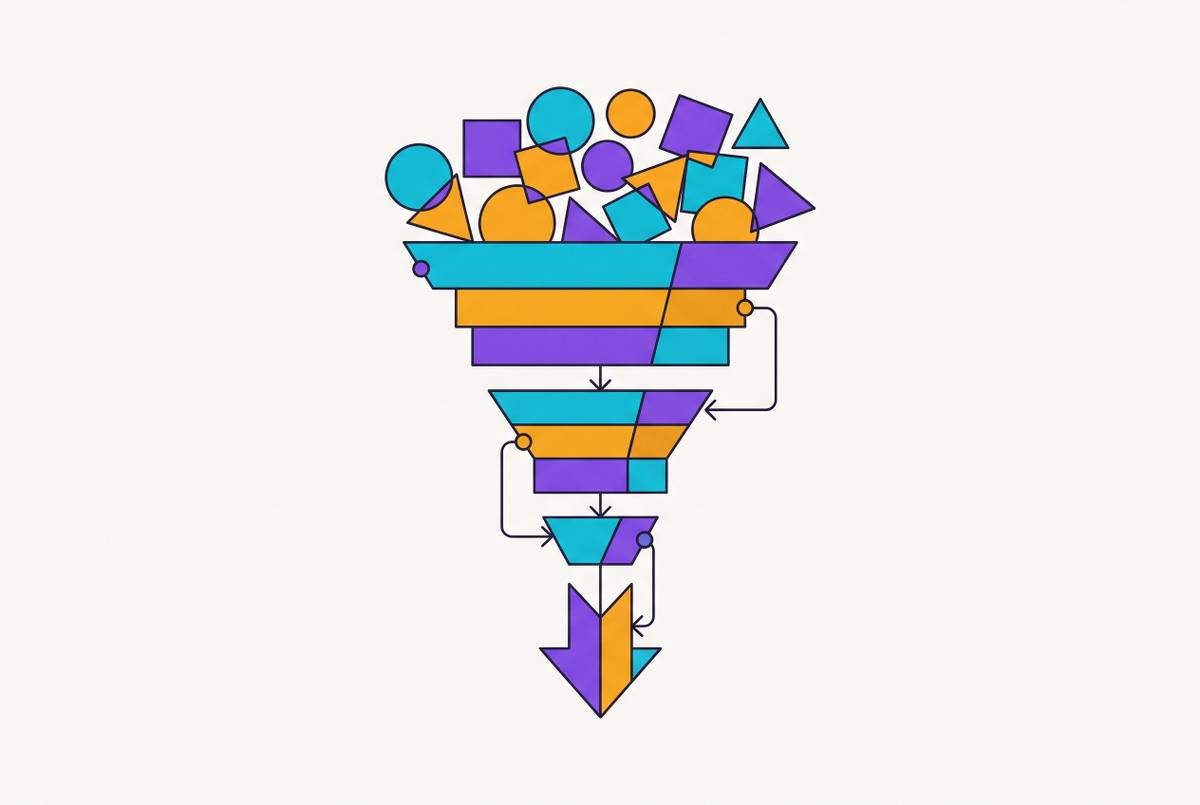
Mapped across the funnel, the pattern holds. Top-of-funnel and repeatable content goes recorded, mid-funnel and self-directed exploration goes interactive, and late-stage, competitive, high-dollar work goes live. Repeatable post-sale training goes recorded; complex or high-value post-sale accounts go live.
Whatever format gets chosen, the real question is whether it's actually ready to do its job. A live demo with no discovery behind it fails the same way a recorded demo with sloppy audio and no editing fails: both waste the moment they were supposed to earn. Getting good at one format and mediocre at the other is a blind spot, not a strategy. The teams that win got good at producing both, and built the judgment to know, deal by deal, which one the moment actually calls for.