Competitive Differentiation Through Demo Sequencing
Ordering your product demo strategically converts more buyers than features alone.
The SaaS market is on track to hit roughly $465 billion in 2026, up from about $408 billion this year, and every dollar of that growth makes it harder to stand out. Features get copied inside a sales cycle now, sometimes within weeks of launch. What stays hard to copy is the order a product gets shown in: to whom, at what moment, and what comes next. Most revenue teams still treat that order as an afterthought, and that's the mistake worth fixing before anyone touches a single slide.
How large the execution gap actually is across the SaaS market
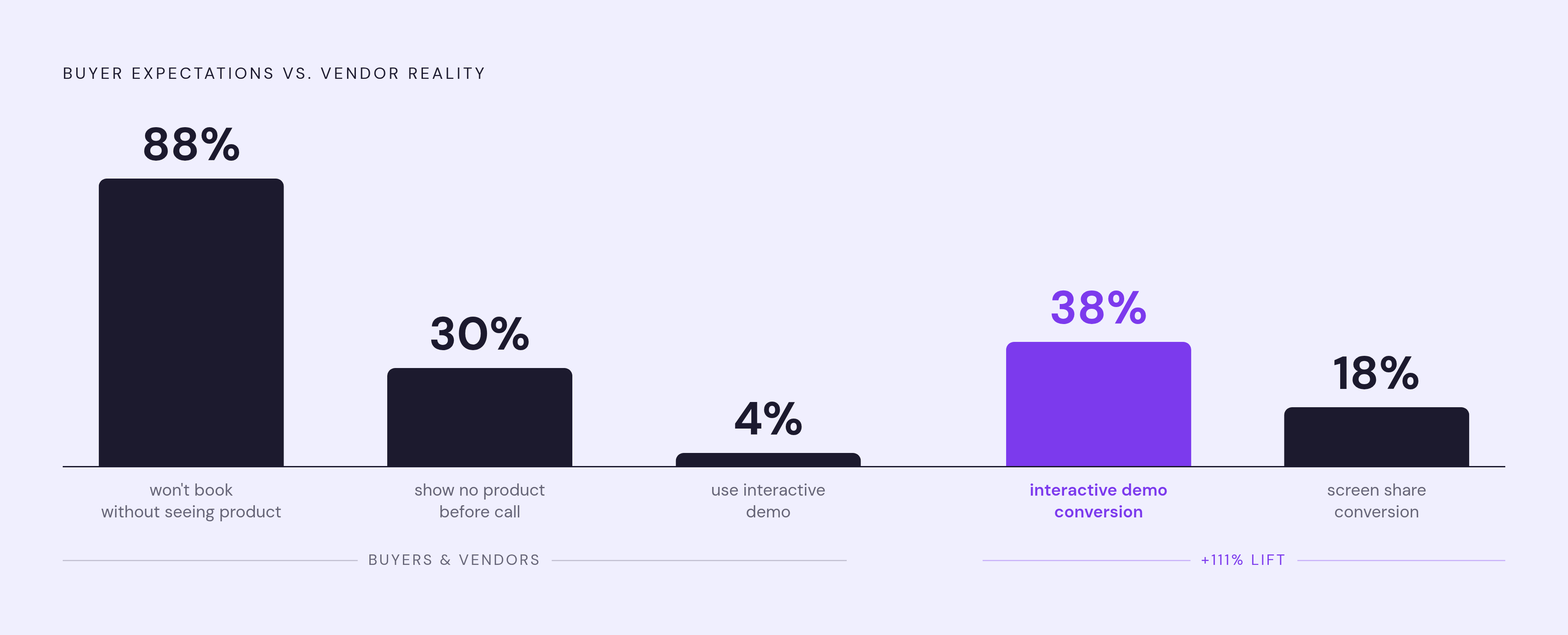
Start with a number that should embarrass most revenue teams: of 200-plus SaaS companies studied by Howdygo, 30% show no product at all before a sales call. No screenshot, no GIF, nothing. The buyer books a meeting on faith and finds out what they actually bought forty minutes in.
Only 4% use any kind of interactive demo, despite data showing interactive demos convert at 38% versus 18% for a generic screen share. That's a 111% jump in conversion sitting on the table, mostly untouched. It isn't sitting there because the technology is hard to get. It's sitting there because almost nobody has bothered to build the sequence around it.
Buyers have made their preference obvious anyway: 88% of software buyers won't book a sales call without seeing the product in action first. Buyer expectation is running way ahead of vendor behavior, and that gap is the whole opportunity. Most competitors are either hiding the product entirely or showing it badly, in no particular order, to everyone the same way. Beating them doesn't take a bigger budget. It takes sequencing that reflects how a buyer actually moves through a decision, instead of how a rep feels like presenting that day.
What demo sequencing actually means and what it is not
Demo sequencing is not one really good demo, and treating it that way is where most programs go wrong from the start. A single polished asset can't adapt to who's watching or what they already know. Sequencing is the deliberate design of which capabilities get shown, to which persona, at which stage, in what order, and what happens the moment after they've seen it.
Three decisions make up a sequence. What to lead with: the hook that earns attention and frames differentiation before a competitor gets the chance. What to hold back: capabilities revealed later, once the buyer has enough context to understand why they matter. And how momentum builds across touchpoints, so each demo moves the buyer's understanding forward instead of repeating the last one in a different font.
The thing that actually kills these programs isn't a production problem. It's reps walking a prospect through every feature regardless of whether that prospect cares about half of them, and calling it thoroughness. That's noise dressed up as diligence, and buyers can tell the difference within the first two minutes.
Sharing a pitch deck and a battlecard isn't sequencing either. Sequencing is the architecture of what a buyer experiences over time. Different demo types exist because different stages of a buyer's journey call for different things. Confusing "we have assets" with "we have a sequence" is the exact error that keeps this piece worth writing.
Mapping demo types to buyer stages and entry points before you build anything
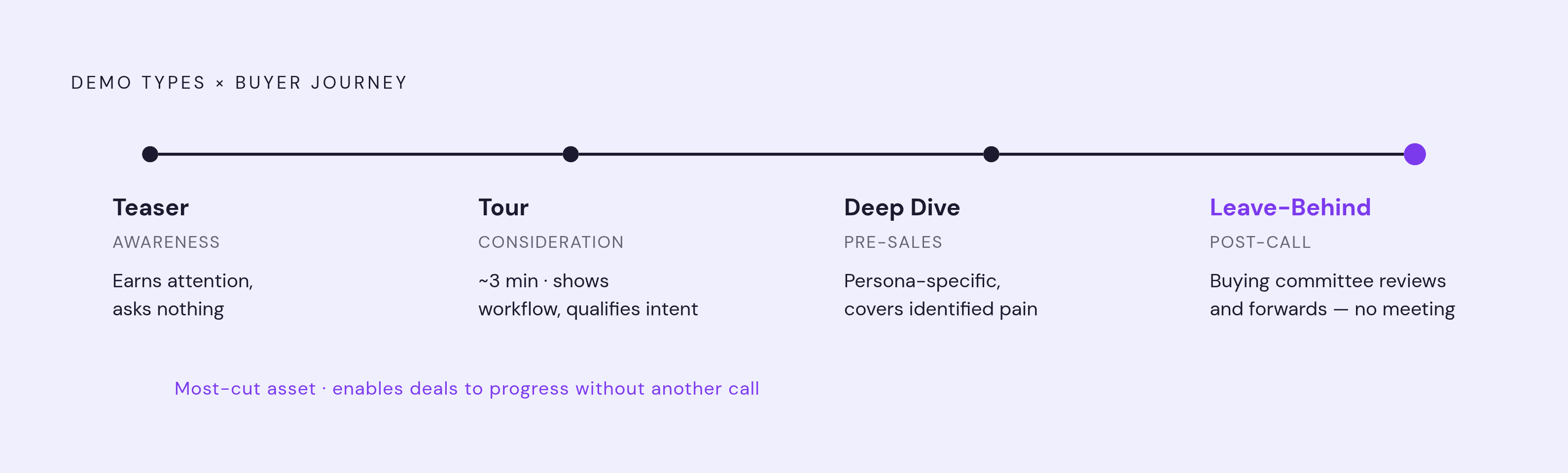
Figure out where the buyer is coming from before deciding what to show them. An ad click, an organic search, an email nurture sequence, and a post-trial signup are four different buyers carrying four different levels of context. Treating them identically wastes the first, most valuable moment of attention a company gets, and most teams do exactly that by default.
Four demo types map roughly to four stages. The teasersits at top of funnel: pure awareness, earns attention, hints at differentiation, asks nothing of the buyer yet. The tour, about 3 minutes, belongs to consideration: shows the workflow, builds credibility, qualifies intent without a rep in the room. The deep dive shows up at late consideration, pre-sales: persona-specific, built from discovery, narrow enough to cover only the capabilities that solve the pain already identified. The leave-behind comes after the call: gives the buying committee something to review and forward internally, without needing to schedule another meeting.
Outreach has proposed a persona matrix for organizing this: buyer personas (Sales, Marketing, Operations, Enablement) on one axis, High Touch versus Low Touch on the other. Every cell in that grid gets its own sequence, its own assets, its own cadence. A senior buyer evaluating a high-value deal gets more touches, spread over more time, with more manual personalization, because the deal size justifies the labor. Giving a self-serve buyer that same white-glove treatment doesn't feel generous, it slows down a deal that wanted to move fast on its own. That's a real cost, not a courtesy.
None of this needs to launch as a finished matrix. Trying to build the whole grid on day one is how these programs stall before they start. Find the single highest-friction step in the evaluation flow, build one demo for it, measure what changes, then expand from there.
Leading with the right capability, what your opening demo should and shouldn't do
The first demo sets the frame everything else gets judged against. Lead with a commodity feature, and the buyer starts comparing on commodity terms from minute one. That's the whole game, decided early, often without anyone on the call noticing it happened.
A strong opening demo does three things. It surfaces the differentiation competitors either don't have or can't show as cleanly. It speaks directly to the pain the buyer walked in with, which means actual persona research beforehand, not a generic tour recycled from the last deal. And it creates what's sometimes called a hinge moment: a point where the buyer's understanding of their own problem shifts, not just where the solution gets introduced.
Treating an opening demo like a feature inventory is the single most common way teams waste their best moment of attention, and it's entirely avoidable. Discovery makes the alternative possible: what gets learned about the buyer before the demo determines which 3 to 5 capabilities get shown, and the demo gets built around only those. Leading with pricing tiers, integrations, or settings before showing any value buries the differentiation under table-stakes content nobody came to see.
Capabilities that only make sense with context shouldn't lead the sequence at all. Save them for later, once the buyer has a frame of reference that makes them land instead of confuse.
How to build narrative momentum across multiple touchpoints so each demo advances the deal
Every touchpoint should pick up where the last one left off. Repeating the same content louder isn't momentum, it's noise with a bigger microphone, and buyers disengage from it fast.
Behavior should trigger progression, not the calendar. If a prospect watches the bulk of a deep-dive video, that's an intent signal, and it should trigger the next asset or the next outreach, whether that's a meeting request or a competitive walkthrough. Nurture sequences run on the same logic: swap "read our case study" for "see how this feature works in 60 seconds," and let the prospect self-advance at whatever pace actually suits them, instead of the pace a drip campaign assumes everyone shares.
The leave-behind matters more than most teams treat it, and it's usually the first asset cut for time. After a live call, a video or interactive demo gives the buying committee something to review on their own. Multi-threaded deals need assets a champion can forward internally, without a rep sitting in the room to narrate every slide.
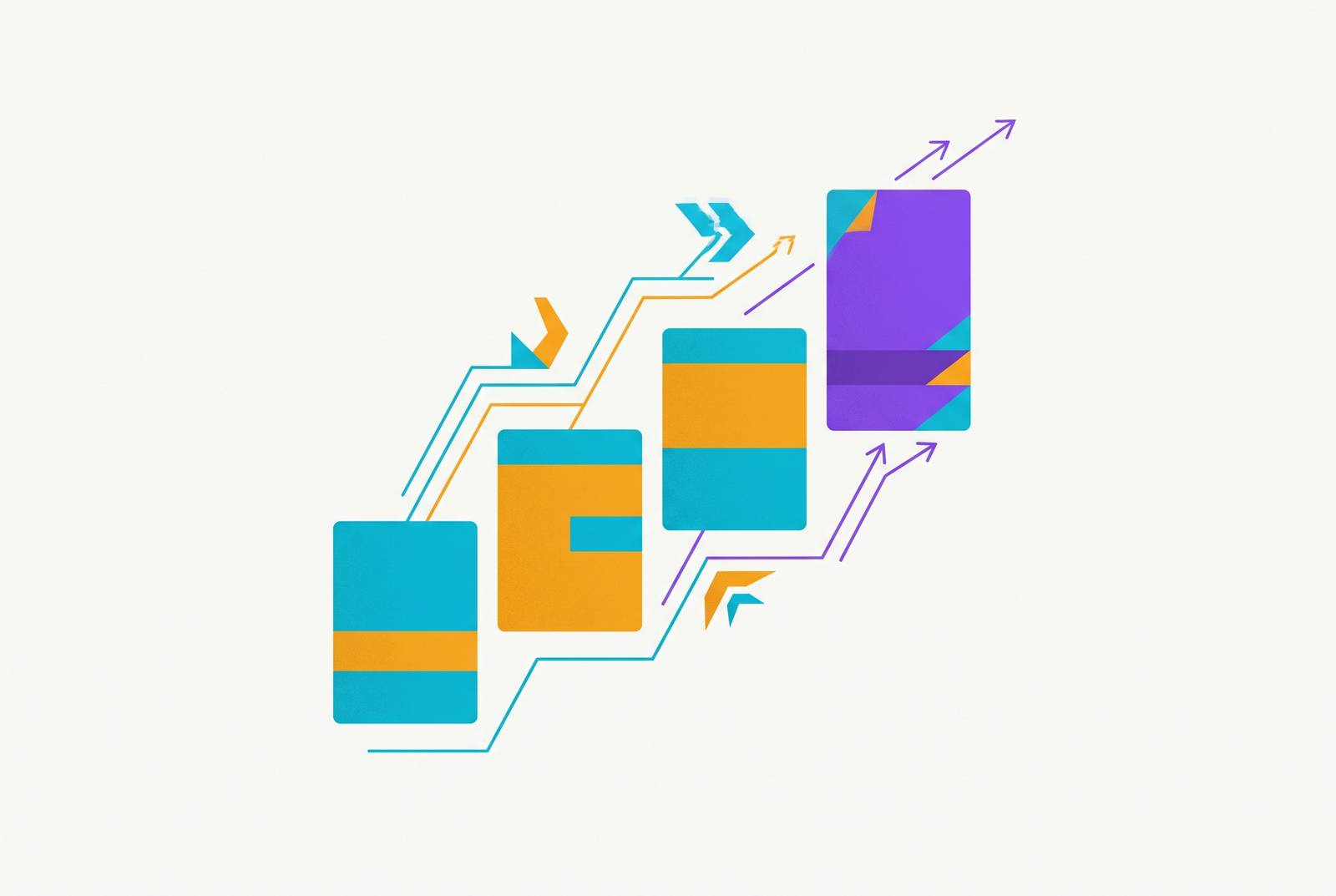
Laid out across four touchpoints, the arc looks something like this: the teaser establishes the problem and hints at differentiation, the tour shows the workflow in context so the buyer can picture themselves inside the product, the deep dive addresses the specific pain uncovered in discovery, and the leave-behind gives the champion something to carry internally without scheduling yet another call. Each handoff should feel earned. The trigger is what the buyer actually did, not how many days have passed since the last email went out.
Why the "polishing trap" prevents most teams from maintaining a sequenced demo program at scale
Most demo programs die the same way, almost every time. A team starts with a simple recording tool, then exports the footage to a heavy editor like Premiere or Final Cut to make it look "professional." Once that video's been through a full outside edit, updating it means a full re-shoot from the start, not a five-minute tweak.
That's fatal to sequencing, because a real sequenced program needs constant updates. Product changes, new personas get added, competitive positioning shifts underneath a deal already in progress. A workflow that requires a re-shoot every time something changes can't keep pace with any of that, and it stops trying within a quarter or two. This is the actual reason most sequencing initiatives die: not lack of strategy, not lack of buy-in, but a maintenance cost nobody budgeted for.
Run the math on a 12-touchpoint persona matrix. That's potentially dozens of assets to maintain, and if every update is its own production cycle, the sequence goes stale fast. Differentiation erodes right along with it. Teams end up reverting to one generic demo shown to everyone at every stage, which is exactly the undifferentiated mess sequencing was supposed to fix in the first place.
The actual fix is a capture-once workflow: record it one time, generate multiple asset types (video, interactive, article, leave-behind) from that single recording, no separate production runs required. Quantum Metric's results from this kind of approach are worth citing directly: 2x the conversion rate on their primary demo request page, 5x more engagement compared to older video content, and 10x faster asset creation. That speed gain is the actual unlock. It's what makes a full persona matrix maintainable instead of a slide in a strategy deck nobody ever executes.
What an AI-assisted production workflow looks like for teams building and maintaining a demo sequence
The workflow itself is fairly simple to describe, even if most teams have never set one up. Record or upload a screen capture, let AI rewrite the script and add voiceover, apply smart zoom and captions automatically, and generate both a video demo and its accompanying documentation from that same source material in one pass.
Video and documentation shouldn't be built separately, because building them apart is exactly where sequences quietly rot. Some tools in this category generate both a polished video and step-by-step documentation from a single screen recording. A step-by-step article version of a deep dive serves a different purpose (self-serve research, async stakeholder review), but if it's built from the same source as the video, both stay in sync when the product changes. Build them apart, and one of them goes out of date within a quarter without anyone flagging it.
AI-powered platforms can produce professional training and demo videos something like 11 times faster than traditional production methods. The practical implication is bigger than the speed number itself: a team can run a full persona matrix without needing a dedicated production department sitting behind it.
Localization compounds the advantage, and it's usually the last thing teams think to sequence around. Translation into 40-plus languages means a sequence built for one market can go global without rebuilding every asset from scratch. That reach makes localization less of a nice-to-have and more of a sequencing multiplier in its own right.
Integration with the GTM stack closes the loop. Push the video to a CMS, sync engagement signals into Salesforce or HubSpot, route a Slack alert when a target account crosses a meaningful watch threshold. That's how a behavioral trigger turns into an automated step in the sequence, rather than something a rep has to notice and act on manually, which is exactly where most manual processes quietly fail.
A few platforms are worth naming for specific jobs inside this workflow. Colossyan handles AI-powered training video creation with avatar and voiceover support and multilingual output, suited to teams that need frequent updates. Knowlify is built specifically for turning documents, SOPs, and PDFs into animated explainer videos. Camtasia remains the standard for straightforward screen-recorded software training. And for teams that need the full capture-once pipeline, screen recording through to polished video and step-by-step documentation, with branded templates, blur tools, and one-click translation built in, AI-powered platforms purpose-built for exactly that let teams ship multiple demo formats from one recording without a production background on staff.
How competitive intelligence feeds back into the sequence, adjusting what you show based on who you're up against
A well-run sequence isn't one script. It's several, branching by which competitor is sitting across the table in a given deal. What wins against one alternative can fall flat against another, and pretending otherwise costs deals that were winnable.
Competitive sales enablement means something specific here: proven objection responses, deal-specific talk tracks, and verified buyer insight, not a generic battlecard PDF nobody reads past page two. Klue's platform automatically pulls proven objection responses out of past sales calls and pushes them to reps proactively, either through post-call Deal Tips or on demand through an in-line assistant. The sequence gets shaped by what actually worked in comparable deals, not by what a product marketer guessed would work six months ago in a conference room.
The results Klue reports back this up: a 28% lift in win rate against top competitors, and more than 10 hours saved weekly for product marketers. That saved time isn't incidental. It goes straight back into maintaining and refining the sequence itself, which is the part of the loop most teams never close.
Mindtickle takes a different angle, with AI roleplay that lets reps rehearse pitches and objection handling against a simulated buyer, scored against frameworks like MEDDIC, MEDDPICC, Challenger, or SPIN. That matters most at the moment the rep has to actually execute the sequence live, under real pressure, with a real buyer watching and no script to fall back on.
Here's the layer competitors genuinely can't see. They can watch which features get demoed publicly, sitting in on a webinar or reading a case study. They cannot see which variant of the sequence runs against their specific deals, in real time, informed by what's worked against them before. That's the part of the moat that stays opaque no matter how good someone's competitive intelligence gets.
Worth tracking too: the enablement tooling landscape itself is shifting fast underneath all of this. Seismic and Highspot announced a definitive merger in February 2026. Showpad completed its merger with Bigtincan back in October 2025. Gong announced a major push into revenue enablement and account management, under the name Mission Andromeda, in late February 2026. That consolidation changes what tools are even available to build a sequence on, and it's worth watching before locking in a stack for the next two years.
Connecting demo sequence performance to measurable business outcomes
Tracking demo completion rates or view counts feels like measurement, but it isn't, and mistaking one for the other is how good programs get cut in a budget review. A view count says someone pressed play. It says nothing about whether the sequence moved that person closer to a decision, which is the only thing that actually matters to a revenue leader signing off on the program.
Real measurement ties each touchpoint to what happens next. Does a heavily watched deep dive correlate with faster time-to-close? Does a leave-behind shared with a buying committee change how deals progress? Those are the numbers that turn demo sequencing from a production habit into a line item finance actually respects. Most teams still aren't tracking them, and that's exactly why so many sequencing programs get killed for the wrong reasons: not because the sequence failed, but because nobody could prove it worked.