Full-Funnel Demo Strategy for B2B SaaS Growth
Demos now need to work at every funnel stage, not just the close.
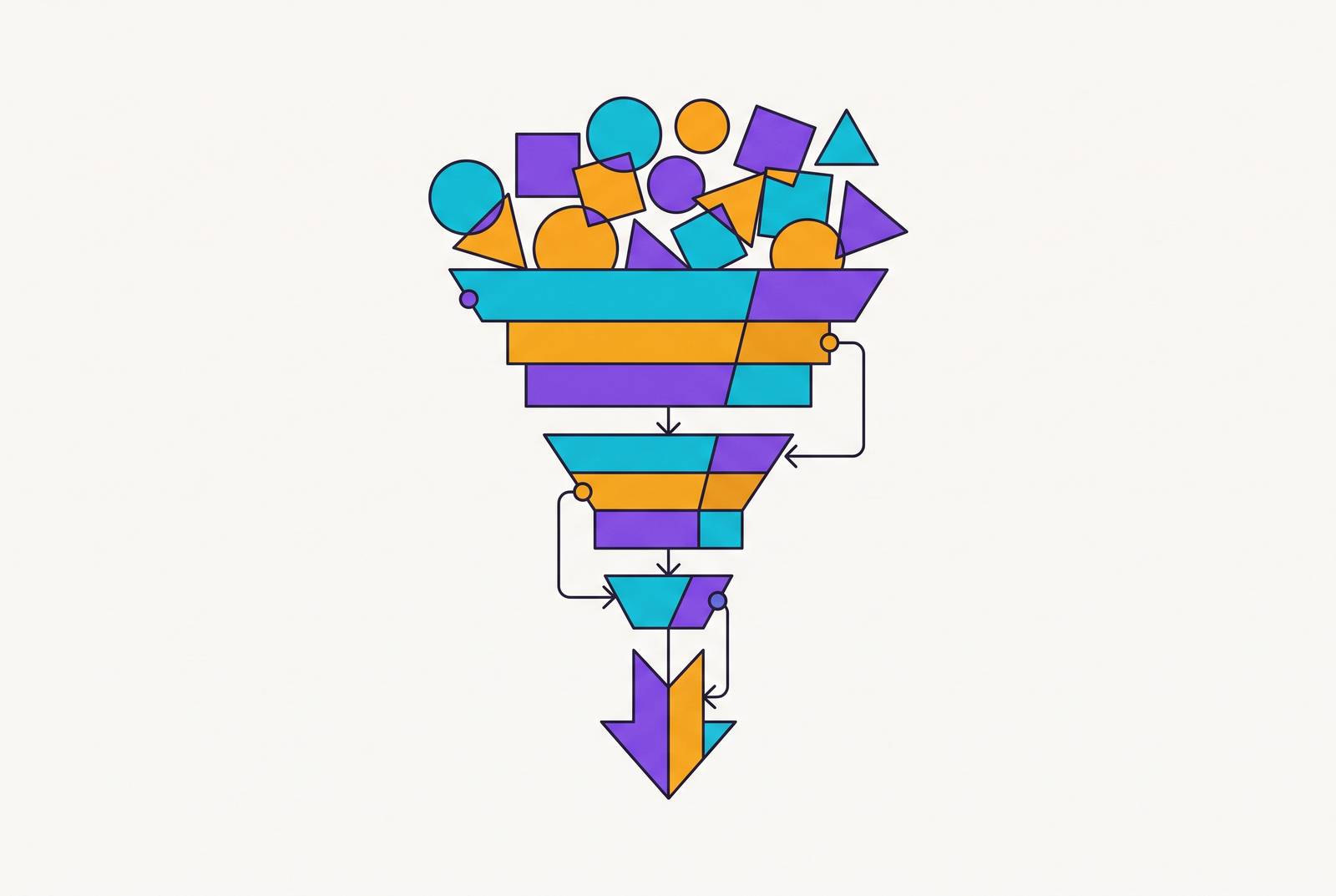
A B2B SaaS demo isn't one meeting near the finish line anymore. It's a format that shows up at every stage of the buyer journey, from a 20-second clip a stranger scrolls past on LinkedIn to a role-specific walkthrough a customer watches eight months after signing. Most teams still treat it as one event, and that's the mistake worth naming up front: pouring the whole budget into polishing a single bottom-funnel demo while leaving buyers to fend for themselves everywhere else is optimizing the wrong end of the pipe. Fix that, and conversion moves at every handoff along the way, not just at the close.
Gartner's 2025 Sales Survey found that 61% of B2B buyers would rather buy with no sales rep involved at all, and buyers spend only 17% of their purchase journey actually talking to suppliers. The other 83% happens somewhere a demo needs to already be sitting, waiting. The fix isn't a better sales demo. It's more demos, in more formats, spread across the funnel, so the product speaks for itself long before a rep ever gets on a call.
How the B2B SaaS funnel actually converts today, and where demos can move the needle
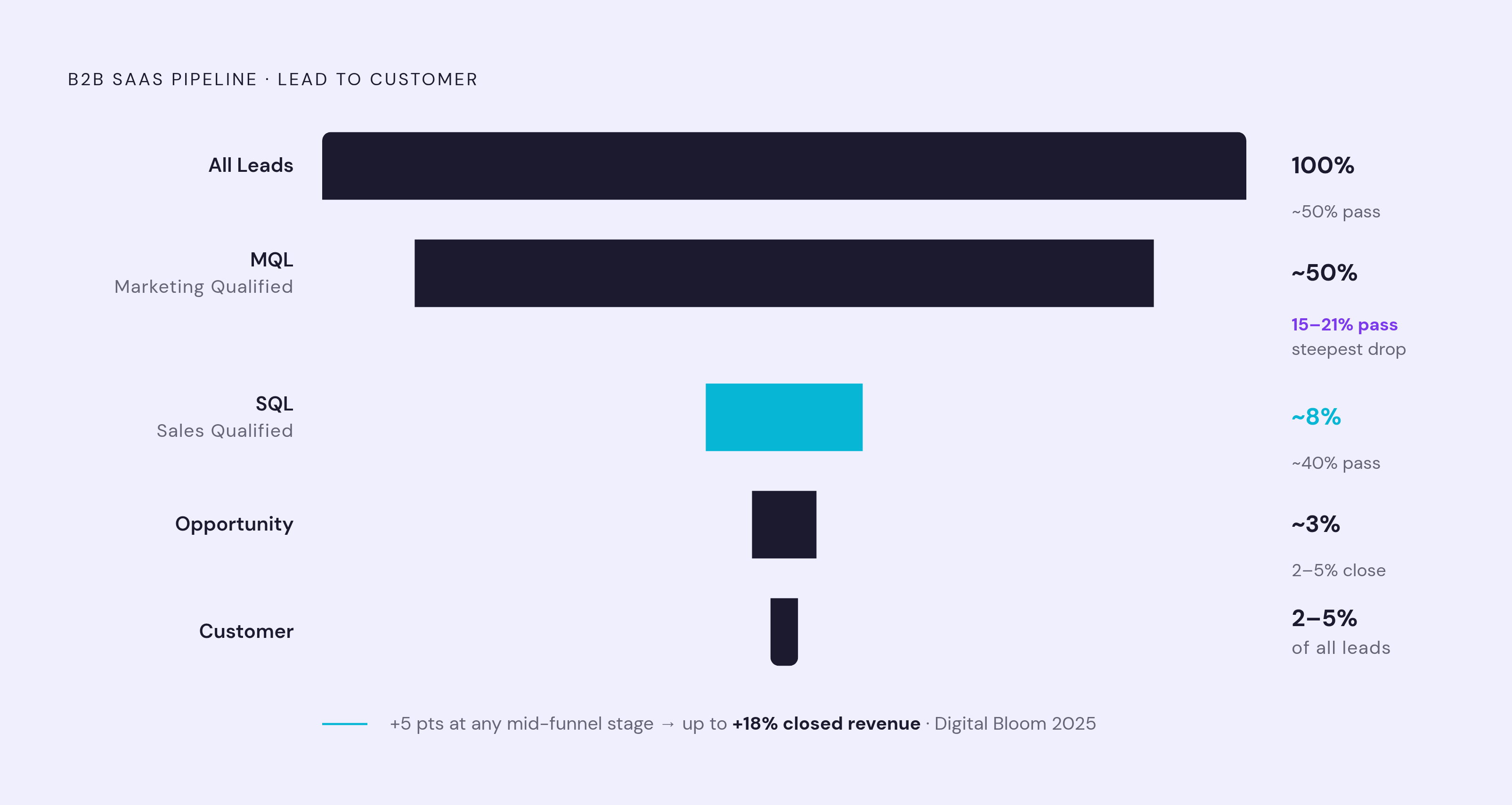
The numbers on the current funnel aren't flattering. Digital Bloom's 2025 B2B SaaS pipeline benchmark puts average lead-to-customer conversion at 2% to 5%, and the steepest drop happens at the MQL-to-SQL transition, where only 15% to 21% of leads make it through. That's the real bottleneck, and it happens well before anyone books a live demo. Fixing the live demo doesn't touch the biggest leak in the pipe, so teams that pour resources there first are bailing water from the wrong end of the boat.
Sales cycles run long enough that no single demo event can carry the whole relationship. Median cycle length sits around 84 days, and a lot happens in that window that has nothing to do with a rep's calendar.
Pipeline benchmark data shows a 5-point lift at any mid-funnel stage raising closed revenue by up to 18%. That's the kind of return that justifies real investment in content most teams currently treat as an afterthought, buried in a "resources" tab nobody clicks.
Format matters, and interactive beats static by a wide margin. Optifai's Sales Ops Benchmark, covering 939 companies, found interactive demos converting at 38% against a 25% average demo-to-close rate for B2B overall. Enterprise opportunity-to-close sits around 31%, versus 39% for SMBs. Closing that enterprise gap doesn't mean cramming more into one 90-minute call. It means more touchpoints spread across the longer cycle those deals already take.
Awareness stage: product teaser clips that earn attention before buyers are shopping
At the top of the funnel, buyers aren't evaluating vendors. They're still figuring out whether they even have a problem worth naming. Running a polished product walkthrough here is the single most common awareness-stage mistake: nobody scrolling LinkedIn on their lunch break wants a feature tour for a category they haven't decided they need yet.
The right format is short and outcome-first: a 15-to-45-second clip that shows the pain, then hints at the fix, dropped into an SEO blog post or a feed. Category-level landing pages benefit from the same logic, an explainer that dramatizes the problem rather than listing features. Homepage previews do quiet work too, giving a visitor enough of a credibility signal that they don't feel like they need to book a call just to understand what the company sells.
Webinars belong in this bucket, even though they don't look like a demo in the traditional sense. Research cited by martal.ca found webinars generating up to 73% higher-quality leads than other channels, while costing up to 90% less than an in-person event. Frame a webinar as education, and it still works as a live product demo, minus the pitch bolted on.
Production at this stage is a volume game. Teams need something like 20 to 50 short videos a month, not one glossy explainer produced once a year and left to gather dust. That kind of output only happens with AI-assisted production: scripted, voiced, captioned screen recordings that don't need a video editor's calendar to ship.
One rule holds regardless of format: top-of-funnel content should never pitch features, ask for a meeting, or assume the viewer already knows what category the product lives in. That's a mid-funnel job, and mixing the two up is how good top-of-funnel content quietly turns into a bounce.
Mid-funnel: guided product experiences that build the internal business case
By the middle of the funnel, buyers know they need a solution. Now they're building the internal case for buying this one, which means they need to watch the product work, not just read about it.
That 61% figure from Gartner matters most right here. Buyers who'd rather skip the sales rep entirely need something to poke at on their own terms: a guided product tour on a solution page, a use-case-specific walkthrough (how a customer support team actually uses the thing, not a tour of every button), or an ROI calculator paired with a short clip explaining what the inputs mean.
Walnut's 2026 B2B conversion data backs the shift. Interactive demos produced a 32% average increase in conversions when they replaced or supplemented static formats, and teams personalizing at least half of their demos saw conversion lifts above 40%. A generic product tour left unchanged for six months is quietly costing pipeline every day it sits there.
These assets don't stay in one department, either. Research found 78% of teams using interactive demos deploying them across at least two functions, so a mid-funnel demo built by marketing ends up in sales decks, customer success onboarding, and champion emails. Forrester puts the average B2B buying committee at 13 people across two or more departments, and nobody's flying a solutions engineer in to re-present the tour to the CFO. If the content can't survive being forwarded without a live human attached, it's built wrong.
A short, persona-specific video that a champion can forward internally beats a slide deck almost every time. It doesn't need a meeting scheduled around it, and it doesn't lose anything in translation the way a recap email always does.
The most common mid-funnel mistake is over-indexing on breadth. Buyers at this stage aren't asking "what does this software do?" They're asking whether it solves their specific problem, and demo content built around use-case depth beats a tour of every feature in the product, every time.
Bottom-funnel live demos: structure and format that close without over-engineering
The live demo is usually the last real gate before a prospect accepts or walks away from a proposal, per Walnut's SaaS funnel guide. The Optifai Sales Ops Benchmark puts the SaaS industry demo-to-close rate at around 30%. Enterprise averages a leaner 18%, but the top-performing teams push past 40%, according to Optifai's benchmark.
That gap between average and elite isn't a talent gap, and treating it as one is the wrong diagnosis. It's infrastructure. A standardized demo environment, good enough that a junior SE three months into the job runs a session roughly 80% as effective as a senior rep's (per Guideflow's sales enablement research), does more for close rates than hiring another star performer. Teams at the high end also qualify before the call, so the live demo hits known pain points instead of running a generic feature tour, and they build the demo around the room, because the economic buyer, the technical evaluator, and the end user each need a different thread pulled through the same session.
Organizations running a formal sales enablement strategy see higher win rates on forecasted deals. That's where the infrastructure investment shows up on the scoreboard, not in some soft "better rep morale" argument.
Industry research puts the stall rate for B2B purchases at a very high rate. A demo structured to surface objections live, in the room, instead of letting them fester afterward in an email thread, works as a stall-prevention mechanism as much as a sales tool.
The demo shouldn't end when the call ends, either. A recorded recap clip, an ROI summary, and security documentation the champion can forward without pulling the SE back in all extend the persuasion the live session started. That session needs to end with a concrete next step on the calendar, not a vague promise to follow up sometime next week.
Post-sale demos as expansion drivers: onboarding, training, and upsell walkthroughs
Closing the deal isn't the finish line, and treating it that way is how churn quietly builds for the next two quarters. Churn and expansion both trace back to how well a customer actually understands what they bought, and that's a demo problem just as much as an onboarding one.
Product-led growth logic applies well past the signature. Data cited by martal.ca found 91% of PLG-focused SaaS companies planning to double PLG investment, because self-serve experiences cut acquisition cost and drive expansion without adding sales headcount.
The formats that work post-sale look nothing like anything earlier in the funnel. Onboarding walkthroughs need to be role-specific: an admin setting up permissions needs a different clip than an end user logging in for the first time. Feature adoption videos tied to in-app triggers or CS check-ins catch users at the exact moment a feature becomes relevant. Upsell and cross-sell clips surface advanced functionality right when a customer's usage pattern suggests they're ready to grow into it.
Training content has the same volume problem marketing has upstream. L&D and CS teams need a library of short walkthroughs that get updated when the product changes, not a single recording from eighteen months ago showing a UI nobody's used since. Global accounts make the problem sharper: training material that only exists in English quietly turns non-English-speaking users into second-class customers. One-click localization into upwards of 100 languages is a reasonable bar to clear now, not a luxury add-on.
There's a hard economic case underneath all of this, too. B2B SaaS unit economics generally call for CAC payback under 90 days and an LTV-to-CAC ratio above 3-to-1. Expansion revenue from customers who actually understand the product is what makes the LTV side of that math work. CS teams that produce their own demo and training content, without waiting in line behind a video production team, close the time-to-value gap that causes a lot of early churn in the first place.
Producing demo content at funnel scale without a video production team
A full-funnel demo strategy means content at every stage, for multiple personas, across multiple use cases. That's realistically 20 to 50 videos a month, not one polished asset produced once a quarter and treated like a trophy.
Industry projections suggest that by 2026, the majority of marketing videos will be AI-generated or AI-assisted. That shift is what makes funnel-wide demo coverage realistic without a production department bolted onto every marketing team.
What AI-assisted production actually replaces is the tedious middle of the process: manual script cleanup, voiceover recording sessions, frame-by-frame editing for zoom and captions and transitions, and the separate documentation workflow that usually runs parallel to video instead of alongside it. What it doesn't replace are the human calls: who's the audience, what's the use case, what's the message. AI handles the grunt work so the team spends its attention on those decisions instead of scrubbing a timeline for the tenth time.
Picking the wrong tool for the job is an easy way to burn a quarter, so match the tool to the format instead of grabbing whatever's trending. HeyGen fits marketing-tilted avatar video, with a lower activation cost and a faster ramp for teams new to the format. Browser-based short-form video tools offer AI-powered captions and templates built for fast turnaround. Generative text-to-video tools suit campaign ideation and ad hooks better than structured product walkthroughs, as they aren't built for step-by-step demo accuracy. And a growing category of AI-powered screen recording platforms takes a raw capture and turns it into a polished video with a rewritten script, a natural-sounding voiceover, smart zoom, captions, and matching documentation, closing the gap between "recorded something" and "published" without anyone on the team needing to know video editing.
Pricing is a real point of friction. Seat-based pricing is a recurring structural mismatch across video production tools, mostly because seat fees don't map well to the bursty, project-based nature of demo production. Evaluate tools by cost per video at realistic monthly volume, not by the number sitting on the pricing page.
Brand consistency is the other quiet risk. Once CS, marketing, and L&D are each producing videos independently, a style guide sitting unread in a shared drive doesn't do much. Branded templates and built-in guardrails inside the production tool itself are what actually keep output coherent across teams.
Measuring whether the demo strategy is actually working across the funnel
A single conversion number can't tell this story, and teams that report on one blended demo metric are measuring the wrong thing. Each stage needs its own number, because a teaser clip and a live enterprise demo are trying to do completely different jobs.
At the top of the funnel, watch video view rate and watch-through percentage on teaser clips, along with the lift in organic traffic and time-on-page for pages running embedded product video against pages without it. For webinars, track registration-to-attendance rate and how many of those attendees turn into MQLs afterward.
In the middle of the funnel, interactive demo completion rate matters, along with exactly where prospects drop off inside the tour. MQL-to-SQL conversion before and after deploying guided tours in nurture sequences is the number to watch against that 15% to 21% baseline, since that's the bottleneck mid-funnel content is specifically built to loosen. Champion share rate, how often a leave-behind demo actually gets forwarded inside an account, is a strong proxy for whether the content does its job without a rep in the room.
At the bottom, demo-to-close conversion rate by segment is the anchor metric, benchmarked against the 30% SaaS average and the 18% enterprise average, with top-performing teams as the target rather than the baseline. Deal velocity after the demo, days to close, tells you whether format and timing are actually working together.
None of these numbers mean much sitting alone. What matters is the pattern across all four stages: a demo strategy works when the MQL-to-SQL bottleneck loosens, when champion share rates climb, and when close rates edge toward the top-performer range instead of drifting toward the enterprise floor.