Ungated Demo Pages and Their Effect on Pipeline Velocity
Ungated demos compress sales cycles by letting buyers self-qualify faster.
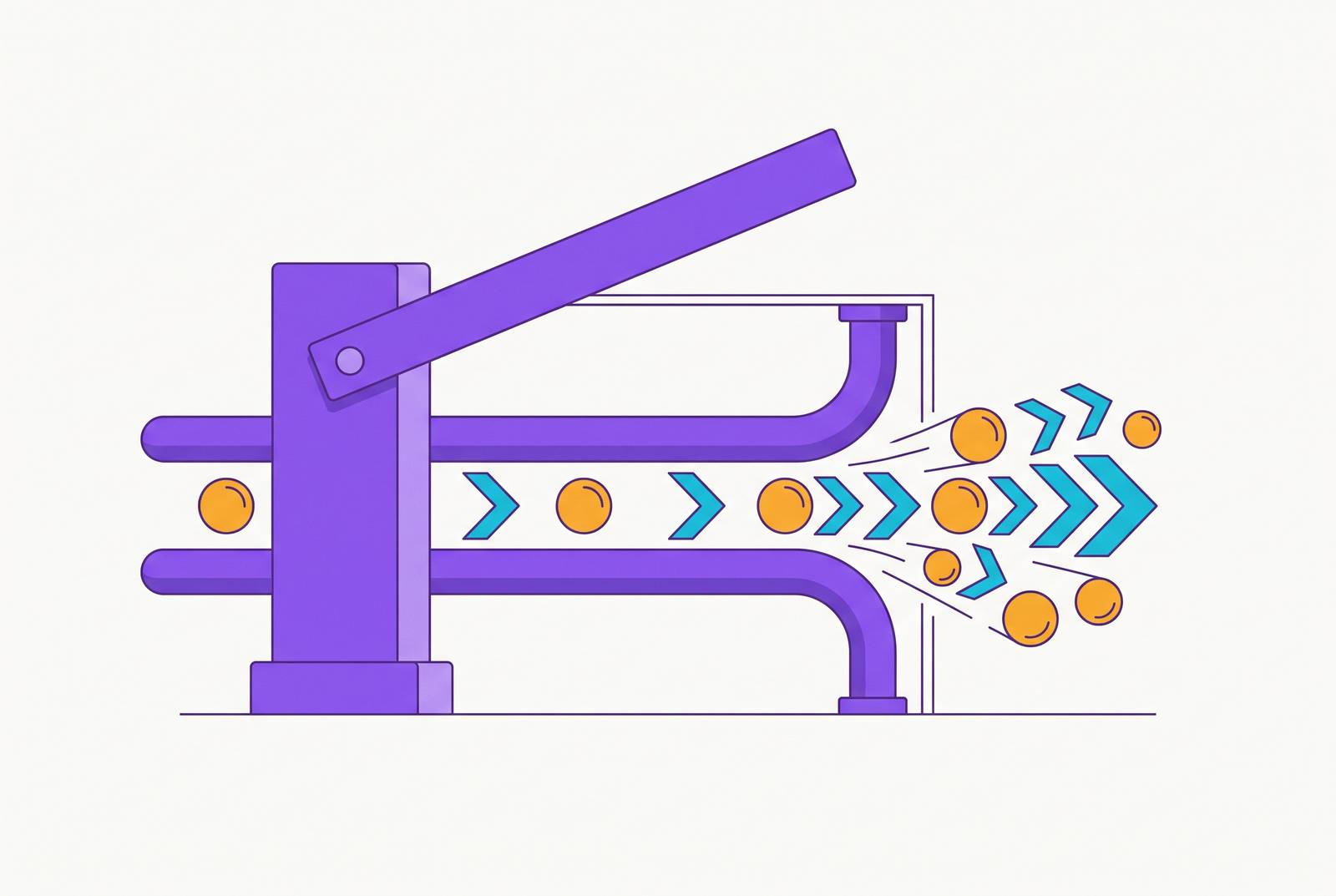
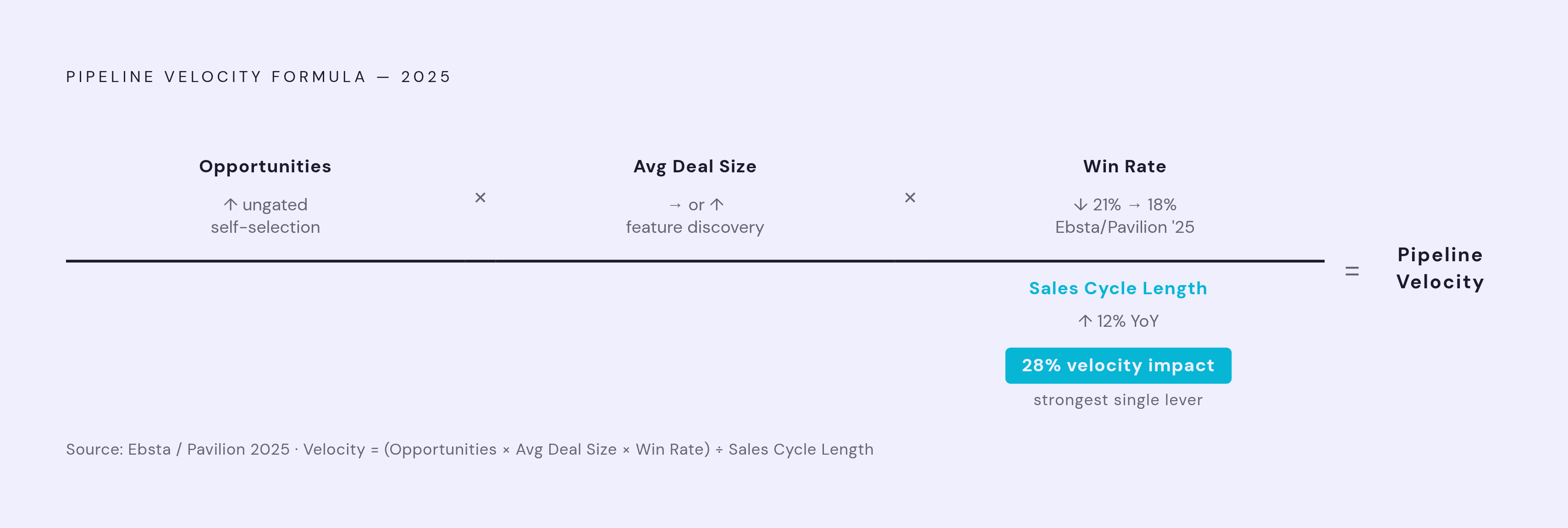
Pipeline velocity comes down to four numbers pushed against each other: opportunities, deal size, win rate, and cycle length. The formula is simple: (Number of Opportunities × Average Deal Size × Win Rate) ÷ Sales Cycle Length. Most B2B teams are watching two of those four numbers move the wrong way at once, and the fix isn't a new outbound motion or a bigger SDR team. It's ungating the demo.
Start with the bad news. The 2025 Ebsta/Pavilion B2B Sales Benchmark Report found average sales cycles got 12% longer year over year, while win rates fell from 21% to 18%. The numerator shrank while the denominator grew, in the same market, in the same year. Of the four levers, cycle length carries the most weight: that same benchmark data attributes a 28% impact to cycle length reduction alone, more than deal size or win rate improvements on their own. So cycle length deserves the closest look, and the answer, more often than sales teams want to admit, is the demo form standing between a buyer and the product they came to see.
How gated demo forms slow down buyers who are already ready to buy
Picture the sequence. A buyer lands on a product page, wants to see how it works, and hits a form instead: name, company, email, phone number, maybe a dropdown asking about company size. Submit. Wait. A rep reaches out, schedules a call, and only then, sometimes days later, does the buyer actually see the product they came to look at. Every step costs time, and time is the one thing a high-intent buyer won't spend.
That wait is corrosive. Buyer intent peaks the moment the form gets filled out and decays from there; every hour that passes before a rep responds is an hour closer to that prospect getting pulled into another priority, or picked off by a competitor who answered faster. Chili Piper's 2025 benchmark report found that letting buyers book a meeting immediately after filling out a form more than doubles inbound conversion, from 30% to 66.7%. Most B2B sites still don't run instant scheduling, so the buyer waits, and the waiting is the whole problem.
Lead quality stacks a second problem on top of the speed problem. Sales-accepted rates on inbound MQLs sit around 15% to 25%, meaning three-quarters or more of the people filling out that form aren't real buyers. They're researchers, students, competitors doing recon, someone's intern building a comparison spreadsheet. The form doesn't filter for intent; it filters for who's willing to type an email address. High lead volume with the wrong leads doesn't help velocity, because every hour a rep spends chasing a tire-kicker is an hour not spent on someone ready to sign.
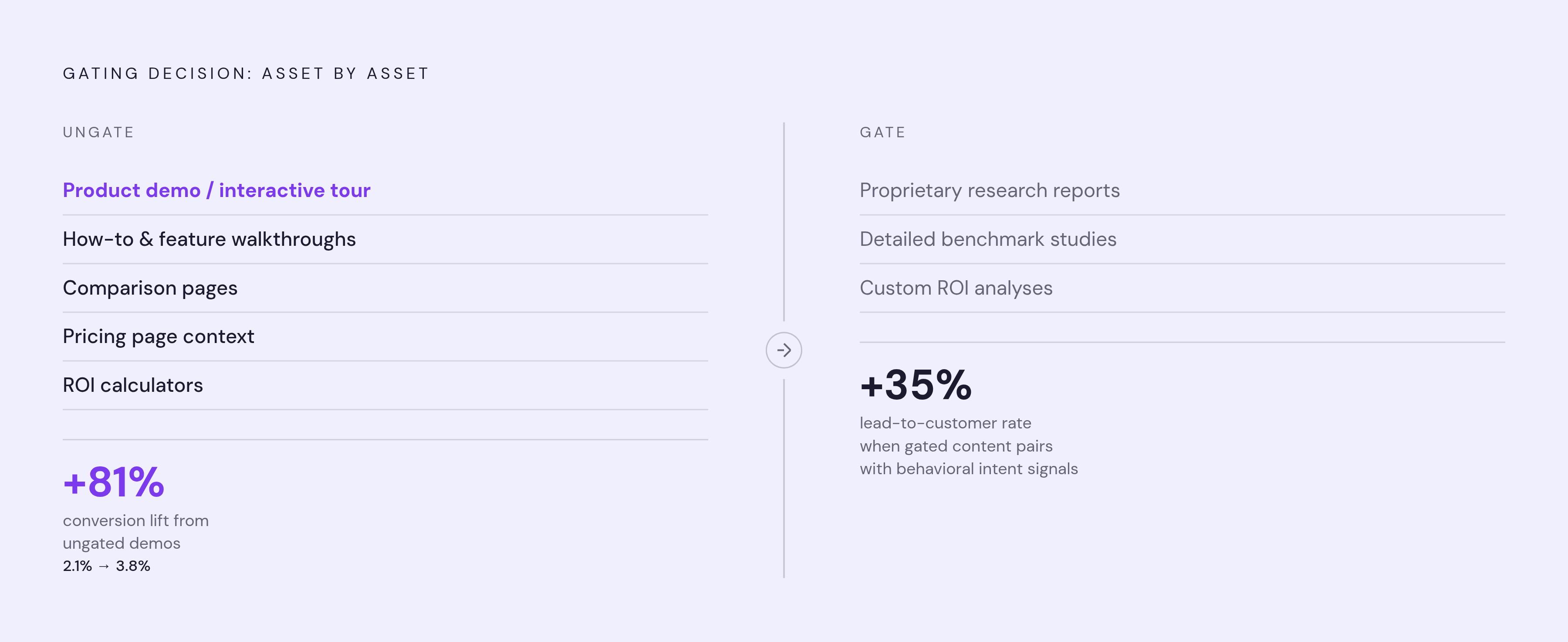
One counterpoint deserves a fair hearing. A Demand Gen Report study tracking 580 B2B pipeline sources found that gated content, paired with first-party behavioral intent signals, produced a 35% higher lead-to-customer rate than ungated sources. But putting a form in front of a detailed research report, where a buyer trades real information for something they clearly want, is a different move from putting a form in front of the demo, where the buyer just wants to see the product work. Gating the wrong asset, not gating in general, is the actual mistake.
How ungated demos increase the number of qualified opportunities entering the pipeline
Ungating the demo catches buyers who never would have filled out that form to begin with. These are people doing independent research, comparing three or four vendors across open tabs, who want to see the product before they'll talk to anyone. Give them access and they self-qualify, or self-disqualify, without a rep spending a minute on them.
Walnut Platform tracked a B2B SaaS HR technology company that swapped its gated demo request form for an ungated interactive product tour on its pricing page. Conversion went from 2.1% to 3.8%, an 81% jump. That's a company doubling the top of its funnel with the same traffic. Across the market, 73% of top-performing interactive demos now run ungated, and a meaningful share of interactive demo visitors convert into qualified opportunities. A volume-obsessed lead gen team will miss that signal every time, because it's too busy counting form fills to notice who actually finished the demo.
The mechanism holds up structurally, not as a one-off trick. Someone who finishes an ungated demo has already looked at the product and decided to keep going; they show up to the sales conversation pre-qualified. What they clicked into, how long they stayed, whether they came back a second time, tells a rep more than a name and an email address ever will. Ungating fixes the bottleneck at the source instead of patching it three steps downstream, which matters given that average B2B teams only convert 15% to 21% of MQLs into SQLs in the first place.
There's a search effect too, and it's getting harder to ignore. Ungated pages get crawled and cited by AI-powered search tools; gated content gets cited 94% less often by systems like Google's AI Overviews and Perplexity. A buyer typing a question into an AI search tool lands on the vendor with the open page, not the one hiding behind a form. Buyer behavior already shifted. The form wall just hasn't caught up.
How buyer self-education via ungated demos affects deal size
The worry here is obvious. If a buyer can explore the product without a rep in the room, won't they just pick the cheapest plan and check out? No rep means no one steering them toward the higher tier or the module they didn't know existed. It's a reasonable fear, and it's backwards.
Buyers exploring a demo on their own tend to spend more time in the advanced features, the ones a scripted, rep-led demo might never get around to showing. They stumble into capability they didn't know to ask about, and that changes what they think they're buying. Personalization sharpens this further: Walnut Platform data from 2025 found that teams personalizing 50% or more of their demos saw over 40% higher conversion than teams running generic, one-size-fits-all versions. The broader market data points the same direction: personalization consistently ranks among the highest-ROI growth levers available to B2B companies.
The buying committee matters here too. Industry research puts the average B2B purchase decision at 6 to 10 stakeholders. An ungated demo lets every one of those people explore on their own schedule, in parallel, instead of waiting on a rep to book six separate calls. By the time the sales conversation starts, the room is already aligned on what the product does, so the conversation skips the basics and goes straight to scope and fit. That produces bigger commitments, not smaller ones.
None of this happens automatically, though. The demo still has to earn the attention: it has to show depth and get built around the buyer's actual problem instead of running through a generic feature tour. Ungating opens the door. What the buyer finds on the other side decides whether they walk toward a bigger deal or a smaller one.
How removing the gate improves win rate by shifting what reps walk into
Win rates are already sliding, down to 18% from 21% per those same Ebsta/Pavilion numbers. Reps are working the same hours and closing less of it. Trace the reason back far enough and it lands on the first real call, and what the buyer knows walking into it.
In a traditional gated flow, the rep knows the product cold and the buyer knows almost nothing. The discovery call turns into an orientation session, burning time that should go toward qualifying fit and negotiating terms instead. A buyer walking in with zero self-education is still in evaluation mode, not decision mode, and evaluation-mode buyers are hard to close because they haven't built any conviction yet.
Ungated demos flip that order. By the time the rep gets involved, the buyer has already seen the product, already identified a use case for it, and already decided the conversation is worth their time. The rep isn't pitching from zero; the rep is confirming a decision that's mostly already made. That Walnut Platform HR tech example, the one that jumped from 2.1% to 3.8%, points to the same mechanism underneath: ungated exposure at the top, combined with a rep who follows up at the right moment, beats either piece running alone.
Teams that get their ungated demo programs right report win rate gains alongside 30% to 40% shorter cycles, and that's not a coincidence. Both numbers move together because both trace back to the same root cause: conviction the buyer built before the rep ever showed up.
How ungated demos compress sales cycle length — the variable with the highest velocity leverage
Cycle length carries that 28% impact on velocity, more than any other single lever, so it's worth being precise about how ungating shortens it, mechanically, step by step, instead of waving at the number.
The buyer figures out what the product does on their own time, before a rep gets involved, which cuts one or two early discovery calls out of the sequence entirely. Multiple stakeholders explore the product in parallel instead of waiting their turn for a rep-scheduled session; what used to take three or four sequential demo calls now happens simultaneously across the buying group. The rep's first real conversation lands much later in the buyer's decision process, so fewer total touches carry the deal from first contact to signature.
The intent decay problem applies here with more force than anywhere else in the formula. Every day a buyer sits waiting for a scheduled demo is a day a competitor slides in, or the internal champion loses steam, or the deal quietly stalls out. Removing the gate removes the entire waiting period rather than just shortening it. That 30% to 40% shorter cycle tied to well-run interactive demo programs comes directly from this: fewer early-stage calls, faster alignment across the buying group, and reps entering a process that's already moving instead of one that hasn't started.
Industry data puts average B2B buying cycles at 6 to 12 months across those 6 to 10 stakeholders. Even a 20% to 30% compression against that timeline recovers weeks, sometimes months, per deal. The SEO effect loops back in here too: a buyer who finds the product through ungated content during a research phase that can run 6 to 12 months on its own is already further along by the time sales gets contacted. The cycle the rep experiences shortens, even though the buyer's total research window never changed.
What the formula actually looks like when you run the numbers on all four levers together
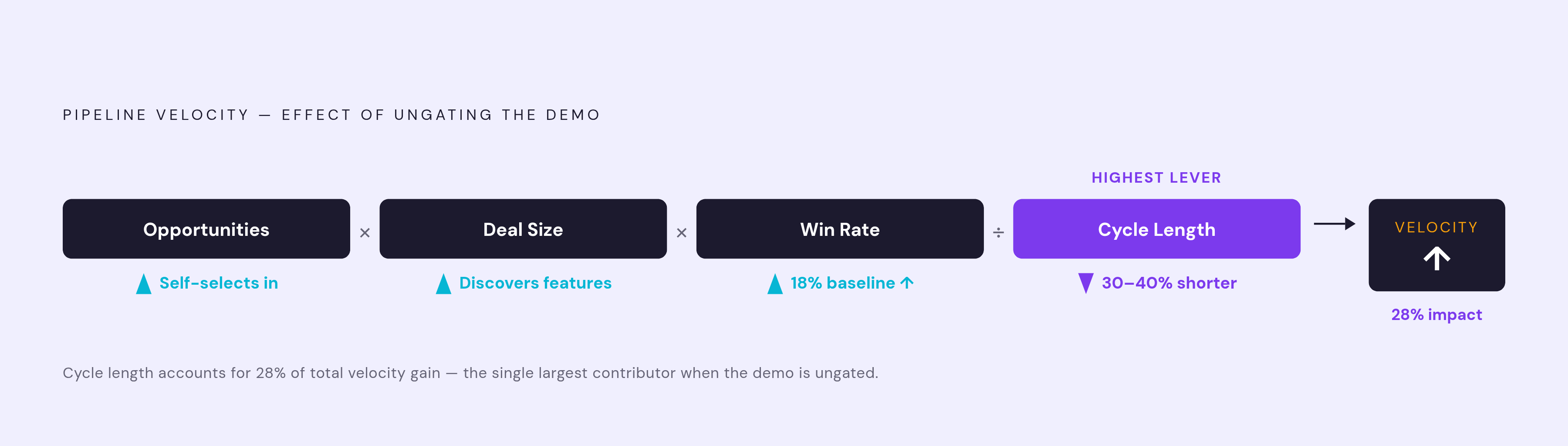
Velocity is a product, not a sum. That's the detail that makes ungating worth the tradeoff: small gains on each of the four variables don't add, they multiply.
Walk through the direction of each lever, without pretending these numbers form a precise forecast. Opportunity count rises because buyers self-select by finishing the demo before a rep ever gets involved. Deal size holds or grows because buyers who explored advanced features on their own arrive with a wider sense of what the product can do for them. Win rate improves because reps walk into conversations with buyers who've already built conviction instead of buyers who need convincing from scratch. Cycle length compresses because early-stage calls disappear, stakeholders align in parallel, and there's no waiting period for intent to decay during. Run those four changes through the formula from the opening, and the result compounds instead of stacking.
There's a data advantage buried in here too, one that compounds on its own. Ungated demos throw off behavioral signals that gated forms rarely produce: which features someone explored, how long they stayed, whether they came back a second or third time. That data feeds directly into how reps prioritize outreach, which makes qualification faster on the next deal, and the one after that.
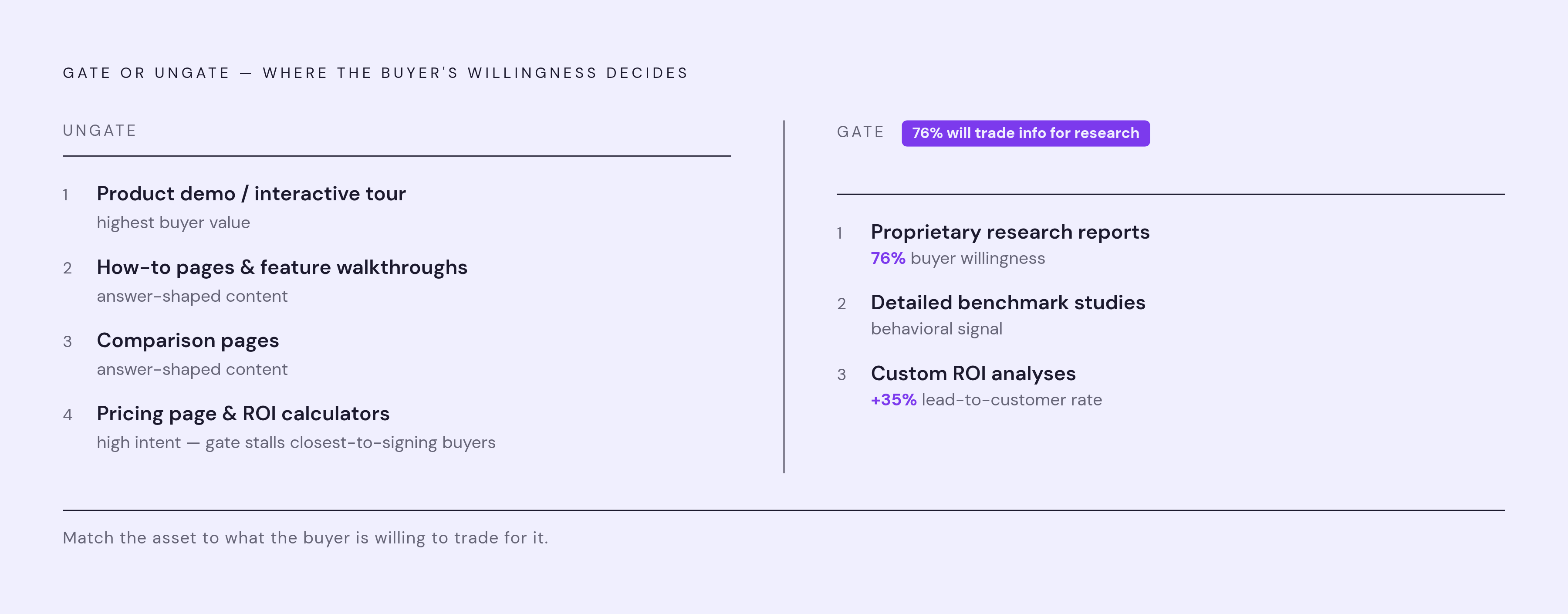
Gating everything carries its own cost, and gating nothing carries a different one. The right model is hybrid, and most teams get the split backwards: they gate the demo, the exact asset that should be wide open, and leave the real research assets to compete on SEO alongside everything else. Gate the highest-value proprietary work instead: the detailed research reports, the custom ROI analyses, the stuff where that 35% lead-to-customer advantage for gated-plus-behavioral-signal content actually applies. Ungate the demo and the answer-shaped content buyers need to build their own conviction. Buyer behavior consistently shows that buyers are more willing to share information to access substantive research reports than they are for standard content. That gap tells a team exactly what belongs behind a form, and exactly what doesn't.
How revenue teams evaluate the tradeoff and decide what to ungate
Here's the honest version of the tradeoff: ungating means giving up some direct lead capture in exchange for better lead quality, faster velocity, and more organic discovery through search. The mistake almost every team makes is gating the demo anyway, out of habit, without ever checking whether the demo is actually the bottleneck.
A quick diagnostic settles most of the argument. If MQL-to-SQL conversion sits below that 15% to 21% benchmark range, the pipeline is clogged with low-quality leads, and ungating the demo raises the bar on what gets in rather than lowering it. If cycle length is the bottleneck, running longer than the segment median, ungating addresses the biggest lever directly, since that 28% velocity impact from cycle compression comes almost entirely from removing friction, and friction is exactly what a gate creates.
What comes off the gate first: the product demo or interactive tour itself, since it's the highest-value asset to the buyer and the highest-friction one to gate. Answer-shaped content comes next: how-to pages, feature walkthroughs, comparison pages. Buyers hit these mid-research, and a form in front of them doesn't produce a qualified lead, just a bounce. Pricing page context and ROI calculators belong in this group too; anyone who's made it that far already has high intent, and gating stalls out the exact people closest to signing.
What stays behind the gate: proprietary research reports, detailed benchmark studies, custom ROI analyses built for a specific account. These are the assets where that 35% lead-to-customer lift for gated-plus-behavioral-signal content actually holds up, along with anything at the high end of that willingness-to-share gradient, where 76% of buyers will trade information for a research report but won't do the same for a routine blog post or checklist.
The real work isn't picking a side in the gating debate. It's matching the asset to what the buyer is actually willing to trade for it, and being honest about which of the four variables is holding the pipeline back right now.