Ownership Models for Demo Content in B2B SaaS Organizations
Assigning demo content ownership prevents inconsistency across teams.
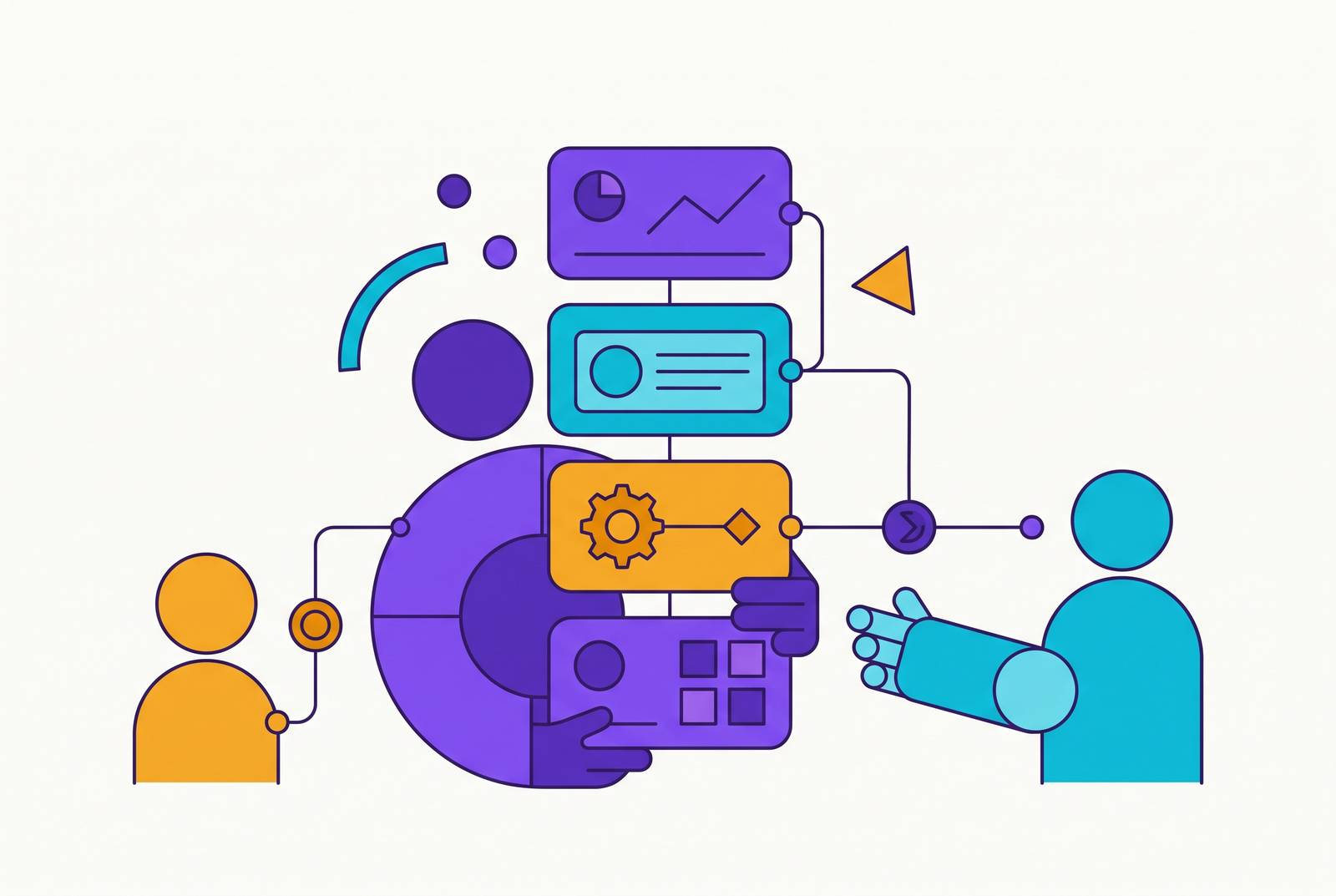
Demo content in most B2B SaaS companies has no single owner. Product Marketing, Sales, Customer Success, and L&D each hold a piece of it, and none holds all of it, so quality, consistency, and accuracy fall through the gaps between teams. A rep runs a live demo that contradicts the interactive product tour on the website. A new customer gets an onboarding walkthrough built around a feature that was renamed two releases ago. Both are symptoms of the same structural gap: nobody was ever assigned to own demo content end to end.
Why demo content has no clear owner
Every function touching the buyer journey has a real claim on demo content, and that's the root of the problem. Product Marketing owns messaging and positioning. Sales owns the live conversation. Customer Success owns what happens after the deal closes. L&D owns training and certification. Each of these mandates is legitimate on its own terms, but none of them covers the full lifecycle of a demo asset, from the day it's built to the day it gets retired.
What results is a set of disconnected pieces, each built by a different team, each reflecting a different moment in the product's history. PMM builds a product tour. Sales maintains its own live demo deck. CS creates onboarding walkthroughs. L&D assembles training modules. These four things often disagree with each other on feature names, on pricing, on what the product actually does, because the four teams that built them were never working from the same source or reporting to the same owner.
The gap between these experiences is most visible at the handoffs. If those three experiences describe three slightly different products, the buyer notices, and they notice at the exact moment their scrutiny is highest: when they're deciding whether to trust the company with their budget and their workflow.
This problem is getting more expensive to ignore. B2B buyers now complete roughly 70% of their research before they ever talk to a sales rep. The vacuum is the predictable outcome of demo content sitting at the intersection of four functions, with no one ever deciding, deliberately, who's in charge.
What "owning" demo content means across the funnel
Before comparing ownership models, it helps to separate what "ownership" actually requires at each stage of the funnel, because the word means something different depending on where the buyer is standing. Treating it as one job, assigned to one team, is part of how companies end up with no real owner.
At the top of the funnel, where the demo is sparking interest and qualifying leads, the content functions as a marketing asset. Its job is to show what the product does and let the buyer judge, unassisted, whether it solves their problem. Owning this stage requires authority over messaging and control over where the content gets distributed.
By mid-funnel, during active evaluation with multiple stakeholders weighing in, the same content turns into a sales asset. Owning this stage takes deep product knowledge and the ability to shape the story around one specific account's use case, something a static marketing asset can't do on its own.
Further down, during technical validation, security review, and procurement, the demo often becomes a sandbox or proof-of-concept environment. Ownership here sits with solutions engineering or solutions consulting, and the bar for accuracy is strict: the content has to match the current product state down to the API level, because technical buyers will test it against reality.
After the deal closes, during onboarding, adoption, and expansion, the demo becomes training and enablement content. Ownership shifts to CS and L&D, and the material needs to be organized by role and use case rather than by buyer persona, since the audience has changed from "someone deciding whether to buy" to "someone trying to get work done," which is why tools that tie video and documentation to a single source recording matter most, sparing a resource-constrained CS or L&D team from rebuilding two separate assets every time the product ships.
Because a typical B2B SaaS deal touches many marketing and product interactions before it closes, one piece of demo content almost never does a single job at a single stage. It gets reused and repurposed across stages. Someone has to be assigned ownership at each of those four separate stages, not once. Demo content tied to a live product has to change every time the product changes, and without someone assigned to make that update, it just doesn't happen. This is especially true for screen-recording-based content, product tours, annotated screenshots, walkthrough videos, where a single UI change can make an entire library wrong overnight. Platforms like Clueso, which generate step-by-step documentation alongside video from one source recording, can cut down on that kind of drift by keeping the video and its written counterpart in sync. That only works, though, if someone has the authority to update the source and push the change out everywhere it needs to go.
The four ownership models most B2B SaaS organizations use
Most B2B SaaS organizations land on one of four ownership structures, usually without much deliberate thought. Each one has an internal logic, and each one breaks in a specific, predictable way.
The first model puts Product Marketing in charge as the single owner. PMM holds the source of truth for messaging, for the demo narrative, and for content standards; Sales and CS can use what PMM produces but can't change it without going back through PMM. This centralizes quality control and keeps messaging consistent across every version of the demo. It breaks when PMM can't keep up with demand: Sales starts adapting content without approval because the official version doesn't fit a specific account, and CS builds its own shadow library because PMM's material never covers post-sale depth. This model works best at early-stage companies with a small sales team and a PMM who has the capacity to actually produce content, not just set strategy.
The second model routes everything through a dedicated Sales Enablement function. It breaks when enablement turns into a pass-through layer instead of a real quality gate: if the function doesn't have the authority to reject or retire outdated material, the library goes stale anyway. This model fits mid-market companies with real enablement headcount and a sales motion where AEs and SEs are running different kinds of demos for different audiences.
The third model distributes ownership by funnel stage and holds it together with federated governance. PMM owns top-of-funnel demos, Sales owns mid-funnel live decks, SE owns bottom-of-funnel sandboxes, CS owns post-sale walkthroughs, and a cross-functional committee sets shared standards for naming, versioning, and retirement. A reorg can dissolve the whole structure overnight. This model suits larger organizations with clearly defined stage boundaries in their sales process and a RevOps or operations function able to keep the governance infrastructure running.
The fourth model hands the whole demo-to-onboarding lifecycle to Customer Education or L&D, treating demo content as the first module of an ongoing education program. It breaks because L&D-built content tends to prioritize completeness over persuasion: it explains everything and converts almost nobody, which makes it a poor fit for top-of-funnel, where precise messaging drives conversions more effectively than instructional depth. This model works best at PLG companies, where the product trial essentially is the demo and the line between pre-sale and onboarding content is deliberately thin.
Matching ownership model to go-to-market motion and company stage
No single model is right for every company. The right fit depends on the intersection of go-to-market motion (PLG, sales-led, or hybrid), company stage, and how complex the sales process is. Picking the wrong model for the context compounds the mismatch into governance debt that gets harder to unwind the longer it sits.
PLG companies, where the product itself is the demo and self-serve onboarding drives most acquisition, should lean toward L&D-led ownership or a hybrid where Growth owns top-of-funnel interactive content and CS owns the onboarding library. The risk for PLG companies is treating demo content like a marketing asset instead of a product experience, which opens a gap between what the interactive tour promises and what the product actually delivers the first time someone logs in.
Early-stage companies, pre-product-market fit, with a small go-to-market team, should default to PMM ownership. It's the easiest to maintain with limited headcount. One person controlling the demo narrative can course-correct faster than any committee can convene.
Hybrid companies, running PLG acquisition alongside sales-led expansion, face the hardest version of this problem, because they need several models running at once: self-serve top-of-funnel content owned by Growth, enterprise demo content owned by Enablement, post-sale content owned by CS, with no single team holding authority across all three. The practical fix for hybrid companies is federated governance, built around an explicit charter that spells out which team owns which stage, who breaks ties when there's disagreement, and how often the library gets audited for accuracy.
How high-performing teams catch ownership failures early
Unclear ownership produces three failure patterns, and all three are predictable, recognizable once you know what to look for, and costly. Teams with real ownership catch each one early, before it turns into a lost deal or a support fire.
The first is messaging drift. Different versions of the demo end up telling different stories: one leans on integration depth, another leads with ease of use, a third quotes pricing that's since changed. The early warning sign is a rep or CS manager reporting that a prospect flagged a mismatch between the website demo and the live one. That's a governance failure, not a communication slip.
The second is stale content still in circulation. Support tickets or CS escalations referencing a feature or workflow the demo showed, but the product no longer matches, are the warning sign, because the customer expected what they'd seen.
The third is shadow libraries. An audit reveals the warning sign, when it turns out most reps are working from a deck or walkthrough that was never officially published, built by one rep, shared over Slack, and now standard across the whole team.
High-performing teams don't solve these patterns with more collaboration, more Slack channels, more review meetings. They solve them by naming one role with both the authority and the obligation to audit, update, and retire content on a set schedule.
How production tooling and AI workflows change governance
AI production tools have changed the math here by making demo content radically cheaper to produce. That's good news for output and bad news for governance, because lower production cost without stronger ownership means volume outruns quality faster than before.
When producing a software walkthrough video meant booking a video producer, running a recording session, and spending hours in an editing timeline, that cost acted as an informal filter: only content worth the effort got made. Without a clear owner, every team will produce its own version, and the shadow libraries and messaging drift described above increase in volume and accelerate. Teams adopting these tools need to tighten ownership at the same time they speed up production, not assume faster output makes someone accountable on its own.
There's a real upside for governance buried in this shift, though. When demo content gets generated from one shared source, a script, a recorded workflow, a documentation template, updating that source can push the change across the whole library, instead of requiring every asset to get manually reedited one at a time. A team that controls both the source of truth and the production workflow can keep content accurate at scale in a way a team stitching together bespoke, manually edited assets never can.
Platforms like Clueso are built around that workflow. A screen recording becomes the source; AI rewrites the script, adds voiceover, applies smart auto-zoom and captions, and generates step-by-step documentation to go with it. The platform's support for 40-plus languages through one-click translation addresses a related fragmentation point too: localized demo content often ends up owned by regional teams simply because translating and updating it centrally was too slow and too expensive, and those regional libraries tend to drift from the core message over time.
Assigning the ownership model: the decision criteria high-performing teams use
What separates teams with a working ownership model from teams without one is whether the ownership decision got made on purpose, against clear criteria, rather than inherited by default from whoever happened to build the first demo.
Start with who has the authority to retire content.
Next, who resolves messaging conflicts. When two versions of the demo tell different stories, one named role, not a committee, not a Slack thread, needs the authority to call one version correct and remove the other. Without that role, the conflict gets settled by whoever has the most political weight in the building, which isn't governance, it's just politics.
Check whether the ownership model matches how fast the product ships. The model's pace has to match the product's pace, not the org chart's preference.
Look for a clear handoff protocol between funnel stages. Without that, the handoff turns into an informal copy-paste job, and that's where the governance chain quietly breaks.
Last, check whether every team can produce content to standard without waiting on another team's bandwidth. If PMM becomes the bottleneck, shadow libraries will form no matter how well the model looks on paper. This is where production tooling earns its keep: when CS or Sales can produce a walkthrough video and its matching documentation to brand and messaging standards without waiting on PMM or a dedicated video producer, the ownership model holds together on its own.
Bring these five questions into the next team meeting about demo content. The answers will show whether the current setup was built on purpose or just happened by default, and that's the starting point for fixing it.