Buyer Self-Education Trends Reshaping B2B SaaS Demo Requests
Self-educated buyers are already picking winners before they ever ask for a demo.
Buyers finish roughly 70% of their purchasing journey before they ever contact a vendor. That number alone rewrites what a demo request means. A demo used to mark the start of a sales process. Now it marks somewhere near the end, a formality that happens after the real decision got made.
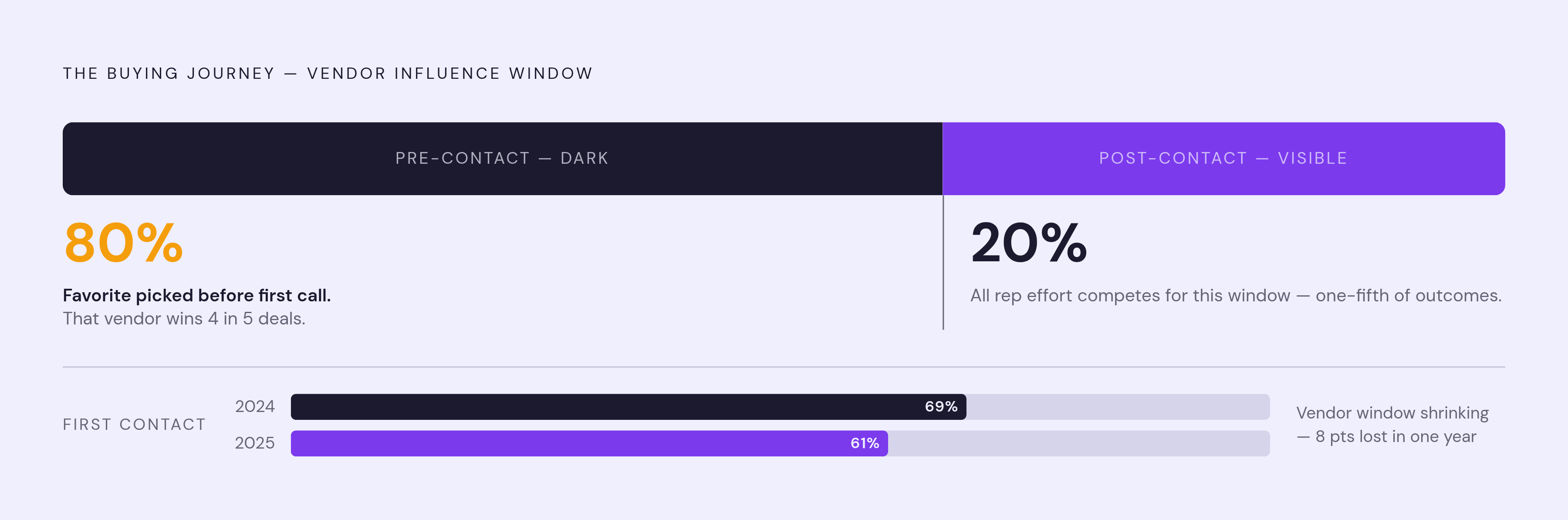
Most vendors still treat the demo as the moment evaluation begins. It isn't, because most vendors still treat the demo as the moment evaluation begins, yet research spanning thousands of B2B buyers found they settle on a favorite vendor before ever speaking to a salesperson, and that pre-contact favorite wins the deal roughly 80% of the time. Research spanning thousands of B2B buyers found they settle on a favorite vendor before ever speaking to a salesperson, and that pre-contact favorite wins the deal roughly 80% of the time. The shortlist forms in the buyer's head, built on research nobody at the vendor got to watch, shape, or push back on.
This is where the math turns unforgiving for sales teams. If the favorite is already picked 80% of the time before contact, then everything a rep does on a call is fighting for one-fifth of the outcome. Teams that pour their energy into polishing the demo call itself, better slides, sharper talk tracks, are optimizing the smallest lever available to them.
The timeline confirms how fast that window is closing. Average buying cycles dropped from 11.3 months in 2024 to 10.1 months in 2025, and first contact with a vendor moved from 69% of the journey to 61%. That's six or seven fewer weeks of buyer openness to seller influence, gone in a single year. Every cycle, vendors get less say inside a smaller window.
What AI tools changed about buyer knowledge before contact
Buyers used to start with Google. Now 51% of B2B software buyers start their research with an AI chatbot more often than a search engine, up from 29% a year earlier. That's a near-doubling in twelve months, and it relocates where a vendor's influence actually has to live: not on the website, but inside whatever answer a chatbot gives before the website ever loads.
AI isn't a side channel here. Across the full buying process, 71% of buyers rely on a chatbot at some point, and 69% say a chatbot steered them toward a different vendor than the one they started with. One in three ended up buying from a vendor they'd never heard of before that conversation. Overall, 94% of buyers use large language models somewhere along the way, making AI a near-universal part of the research process rather than a niche channel.
So the real question for a vendor waiting on a form fill is this: what happens when a buyer builds an entire opinion of a category, ranks the players, and picks a favorite, all without loading the vendor's website even once? The case studies, the comparison pages, the landing pages built to persuade, none of it is in the room when the shortlist actually forms. Vendors are optimizing pages that buyers increasingly skip.
What the demo request signals in 2026
Buyers expect proof before they'll agree to a call. 88% of software buyers say they won't book a demo until they've already seen the product in action somewhere else. The demo request has stopped being a first look. It's a confirmation step, something a buyer does after forming an impression elsewhere, not before.
The supply side hasn't caught up, and this is the actual failure most vendors won't name. Research from HowdyGo found that 30% of SaaS companies show no part of their product without requiring a sales call first. Only 30% offer a demo video with real product UI in it. Only 4% offer anything interactive. Buyers want proof before committing to a meeting, and most vendors still demand the meeting before offering any proof. That mismatch kills pipeline before a rep ever picks up the phone, and it's a problem vendors created for themselves.
Once a demo happens, conversion depends heavily on who's in the room. A benchmark study covering 939 companies put the B2B average demo-to-close rate at 25%. By company size: SMB converts at 32%, mid-market at 25%, enterprise at 18%. By deal size: under $10K converts at 35%, $10K to $50K at 28%, and $100K-plus deals convert at just 15%. Bigger checks mean longer, more skeptical evaluations, which tracks. But a vendor running one identical demo process across every deal size is leaving a 20-point conversion swing on the table.
The conversion gap between demo formats
Not every demo is the same product in a different outfit. The format a buyer gets shown, a gated call, a self-guided tour, an async video, changes who shows up and who actually converts.
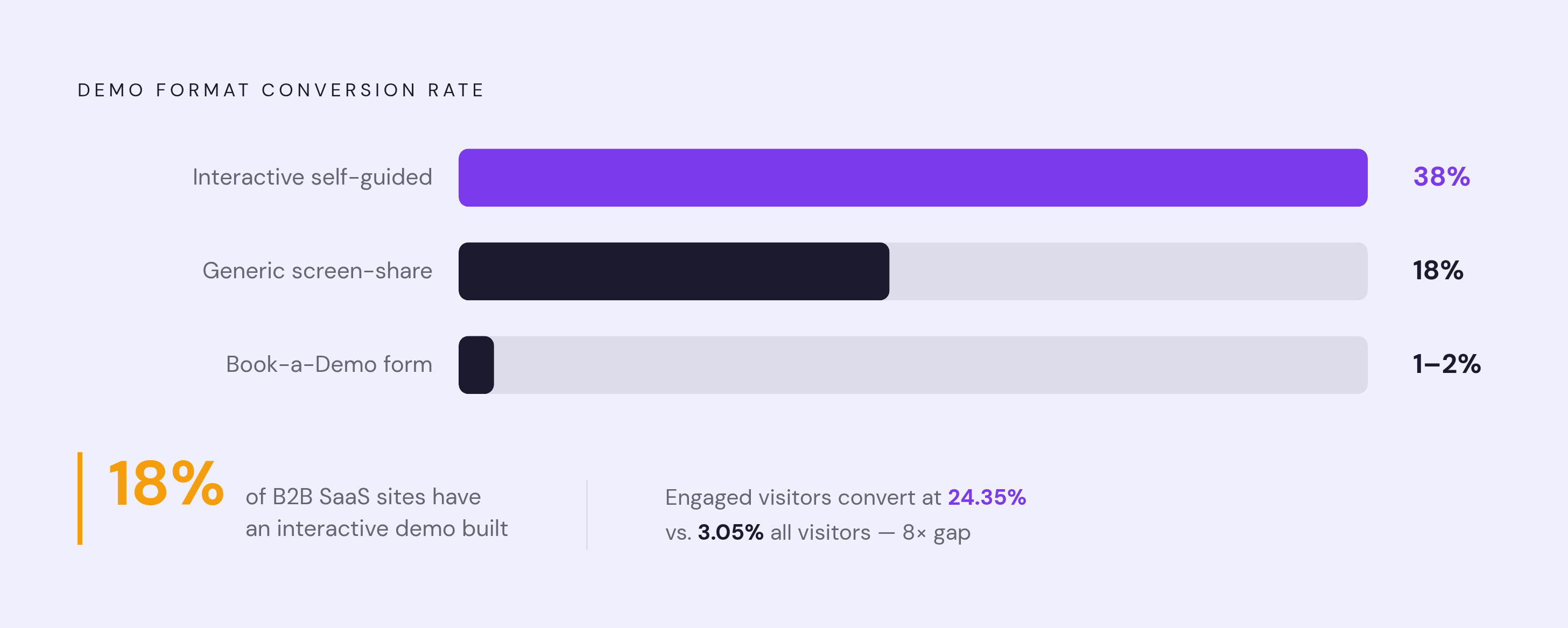
The old standby, a "book a demo" form on a landing page, converts somewhere around 1 to 2% of visitors, a persistently low floor. Scheduling drop-off and no-shows push the share of visitors who actually experience the product to under 1%. Out of a hundred people who land on that page, fewer than one ever sees the thing they came to evaluate.
Interactive demos, where the prospect drives instead of watching a rep click through slides, convert at 38% versus 18% for a generic screen share. More than double. Visitors who engage with an interactive demo convert at 24.35% overall, versus 3.05% for everyone else on the site, roughly an 8x gap. Only 18% of B2B SaaS websites actually have one built.
That gap is the real story here. The format that performs best is the format almost nobody bothers to build. Vendors chasing conversion should stop tuning the call script and start here instead, because this is the fastest fix on the table and the one most consistently ignored.
Pre-demo content strategy as the primary lever for demo quality
Picture two prospects on the same rep's calendar, same 30-minute slot. One has already poked around the product, has a specific question about a single workflow, and knows what needs confirming. The other skimmed one feature page and still needs basic orientation on what the product even does. Same 30 minutes. Only one of those calls is going anywhere.
Self-guided pre-demo experiences close that gap, but the instinct to cram an entire sales demo into a landing page is the wrong one. The goal is narrower: let a buyer confirm that one specific workflow solves their specific problem before committing to a meeting. A tight experience answering one relevant question beats a sprawling tour built to prove feature depth nobody asked about.
Engagement data does a second job here, working as pre-call intelligence no form field could ever supply. A prospect who spends five minutes poking at an integration workflow is telling a rep something completely different than one who keeps circling back to reporting dashboards. What someone clicks on and lingers over says more than any lead-gen question ever will.
That changes what the sales call has to become. By the time someone books a demo, the meeting exists to check an already-formed decision against reality, a conversation built around validation and relevance to that specific buyer's situation. Reps who open with the standard deck are throwing away the exact advantage this pre-demo data hands them. Start by confirming what the buyer already knows. Don't start over at slide one.
AI-assisted video production at scale for pre-demo content
None of this works without volume, and volume is where most teams stall. Real pre-demo education programs aren't built on one polished hero video. They run on a library: persona-specific tracks, workflow walkthroughs, feature-update clips, localized versions for different markets. Building that library used to be the blocker. It no longer is.
AI has changed the production math enough to make that library realistic for teams without a dedicated video department. A 5-minute training video that used to take 5 to 6 hours to script, record, edit, subtitle, and revise now takes roughly 45 to 60 minutes with AI-assisted pipelines. That's an order-of-magnitude drop, and it's the actual reason volume is on the table now in a way it wasn't three years ago.
Video is already table stakes across B2B and SaaS, widely treated as core strategy rather than a differentiator. The baseline expectation is set industry-wide, so the differentiator is how fast and how consistently a vendor keeps making video. It's how fast and how consistently they keep making it.
Length still matters as much as volume. Quick tips and feature highlights work best at 30 to 90 seconds. Tutorial walkthroughs run 2 to 5 minutes. Comprehensive onboarding modules can stretch to 5 to 10 minutes, but completion rates drop sharply past the six-minute mark. Longer material needs to break into 2-to-3-minute segments instead of asking for one long sit-through.
What vendors should change about their pre-demo content program
Everything above points to one shift: the demo is a validation checkpoint now. It's a validation checkpoint, a moment where a buyer who has already completed most of their evaluation checks assumptions against reality one last time. Vendors slow to accept that will keep losing deals they never knew were in play, because the deal was already decided somewhere they weren't watching.
Every piece of pre-demo content built, an interactive tour, a short workflow video, an engagement-tracked walkthrough, exists to make that checkpoint sharper. None of it replaces the human conversation. It changes what that conversation is for.
The rep's job shifts from introducing the product to confirming fit and clearing the last objection. That's a far better use of thirty minutes on a calendar, for buyer and vendor alike, and it's the only version of the demo that still matches how buyers actually behave in 2026.