Building a Scalable Product Demo Library for B2B SaaS Sales Teams
Organize demos by buyer stage and role, not product features.
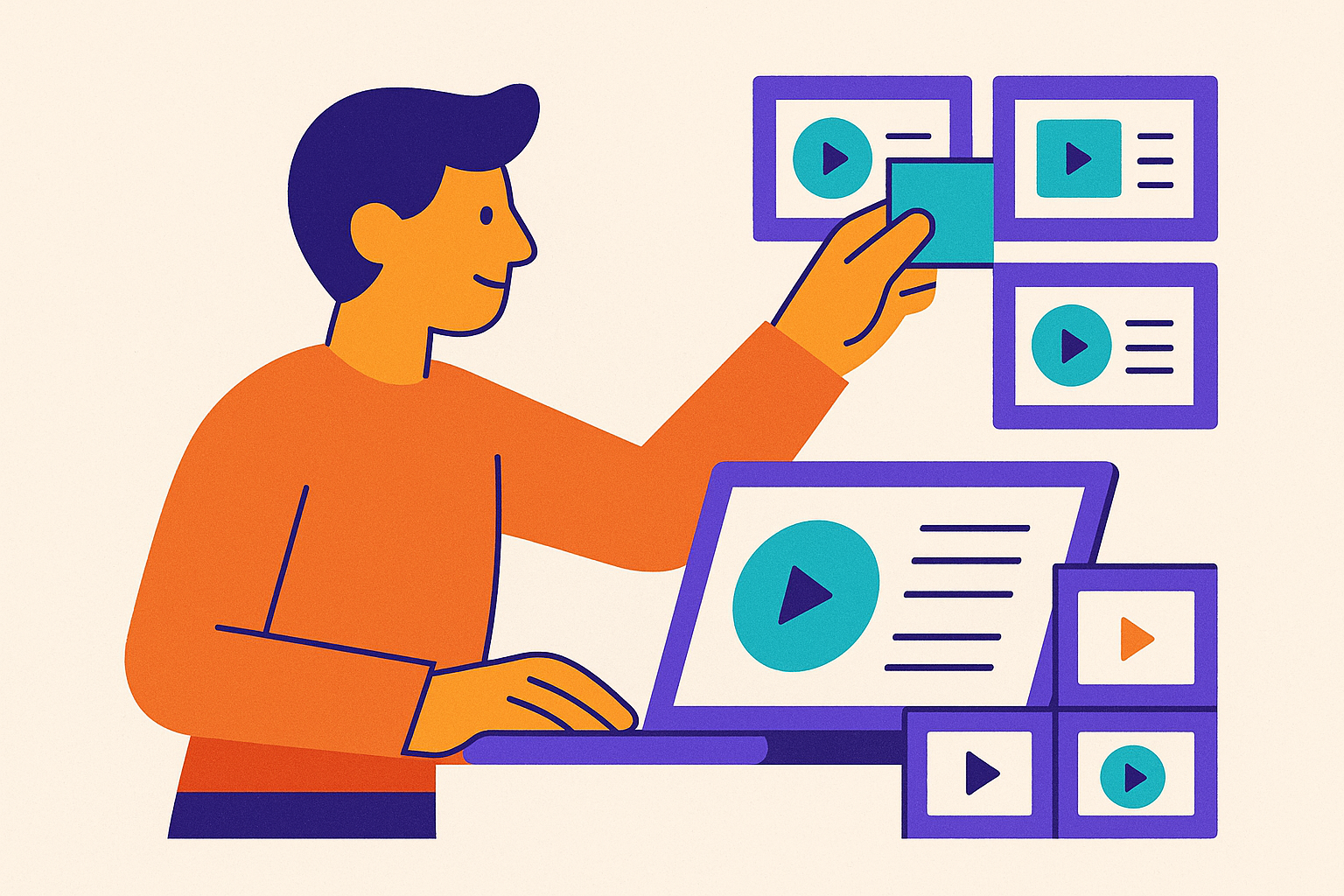
A HowdyGo report cited by ContentBeta found that 88% of buyers want to see the product before booking a call, which makes the demo the first real look most buyers get at how a piece of software actually works. Most demo libraries fail to meet that expectation. A shared drive stuffed with old recordings isn't a system a seller can trust under time pressure. Revenue teams lose the equivalent of 11 full work weeks a year, because they hunt for content that should already exist, or they rebuild something that already exists somewhere. That waste appears in three recognizable symptoms. Sales teams find out about a product launch at the same moment customers do, a coordination breakdown so common that K3C's 2026 launch framework treats it as the clearest signal something upstream has failed. Demos go stale the instant the product's interface changes, and because the video was built with heavy external editing, updating it means starting over, a pattern Leadde's 2026 workflow analysis calls the "Polishing Trap". Each of these symptoms points to the same root cause: nobody designed the library as a system before people started filling it with content.
How demo format maps to buyer stage
A pile of videos isn't a library until it has a shared vocabulary, a way of sorting assets so the right buyer finds the right one at the right point in their decision. That sorting starts with matching demo format to where the buyer actually stands. An early-stage, awareness-level buyer needs something that holds attention for a matter of seconds, a quick visual hook rather than a full walkthrough. Buyers actively evaluating the product need roughly a minute to a minute and a half, long enough to see the thing work without demanding the kind of time commitment only a serious prospect will give. Technical buyers and late-stage deals call for real depth, something in the 3 to 10 minute range where integration details, security questions, and edge cases get real answers. Onboarding content sits in its own category entirely, because it's built around step-by-step guidance that runs a few minutes and assumes the viewer already bought.
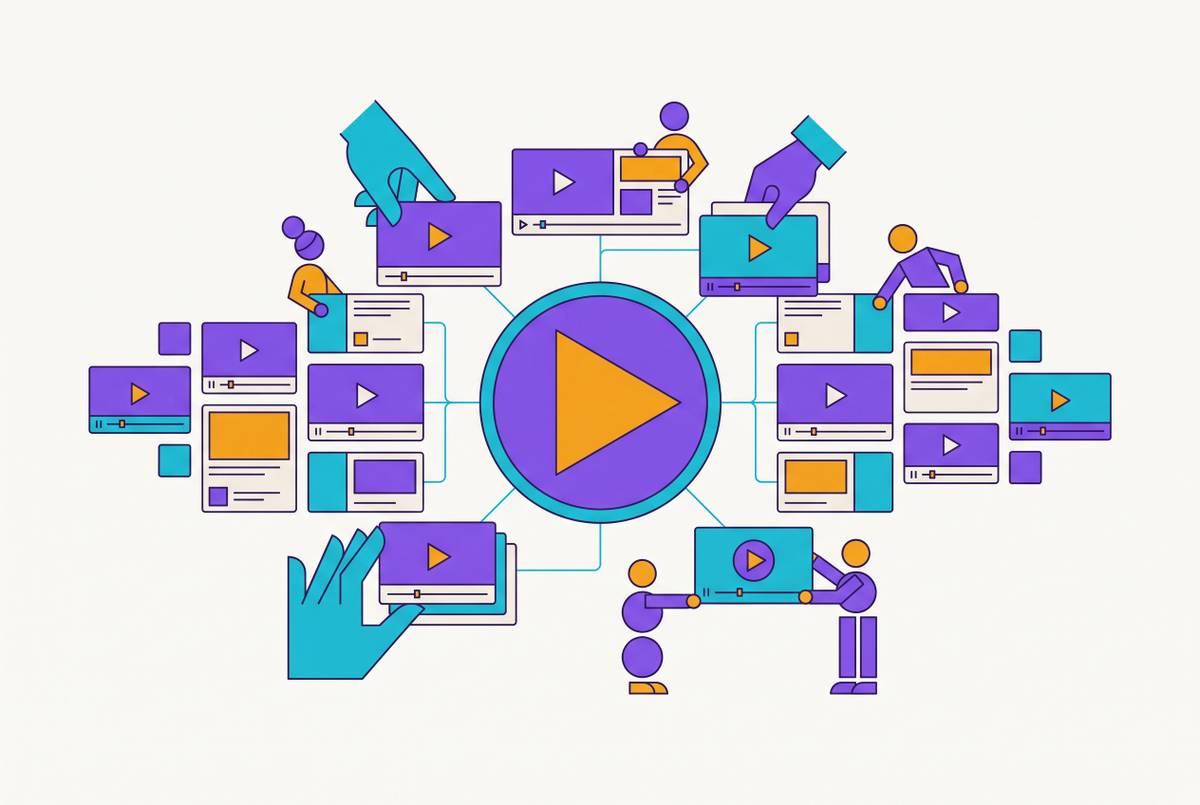
Leadde's 2026 workflow analysis frames the practical pairing this way: landing pages call for an interactive demo, while onboarding and help centers call for a video demo. It's a deliberate match between where the buyer is standing and what that moment demands from the content. You don't need five separate videos for five separate moments. One well-shot master recording can be cut into a short homepage clip, a mid-length onboarding video, a feature teaser, a social cut, and an account-specific sales asset, each one serving a different stage of the buyer journey without a single additional shoot. Getting the format-to-stage mapping right before building anything is what makes that kind of reuse possible later.
Content architecture: organizing assets by role and use case, not by feature
Format tells a team what kind of asset to build. Architecture tells them how to find it again once it exists, and most libraries get that backward. A library built around product features (one folder per module, one video per button) serves the people who built the product. It does almost nothing for the seller trying to answer a buyer's actual question in the middle of a call. The fix is to organize around buyer role and desired outcome instead of around what the product does internally. ContentBeta's guide to demo video examples makes this concrete with a workflow built around a single customer outcome rather than a product module, the kind of structure where a seller searches for "how this solves X problem" and gets exactly one clear answer instead of five tangentially related videos.
Built that way, a library needs a handful of distinct categories rather than one bucket per feature. An economic buyer needs a champion demo built around ROI and business outcomes, with as little feature detail as the conversation can tolerate. A technical evaluator or IT stakeholder needs a deep-dive that actually addresses integration, security, and workflow specifics instead of gesturing at them. An end user needs a workflow demo that walks through their daily job step by step, built around the outcome they want to hit rather than the menu of options available to them. A deal running against an incumbent needs a competitive displacement demo built around differentiation, assuming the buyer already knows what the category does. So a more usable structure sorts distinct categories by job rather than a hundred feature folders nobody can search by need.
Production workflow that makes the library maintainable, not just launchable
Building the first video in a demo library is never the hard part. But you have to keep a hundred videos accurate when the product behind them ships updates every week. Most teams solve the first problem well and the second one not at all, because the production method they chose for launch day quietly works against them every day after.
If you edit a video heavily in an external tool, it locks in place the moment it's finished. Leadde's 2026 analysis calls this the Polishing Trap: once a video is polished and exported, a single UI change doesn't mean a quick scene swap. It means a full re-shoot, because the editing software has no connection back to the product or the source material. Every demo built this way starts decaying the day it's published.
The fix is a production method built around editability rather than around a finished, polished file. Doc-to-Video workflows take existing material (SOPs, product docs, release notes, PDFs, slide decks) and feed it into an AI platform that generates video in editable layers. When the product changes, the update happens at the document layer, in the source material itself, rather than requiring someone to re-record a scene from scratch. That single shift, updating the source document instead of re-shooting the video, is what separates a library that survives a year of releases from one that needs to be rebuilt every quarter.
A workflow built for that kind of durability tends to follow a consistent sequence: start from a template, draft the script with AI assistance, lay in a voice track, record the screen demo, break it into reusable scenes, generate subtitles automatically, export in a format ready for a learning management system, and route everything through a fast-update system that can push a single change without touching the whole asset. Reusable scenes matter most in that chain, because they let one update ripple through many videos instead of forcing you to rebuild each one individually.
One caveat belongs here. If you're building a software walkthrough, actual screen recording still beats AI-generated animation. Nothing else shows the real interface, click by click, with the exact specificity a technical buyer or new user needs to trust what they see. Doc-to-Video workflows solve how quickly a single change can be pushed across many videos. They don't replace the value of recording the actual product in action.
Governance: who owns what
Production workflow decides whether an asset can be updated cheaply. Governance decides whether anyone actually updates it. If a library has no clear owner, it decays even when the production method behind it is excellent, because nobody's job depends on keeping it current, so sellers using outdated demos lose deals they should have won, and the cost of that neglect compounds with every release the product ships.
The ownership split that tends to hold up at scale draws a clean line between two teams. Product marketing owns core messaging and the master asset, the single source of truth for what the product does and why it matters. Sales enablement owns everything built from that master: the specific plays, the persona variants, the versions tailored to each stage of a deal. PitchMonster's 2026 enablement guide describes this as a job of storing, governing, and recommending the right deck, one-pager, or case study for the right deal stage and the right persona, rather than leaving sellers to guess which asset applies.
Beyond ownership, you have to settle three governance decisions before the first video goes live. A version control policy has to say who triggers an update when the UI changes, and what the service-level agreement is for retiring the old asset once the new one exists. Access and permissions need a clear answer: who can publish, who can edit, and who can only view and share. A review cadence needs to be set, whether that's calendar-based (quarterly, say), event-based (triggered by a product release, a pricing change, a competitive shift), or some combination of both. On top of that structure, every one-pager, objection-handling script, and demo narrative needs to be built for the specific positioning it supports rather than repurposed generic collateral stretched to fit an occasion it wasn't built for.
The failure all of this exists to prevent is the one K3C's 2026 launch framework names as the default pattern when governance is missing: sales hears about a new feature from a customer, customer success finds out when the support tickets start arriving, and enablement never gets the chance to brief anyone ahead of time. A library with real ownership and a real review cadence catches that failure before it reaches a customer. It also produces something measurable: a record of what was updated, when, and by whom, which is what makes it possible to actually track whether the library is working rather than just assuming it is.
Choosing tools that match the library's architecture, not the other way around
Tool choice comes last for a reason. Decide what the library contains and who's responsible for it first, and the right tool becomes obvious. Picking the tool first lets the architecture end up shaped by whatever that tool happens to do well. Tool selection should follow content architecture and governance decisions, not precede them: a ten-person team running three buyer personas and an enterprise running global markets need almost nothing in common from a tool, even though both are technically building a "demo library".
Leadde's 2026 workflow ranking identifies five criteria that actually predict ROI on a demo tool, and all five map directly back to the production and governance decisions made earlier: how easily an asset can be edited after launch, how fast it can be produced in the first place, how well the workflow scales to hundreds of videos rather than a handful, whether it supports localization, and whether it can take existing material like docs and slides as direct input.
Within that frame, different tools solve different parts of the problem, and the honest answer is that most teams need more than one. If you want top-of-funnel use, you embed interactive demo platforms on a website or build them for product-led growth exploration, where a visitor clicks through a simulated product on their own. Karumi's comparison of demo software finds that Walnut offers HTML-cloned demos with TranslationAI covering more than 243 languages, along with SOC 2 Type II, GDPR, and CCPA coverage, while Demoboost offers six demo formats inside one platform with per-tour localization and ISO 27001 and GDPR certification. If you need clickable product simulations running at real scale, both suit your team.
Further down the funnel, you face a different problem, because live demo enhancement tools are built for the actual sales meeting rather than the anonymous website visit. Saleo pairs a live demo with an AI Demo Agent currently in beta, backed by SOC 2 and GDPR coverage, and Demostack offers a high-fidelity cloned simulation of the product, having added a Builder Agent and a Demo Partner in June 2026, with SOC 2 Type II and GDPR compliance in place. Those tools fit enterprise sales organizations that run large rep teams across complicated, varied customer environments.
None of this adds up to one tool doing everything. PitchMonster's guide says the typical mid-market configuration pairs a CRM with a content platform and a separate practice layer, so you get three distinct tools covering three distinct jobs rather than one platform stretched thin across all of them. Where that stack needs a production layer that lets a single document update push changes across every video automatically instead of requiring a reshoot, a Doc-to-Video workflow fits naturally, turning existing source material into video that can be updated at the document level instead of re-shot every time the product changes. The architecture built in the sections before this one is what makes that kind of tool choice a straightforward decision rather than a guess.
Sources
- The 7 best demo software for SaaS products in 2026
- 11 Best Sales Enablement Tools for B2B SaaS Teams (2026)
- 45+ Best Product Demo Video Examples for B2B SaaS (2026)
- 9 Best SaaS Product Demo Video Software in 2026 (Ranked by Workflow) - Leadde Blog
- How to Plan a B2B SaaS Product Launch in 2026 (Complete Framework)