Keeping Demo Content Current During Rapid Product Releases
Modular production architecture lets teams update demos without rebuilding them entirely.
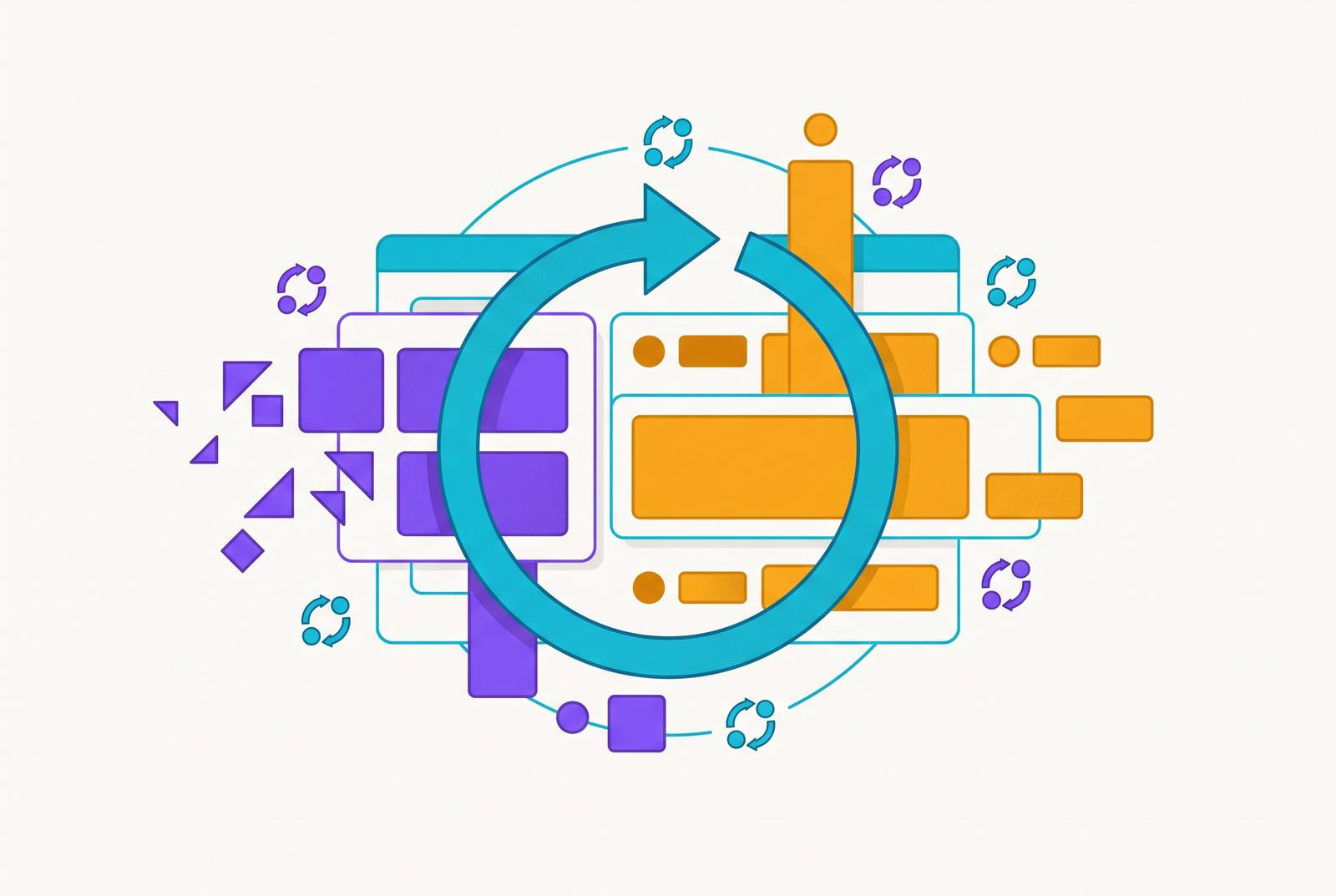
A button moves two pixels to the left, a menu gets renamed, a signup flow drops from four steps to two, and a demo recorded three weeks ago is now lying to every prospect who watches it. That's the specific failure mode that makes demo content different from a hero video or a customer testimonial. Those assets age gracefully. A demo doesn't age at all; it just becomes wrong, often within a single release cycle.
The usual production pattern makes this worse. That file is already out of date by the time it clears review, because the interface it shows is a snapshot of a product that doesn't stop changing.
Distribution multiplies the damage. A demo rarely lives in one place anymore. It gets embedded in onboarding emails, dropped into landing pages, played during webinars, cut into clips for social media. One outdated recording doesn't just sit stale on a single page; it propagates the same wrong screenshot across every channel it touches, simultaneously, until someone catches it.
Treating this as a maintenance problem when it is a production architecture problem
Most teams respond to this by asking how often they should refresh their demos. That's the wrong question. The right one is whether a single screen can be swapped without redoing the entire piece. One is a scheduling problem. The other is a structural one, and it decides whether a demo program survives contact with a real release calendar.
Teams that build each demo as a self-contained project, start to finish, every time, will always lose this race. Shipping velocity doesn't wait for a video team to re-edit a timeline, re-record a voiceover, and re-render a file. When updating a demo feels as expensive as making a new one, teams stop updating and start accumulating stale inventory instead.
Miyagi's 2026 agency guide treats this directly: it names "refresh economics," meaning whether production is structured so a screen can be swapped without redoing the whole piece, as one of its primary criteria for ranking demo production approaches. That's the line that separates a sustainable demo program from a pile of one-off projects that happen to look similar.
Procurement is part of the problem too, not just editing. Re-briefing an outside studio every time a feature changes is slow and expensive, and it turns a routine update into a negotiation. A subscription model, or a known per-video cost, turns that same update into an operational decision someone can make without a purchase order.
A tool that's easy to use on day one but painful to maintain by day ninety produces a cost trap, costing more over time than the option that looked expensive at the start. The hidden expense appears release after release, in every cycle where the demo doesn't get updated because updating it is too much work.
MeridianOps is the cautionary case. The company skipped content governance, and the result wasn't a one-time inconvenience: publication had to pause, a course had to be updated, related assets had to be reviewed, and Customer Success had to be briefed on the gap. Whatever time the fast, ungoverned production process saved on the front end, the remediation effort spent back with interest.
If the architecture is wrong, no amount of discipline fixes it. Teams can commit to refreshing content monthly, quarterly, after every release, and still lose the race if every refresh requires a full rebuild. The fix is a different production model, one where swapping a screen doesn't mean redoing the piece.
What a release-proof demo production system looks like
A modular, AI-assisted production architecture solves the problem the previous section diagnosed. Instead of re-doing a full piece every time the product changes, a team changes the affected screen, regenerates the voiceover for that section, updates the caption block, and publishes, without touching anything else in the piece.
The principle behind this is atomicity. Break content down into the smallest unit that can be replaced independently, so a change to one part doesn't force a rebuild of the whole. That sounds abstract until it gets a concrete shape.
The 90-second spotlight is that shape. It covers a single task, a single decision, or a single behavior in the product, and because it's small and self-contained, it's updatable, reusable, translatable, embeddable directly in the product, and assemblable into longer pathways when a team needs a full walkthrough. When the product changes, the team updates the affected spotlight. The curriculum around it stays untouched.
What makes atomicity practical now, in a way it wasn't a few years ago, is AI's effect on the editing bottleneck. Rewriting a script, regenerating a voiceover, and reapplying captions used to take a full production cycle, often days. AI compresses that into minutes. The test that tells a team whether its system actually works is simple: does a UI change require re-recording from scratch, or does it just mean fixing one scene?
Document-to-video workflows extend this further. Platforms that turn release notes, product guides, SOPs, and sales scripts directly into structured video drafts mean a team can regenerate an updated demo as soon as a new version ships, with no re-scripting and no re-recording. The release note becomes the source of truth, and the video follows from it automatically rather than through a separate creative pass.
None of this works without governance built in from the start. Defining approved tools, review checkpoints, data rules, and clear ownership before scaling AI production is what keeps the speed advantage from turning into a liability when product details shift between draft and publication. Governance here is part of the structure that makes the speed safe to use.
The localization multiplier: why a modular system is the only way to go global without doubling the maintenance burden
A team that already struggles to keep one English demo current across releases runs into the same problem multiplied across every language the moment it expands globally. Adding languages doesn't mean multiplying the content; it means multiplying the maintenance burden on a system that was already behind.
AI-generated multilingual output changes where the work happens. Translation and localization move to the source-document or voiceover layer instead of the timeline-editing layer, so a single content update regenerates every language version at once rather than requiring a separate edit per market.
Trivago is the concrete proof that this works at real scale. The company uses AI-based video localization at brand scale, and that's a public demonstration that dubbing fidelity, the kind that used to require a studio and a cast of voice actors, is achievable without controlled studio conditions.
The architectural implication runs in both directions. One-click localization is only possible when the content is modular and the voiceover is regenerable, and that's the exact same structure that makes a release-cycle update fast in a single language. A team doesn't solve localization and refresh economics separately. One modular architecture solves both at once.
Where video, interactive tours, and agentic demos fit
The architecture argument so far has been about structure, not format, and that distinction matters because video, interactive tours, and agentic demos each carry a different update model. The right system doesn't pick one. It uses more than one, deliberately, matched to the job each format does best.
Produced video earns its place through reach. It works on a homepage, in an outbound email, as a paid ad, inside a sales deck, places where a team needs an asset that's fully controlled and works everywhere without depending on a live connection to the product. Produced video needs an explicit update trigger built into the release process, because nothing automatically tells the video when the interface underneath it has changed.
Agentic demos work differently, and they pose the sharpest challenge to any model built around scheduled refreshes. Platforms like Karumi deploy an AI agent that navigates the real product interface in real time, on a live video call, adapting to a prospect's profile and the questions they ask. Because the agent is driving the actual product, or a sandboxed copy of it, rather than a frozen HTML recreation, it updates automatically the moment the product changes. There is nothing to re-edit, because the agent drives the live product instead of producing a fixed file.
That doesn't make produced video obsolete, and it doesn't make interactive tours redundant either. It points toward a hybrid architecture: produced, AI-polished video for the website and outbound channels, an interactive tour sitting behind it for prospects doing self-serve exploration, and an agentic demo reserved for high-complexity or high-value conversations where a live, adaptive walkthrough earns its cost. Each format updates through its own mechanism, and the system is built to use the right one for the right moment rather than forcing every use case through a single format.
The fastest gains for teams adopting AI demo tools tend to come from exactly this combination: one interactive demo platform for self-serve exploration, paired with an AI video-polishing workflow for launches and ad campaigns. The lesson for format selection is the same lesson the earlier sections made about architecture. What matters is which update mechanism fits which job.
What breaks when teams skip content governance at speed
Speed without governance creates a specific kind of risk that didn't exist when production was slow: content generated and published faster than anyone can review it, so that details accurate at the moment of drafting are already wrong by the moment of publication.
The MeridianOps case shows how this plays out. Skipped governance led to a sequence of consequences: publication had to pause, the course needed updating, related assets needed review, and Customer Success needed a briefing on the gap between what the content said and what the product actually did. Whatever production time was saved by skipping the governance step evaporated in the remediation, and the cost that remained landed on customer trust.
Outdated guides do more damage than no guides. A user who finds nothing assumes they need to look elsewhere. A user who follows a guide that doesn't match the actual product loses confidence in the source, and that loss of trust compounds across every other touchpoint where the same stale asset has been distributed, the email, the landing page, the help center article.
The advice circulating among customer education leaders reflects this directly: define approved tools, review checkpoints, data rules, and clear ownership before scaling AI production, not after a gap has already caused damage. Governance is the structure that makes the speed safe to keep using, release after release.
First, track asset age and last-updated timestamps on every piece of demo content, the same way a team would track inventory. Second, set a release-linked review trigger, so that every product update automatically flags the specific demos referencing the feature that just changed, rather than relying on someone remembering to check.
How to measure whether the system is working
A view count says nothing about whether a demo system is working. The metrics that actually show whether an architecture is paying off are consumption, behavior change, and business impact, each measured against a baseline that isolates what the content itself contributed.
The field has largely moved past treating views as a success metric. Teams that track this well ask whether someone finished the content, whether adoption of the feature it covers went up afterward, and whether support tickets dropped or time-to-value shortened as a result.
Support ticket reduction is the cleanest business-impact signal available for customer education content. A reduction in tickets that traces back to a specific onboarding or training demo is about as direct an ROI argument as this kind of content can produce.
Isolating that effect properly means using a control group. Train one group, delay training for a second group, then compare the improvement in a chosen metric across both groups over a fixed window. The gap between the two groups is the effect attributable to the training itself, not background noise from other factors.
Cost belongs in this equation too. AI-assisted production of a multi-video library costs dramatically less than traditional production. The break-even point on the system investment arrives much faster than it would under the old model. That number isn't universal; it depends on a team's own ticket volume and its own production costs, and it should be modeled against those specific figures rather than borrowed from someone else's case study.
The real payoff of a well-built system accumulates over many releases, not in a single measurement. Demo analytics, which features prospects explore, where they drop off, what questions come up most often in an agentic demo, feed directly back into the next round of content decisions. Each release cycle, the system gets better at knowing which spotlight to update first and what impact that update is likely to have. That compounding advantage, not any single metric, is what separates a production architecture built to last from a collection of videos that happened to get made.