Compliance and Security Considerations in Enterprise Demo Content
Demo videos leak sensitive data silently, while breaches at least trigger alarms.
Enterprise demo content sits right where sales urgency meets security discipline, and that's exactly where shortcuts happen. A screen recording made to show off a product often captures more than anyone meant to share: live customer data, internal usernames, environment variables, ticket details pulled straight from a support queue. A breach in a production system sets off alarms immediately, while a compliance failure baked into a demo video stays quiet. It ships, gets forwarded, and sits on a shared drive for years before anyone checks what's actually in frame. IBM put the global average cost of a data breach at $4.88 million in 2024, up 10% from the year before, and procurement teams now dig into vendor security practices as a matter of routine. A demo that leaks sensitive data while a deal is under review creates a compliance problem, and it kills trust at the exact moment trust is the only thing being sold.
Here's where that risk actually lives: recording, review, storage, and distribution. Each stage needs its own fix, and skipping any one of them undoes the other three.
What kinds of sensitive data actually surface in demo recordings
Most demo content starts as a screen recording of a live, or near-live, software environment. Real data shows up on screen more often than teams like to admit, and it falls into a short list of repeat offenders:
- PII: customer names, emails, phone numbers sitting in a CRM view or a support ticket
- Financial data: contract values, billing records, payment status fields
- Internal configuration: API keys, environment labels, admin panel views, internal user accounts
- Proprietary product data: unreleased features, roadmap notes, pricing logic visible in a backend screen
- Third-party data: vendor names, partner details, or regulated health and legal records if the demo happens to run in one of those verticals
Deadline pressure is usually the root cause, not carelessness. Sales needs a demo by Friday, the test environment is half-populated with junk data, and someone grabs the real one instead because it's faster. That's how a customer's phone number ends up in a video sent to forty prospects.
A blurred clip isn't automatically clean, either. File names, recording software timestamps, and workspace URLs can ride along as metadata and leak context nobody meant to share. What regulation applies depends entirely on what's visible and who sees it: GDPR kicks in if an EU resident's data shows up anywhere in the frame, HIPAA applies the moment health information surfaces, and SOC 2 auditors will ask, point blank, how content like this gets handled before it ships.
The regulatory frameworks that govern how demo content must be handled
No regulation was written with demo videos in mind, yet several of them cover it anyway, and treating demo footage as exempt is the mistake that gets teams caught.
GDPR applies to any recording showing personal data belonging to an EU resident, so the usual obligations, lawful basis, data minimization, retention limits, extend to video files sitting on a vendor's storage platform. HIPAA works the same way for healthcare: covered entities and their business associates need to keep protected health information out of recordings entirely, and any storage vendor in the chain needs a signed Business Associate Agreement. CCPA adds a similar wrinkle for California residents' personal information, particularly once that content leaves a controlled environment.
SOC 2 has become close to a baseline requirement rather than a differentiator. It has become the de facto test buyers apply during enterprise procurement, and a vendor without it can lose a deal on that basis alone, no matter how good the product is. SOC 2 Type 2, which checks controls continuously over time, carries more weight than Type 1, which only attests to a single point in time. ISO 27001 matters too, especially once procurement teams outside North America start looking at the platform.
None of this holds still, and the pace of change is picking up. The EU Cyber Resilience Act has its main requirements approaching, and FedRAMP revisions in the US are moving the same direction: tighter rules on software that touches sensitive content. Teams that wait for those deadlines before adjusting anything will be scrambling. Figure out now which frameworks actually apply to the industry and the buyer base, so the policy exists before an auditor flags the gap, not after.
Where the production workflow itself creates compliance gaps
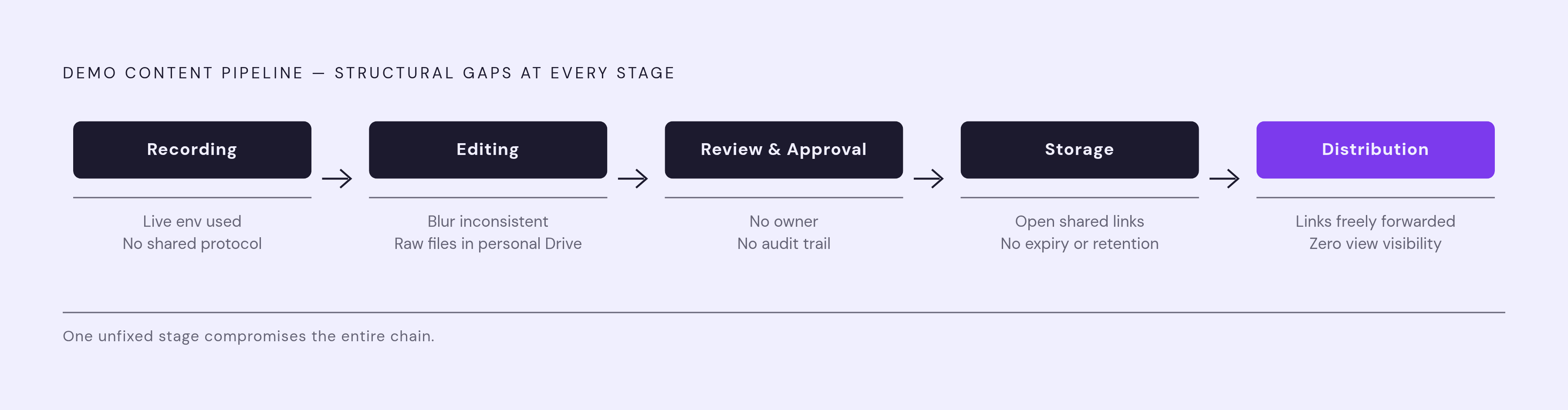
Most compliance failures in demo content are structural rather than deliberate, since nobody sits down and decides to expose customer data. The workflow simply never had a checkpoint built in to stop it.
Walk the stages one at a time. Recording usually happens in a live production environment because the sandbox is incomplete, and there's rarely a shared protocol when several people on a team are each making their own recordings. Editing skips a systematic pass for exposed data before export more often than it should; blur tools get applied inconsistently, someone forgets a frame, and the raw file lands in a personal Google Drive folder nobody's tracking. Review and approval frequently has no documented workflow at all: no clear owner, no audit trail of who signed off on what. Storage defaults to general-purpose tools, Dropbox links, shared folders with open permissions, no expiry date, no retention policy. Distribution runs over email or Slack with links anyone can forward, and zero visibility into who actually watched or downloaded the file.
There's a version-control problem sitting underneath all of this. When a demo script or an SOP lives in a shared drive or as an email attachment, there's no reliable way to confirm the person watching is looking at the current, approved version. This is a well-documented gap in SOP management practice, and it applies just as much to demo content as it does to internal documentation.
AI-assisted production adds another layer. When an AI tool processes a screen recording to write a script, generate a voiceover, or summarize the content, it's handling whatever sensitive data happened to be in that recording. Per ragwalla.com's enterprise AI security guidance, organizations need a clear, verifiable answer on where that data goes, how it's processed, and whether the vendor's security posture actually holds up.
The access control and governance baseline enterprise teams should meet
Access control isn't just about who watches the finished video. It governs who can record in the first place, who edits, who approves, and who's allowed to hit send.
Contentful's 2025 enterprise security analysis and Influencers-Time's 2025 content governance review point to a fairly consistent baseline:
- SSO and MFA tied into existing identity providers, Okta, Azure AD, Google Workspace, as a baseline expectation
- Role-based permissions that separate creators, reviewers, approvers, and distributors into distinct buckets
- Just-in-time access, so elevated permissions expire automatically once a project wraps
- Immutable audit logs recording who touched, edited, approved, or shared each asset, queryable the moment an audit comes knocking
Per Influencers-Time (March 2026), content governance in regulated industries now demands provable control over what got published, how it was approved, and who handled it, across every channel it moved through. SearchUnify puts the frequency of cyberattacks at more than 2,200 a day, roughly one every 39 seconds, and at that pace, access controls become standard operating procedure, full stop. Measure any platform used to build, store, or send out demo content against this baseline before looking at a single feature it offers.
A practical compliance checklist for demo content, from recording to distribution
Before recording, set up a standard demo environment: a purpose-built sandbox running synthetic data only, never production records. Build a data scrub checklist covering names, emails, account IDs, financial fields, internal URLs, and swap in placeholders that are obviously fake. Confirm which regulations apply, GDPR, HIPAA, CCPA, and brief everyone making recordings on what that means for what's allowed on screen. Check that the recording and production platform carries the right certifications: SOC 2 Type 2, ISO 27001, and a signed BAA wherever healthcare data is anywhere in the picture.
During production and editing, treat blur and redaction as a systematic pass, not something tacked on at the end. Raw, unedited recordings should never sit in a personal drive; route them straight into a controlled project workspace. If an AI tool touches the recording for scripts, voiceover, or captions, confirm its data handling policy actually covers the classification of content being fed into it.
Review and approval needs documented sign-off from someone specifically designated as the compliance reviewer, logged with their identity, the version reviewed, and the date, before anything clears for external release. That log is the audit record when a question comes up six months later. Version control belongs here too: only the approved, versioned file should ever be distributable, and earlier drafts need to be locked down or deleted.
Storage means role-based access, not an open link anyone with the URL can view. Set a retention schedule so outdated content gets archived or purged instead of piling up indefinitely, and know where the platform physically stores the data, since that matters for GDPR residency rules.
Distribution should run through access-controlled links with expiry dates. Know the audience before anything goes out: internal training material, prospect-facing demos, and public product videos each carry a different exposure profile. Localized versions need the same compliance review as the source, and a distribution log should track who received which version, when, and through which channel.
How localization adds a compliance layer teams often overlook
Once demo content gets translated, dubbed, or captioned for a new region, most teams file that under production work and skip the compliance step entirely. That's the mistake, and it's the one that catches teams off guard six months into an expansion.
A localized version carries its own exposure profile, separate from a simple copy with different subtitles. New text, new on-screen labels, regional examples swapped in for local relevance, any of that can introduce data or implications that weren't in the original, and each language version becomes a new artifact in its own right. Worse, jurisdiction follows the audience, not the recording's country of origin: a video shipped to viewers in the EU falls under GDPR no matter where it was filmed.
Inconsistent localization already creates uneven knowledge across regional teams. In a compliance-sensitive industry, financial services, healthcare, enterprise SaaS selling to regulated buyers, that unevenness is its own risk, separate from whatever shows up on screen. Localization belongs inside the approval workflow, not after it. Every language version should run through the same sign-off checklist the source file did, and a platform's one-click localization feature is only as good as its ability to keep a separate audit trail per language; one approval record covering the source file falls apart the moment the content is live in six regions.
What to look for when evaluating platforms used to create and host demo content
Demo content workflows rarely live in one tool anymore. Recording, AI-assisted editing, hosting, distribution: each piece might run through a different vendor, and each one has its own approach to handling data.
Start with certifications: SOC 2 Type 2 for continuous monitoring rather than a one-time snapshot, ISO 27001 if content ships internationally, and BAA availability for any buyer in healthcare. Then check the access and governance layer: SSO and MFA tied to enterprise identity providers, role-based permissions covering the entire workflow from creation through distribution, immutable audit logs per asset and per action, and retention or expiry controls built into hosting.
AI transparency matters just as much. If a platform uses AI to rewrite scripts, generate voiceovers, or process recordings, it needs a straight answer to three questions: where does the input data get processed, is it used to train a model, and what data processing agreements are actually in place. Built-in redaction beats manual redaction every time, because relying on a person to remember to blur a field is exactly how fields stop getting blurred. Any team distributing globally also needs the platform to keep separate version records per language output.
Platforms built specifically for software explainer content, the ones combining AI-assisted production with structured approval steps, default redaction, and enterprise-grade access controls, cut down the number of places something can slip through. Stitching those same capabilities together out of five general-purpose tools that were never built to talk to each other leaves more gaps than it closes.
Building a repeatable compliance process rather than a one-time audit
A checklist run once before a big release is a snapshot of one moment, and the risk never stops moving.
A process that actually holds up needs a few things in place. Ownership comes first: someone specific, a content ops lead, a compliance liaison, legal, needs to own the demo content policy, rather than leaving it scattered across whoever happened to hit record that day. Templates cut down on guesswork: pre-approved demo environments, approved script frameworks, redaction checklists creators reach for by default instead of reinventing the process every time. Cadence keeps it alive: quarterly reviews of stored assets to retire what's outdated, audit who's accessed what, and update the checklist as rules shift underneath it. Training closes the loop, because creators, whether they sit in sales, customer success, or L&D, need to understand why the checklist exists in the first place. A team that gets the stakes follows the protocol, while a team handed a checklist with no context treats it as a formality, and formalities are exactly what get skipped when a deal is closing Friday.
The regulatory shifts already on the calendar, the Cyber Resilience Act, the FedRAMP updates, aren't going to wait for anyone to catch up. Building the process now costs far less than rebuilding it under deadline, after a regulator or a procurement team asks the one question nobody had an answer for.