In-House Video Team Versus AI Platform for SaaS Training Content
Frequent product updates make traditional video production too slow for SaaS training needs.
A SaaS company ships a new dashboard layout on a Tuesday. The onboarding video explaining the old layout, recorded three weeks earlier and just approved for release, is wrong before anyone outside the company has watched it. That timing problem, not a budget preference, is what decides whether an in-house video team or an AI platform makes sense for SaaS training content.
Why SaaS training content has a structural update problem
Training content tied to a software product has a shelf life measured in release cycles, not seasons. A filmed walkthrough of a settings page or a checkout flow is accurate until the product team ships a redesign, and in most SaaS companies that happens on a schedule of days or weeks, not quarters. The real cost of a training video was never just the cost to make it. It is the cost to make it again, and again, every time the interface underneath it changes.
Traditional video production runs in sequence: a script gets written, a recording gets scheduled, editing happens, subtitles get added, and someone reviews the final cut. Each step waits on the one before it, and the whole chain commonly takes weeks from first draft to published video. Software does not wait that long between changes. A screen or workflow that shifts on a Tuesday can invalidate a video that took three weeks to produce and has not even finished its internal review, let alone reached a customer.
This matters more for training content than it does for marketing. A slightly outdated promotional video is a cosmetic problem. An outdated training video sends a user down steps that no longer exist in the product. An outdated training video produces a support ticket, a frustrated customer, and a small but real loss of trust in whether the company's own documentation can be believed. A production model built around stable content, filmed once and left to run, cannot serve a category of content that is structurally unstable by nature.
The true cost of an in-house video team once all overhead is counted
Salary is the number most teams look at when they weigh an in-house video hire, and it is the number that most understates the true cost. A full in-house setup carries equipment and studio costs, software licenses across a production stack (editing, motion graphics, screen capture, hosting), plus benefits, office space, and the employer side of payroll. These added costs mean a salary that looks like one figure on a hiring plan tends to run close to double that figure once the team is actually operating.
That cost structure is fixed. It does not shrink in a slow month and it does not scale down just because fewer videos are needed. Fixed costs only pay for themselves above a certain volume of output per month. Below that line, a freelancer or an AI platform will almost always produce a cheaper video, unit for unit, than a salaried team sitting partly idle.
SaaS training content pushes teams below that line more often than they expect, because volume there is driven by the update cycle, not only by demand for new content. A single training video covering a core workflow might need to be remade three or four times in a year because the product underneath it keeps moving, not because the company wants new material. Counting only "new videos needed" badly understates the real production load, and understating the load is what leads teams to staff for a volume they never actually sustain.
What AI-platform production replaces in the workflow
AI video platforms do not replace the judgment of someone who understands the product and the audience. They replace the slow, sequential, manual steps that make traditional production too slow for a category of content that changes this often. That distinction matters, because overstating what these tools do erodes trust with the exact audience, customer education and L&D teams, who need to know precisely where the automation stops.
What gets automated: narration and script cleanup from a raw recording or a rough text draft, AI voiceover and avatar-based presenters that remove the need for a recording booth or a human on camera, automatic subtitles, captions, and zoom or callout effects, and scene regeneration when the source material changes, so a UI update means editing a script and regenerating a scene instead of rescheduling a shoot. Localization into multiple languages runs through the same pipeline, without a parallel production setup for each market. Modern platforms combine narration, avatar delivery, subtitles, script-to-video generation, and multi-language output in a single workflow.
What does not get automated: the decision about what content to build and who it serves stays a strategic call made by people. Subject-matter accuracy review stays essential, since AI generation on its own is not enough to guarantee a walkthrough matches the current product correctly, and human review is what keeps the output trustworthy. Brand and creative direction on hero content, the kind meant to carry emotional weight, still depends on human judgment. Scenario-based training that needs a realistic physical environment or live-action footage still needs a camera and a set.
The operational shift this produces is a change in how a training library gets treated. The library becomes something a team edits directly: when the UI changes, someone updates the script and regenerates the video. AI-powered platforms compress that creation step from weeks down to minutes, which makes it practical to regenerate content as often as the product actually changes, instead of letting an outdated video stay in circulation for weeks while a replacement works its way through a production queue.
Evaluating Clueso as the AI platform option for SaaS training content
Clueso is built around the specific workflow SaaS training teams run every day: a screen recording goes in, and a finished video along with written documentation comes out, without requiring the person creating it to know anything about video production. That narrow focus is what separates a tool built for this job from a general-purpose video editor adapted to fit it.
Video and step-by-step documentation get produced from the same source material as one project. One re-recording updates both the video and the written guide at the same time, instead of someone maintaining two assets on two different timelines. Branded templates, a blur tool for redacting sensitive information on screen, and an article co-pilot let people outside a production team, customer success reps, L&D staff, product managers, sales enablement, build professional-looking content on their own.
Localization is built into the same workflow as a native step. One-click translation across more than 150 languages means a video made for one market can be localized without rebuilding any part of the production process behind it. For a SaaS company with customers or employees spread across multiple countries, that closes the gap between a well-produced training library in one language and markets that would otherwise wait months for a translated version, or never get one.
Pricing runs on a self-serve tier, priced modestly on a monthly basis, suited to a team just starting to build out a content library, alongside a custom enterprise tier billed annually for organizations scaling across departments and languages. That range fits customer education teams, L&D professionals, product managers, sales enablement specialists, and customer success teams at companies from early-stage startups to global enterprises, anywhere the goal is shipping professional training content at real volume without staffing a dedicated production team to do it.
Other AI platform options
No single platform in this category covers every training use case equally well, so the right secondary choice depends on the specific kind of content a team produces most.
Colossyan pairs video generation with course authoring. It supports interactive videos with branching scenarios, built-in quizzes and assessments, a full course-building feature, and SCORM export for integration with a learning management system. That combination suits organizations building complete structured courses rather than one-off training videos, especially teams that previously ran video creation and course assembly through two separate tools and want them combined.
Across this entire category of platforms, the same pattern holds. None of them replace a human accuracy review. All of them cut down the burden of updating and localizing content compared to an in-house team working through a traditional production pipeline. And for the volume of content a SaaS training program actually needs, all of them produce content faster and at a lower cost per module than a filmed workflow can manage.
Where localization breaks the in-house model most visibly
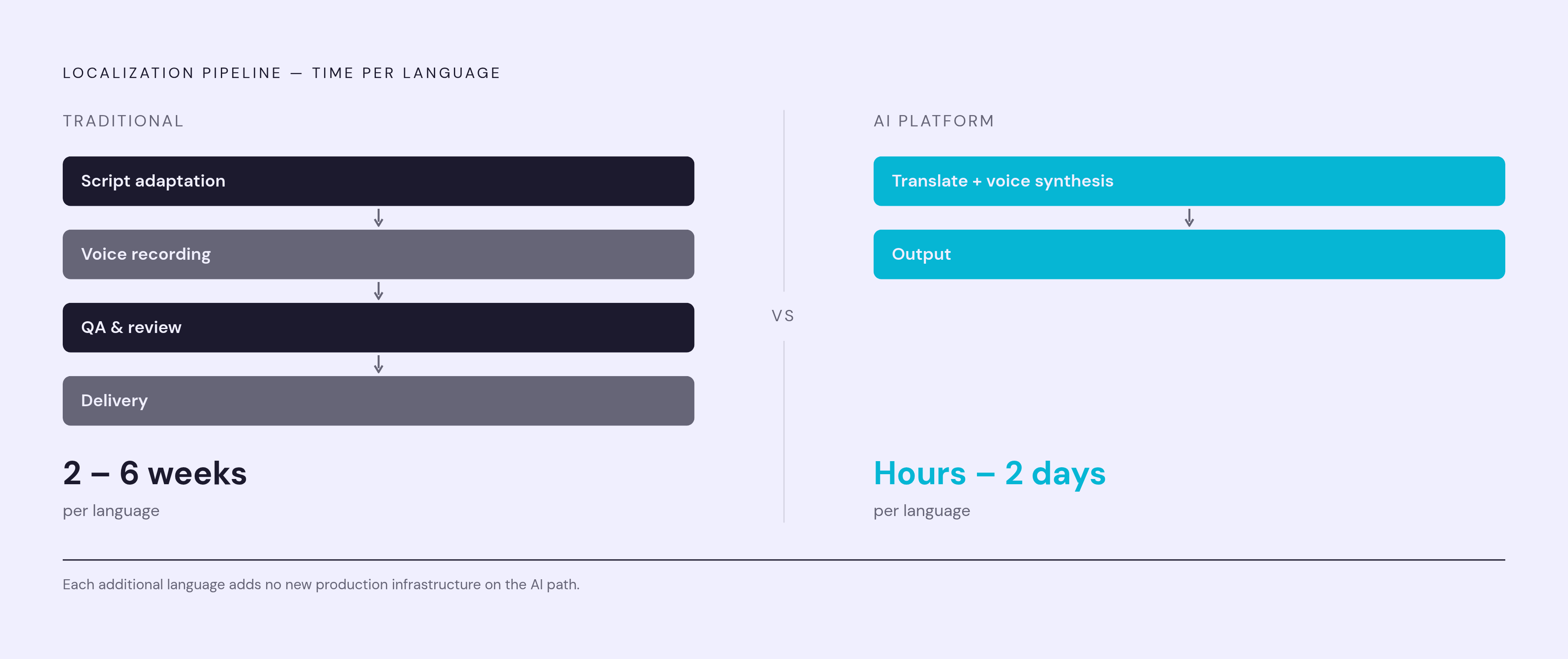
Localization is the clearest point where the in-house production model runs into a wall it cannot get around. In a traditional workflow, each new language requires nearly the same production effort as the original video: new translation, new voice recording, new quality review, even when it reuses the core visual assets. Multiplying that across a slate of target languages makes a training library that was affordable in a single language become unaffordable.
Each additional language in a traditional production pipeline typically adds a substantial fraction of the original budget, not the full cost of a fresh shoot, but a meaningful cost on top of the original, since translation, audio recording, and QA all have to happen again for every language even while the underlying video assets get reused. An AI platform changes that math at a structural level. The same workflow handles two languages or twenty at close to the same cost per minute, because adding a target language does not require new production infrastructure, just a new output pass. Turnaround compresses accordingly: a process that takes two to six weeks under traditional production can run in hours or one to two days through an AI pipeline.
That difference carries real consequences for a SaaS company's growth. A single-language training library leaves a company's fastest-growing customer segments, often in markets outside its home region, without proper training materials, which causes slower product adoption and higher churn in exactly the markets the company is trying to expand into. LKQ Europe, an automotive parts distributor with tens of thousands of employees, used an AI platform (Panopto's Elai) to run multilingual training through its LKQ Academy program, starting with two languages and actively planning an expansion to more than ten, built on the platform's SCORM compatibility and its ability to scale across languages without rebuilding the production process for each one.
The record is not uniformly in favor of AI-generated voice, though. One global SaaS marketing automation platform expanding into a new-language market opted for human voiceovers instead of AI narration, specifically because the team wanted a more natural experience for users in that market. AI localization works well for training content in most cases, but teams entering markets where tone and naturalness carry real weight should plan to put a human review step on the AI-generated voice track rather than assume it will land correctly without one.
The narrow conditions where an in-house team still earns its overhead
A dedicated in-house video team is still the right call in a small number of situations, and naming them honestly is what makes the broader case for AI platforms credible.
Volume above the break-even point is the clearest case. If a team genuinely produces enough video every month that the fixed cost of salaries, equipment, and software comes out cheaper per video than ongoing platform fees, in-house production can win on pure economics. That break-even point sits higher than most teams estimate going in, and the update cycle has to be counted as part of the volume, not treated as occasional extra work layered on top of new content.
Hero content and brand storytelling are a second case. AI-generated presenters can come across as less natural in content meant to carry real emotional weight, brand narratives, executive messages, anything where the goal is connection. Live-action footage with real people still outperforms AI avatars in that kind of content, and that gap is not one current AI platforms close.
Scenario-based training is a third. Safety simulations, live customer interaction role-plays, and other controlled scenarios that depend on a physical environment do not translate cleanly into screen-capture or avatar-based production. That kind of content still needs a camera, a location, and people performing in it.
The strongest objection to the AI-platform approach has nothing to do with cost or speed. It is about brand trust and quality control. A team that produces a high volume of AI-generated video without a clear editorial strategy behind it risks building a library nobody actually uses. Producing content faster only helps if the content still serves a defined learning goal. Speed without direction just produces more material that misses the mark faster.
The hybrid model that most scaling SaaS teams arrive at in practice
In practice, the choice rarely ends up as a strict either-or between an in-house team and an AI platform. Most SaaS companies that scale their training content land on a split: a small internal team, sometimes a single person, handles strategy, accuracy review, and any hero content that genuinely needs human production value, while an AI platform carries the volume of day-to-day training material and all of its updates and localization.
That arrangement plays to what each side actually does well. A person who understands the product and the audience decides what needs to be taught and checks that a walkthrough still matches the current interface. The platform handles the repetitive mechanical work, regenerating a video when a script changes, producing a localized version in a new language, turning a screen recording into a finished asset without a production schedule behind it. Treating that split as a deliberate design choice, built around where human judgment adds real value and where it does not, sets up a training operation that can keep pace with a product that keeps changing, without carrying the fixed overhead of a full production team scaled for volume it will not sustain every month.