Personalized Sales Demo Videos for Outbound Prospecting
Personalized video outperforms cold email by automating production at scale.
Cold email has stopped working as a reliable way to reach B2B buyers. Reply rates average 3.43% industry-wide, most outreach emails sent in 2026 go unanswered entirely, and that collapse is structural.
Personalized video is the alternative that's actually proven out. The mechanism is behavioral: when a prospect watches even five seconds of a video that opens with their name spoken aloud and shows their own company's website in the background, they draw a conclusion fast, the sender did real research on them specifically. That inference does something email can't replicate as easily. It lowers the perceived cost of replying, because answering someone who clearly put in effort feels different from answering a template.
Production is the catch. Recording, trimming, and sending a personalized video manually takes several minutes per prospect, and even a strong rep on a good day can only produce a limited number of them. That ceiling makes manual video prospecting a fine tactic for a handful of high-value accounts and a non-starter for any SDR running real outbound volume. The problem outbound teams face in 2026 is building a production model that can deliver personalized video at the volume outbound actually requires, and that's what the rest of this piece works through.
What makes a personalized demo video feel personal
Personalization in video means establishing contextual relevance in the first five seconds, and the elements that create that relevance are specific, learnable, and repeatable across hundreds of sends.
The name has to be spoken, not typed across the screen. A prospect's name said aloud, in a human voice, within the first five seconds, is the single strongest signal available that the message was built for them and not for a list. Pair that with a dynamic background, their own website or LinkedIn profile rendered behind the presenter, and the signal becomes visual before it's verbal: the prospect recognizes their own brand before they've processed a single word of the script.
What the rep says next matters as much as how it's delivered. Opening with an observation beats opening with an introduction, every time. "I noticed your team just launched a new onboarding flow" outperforms "Hi, I'm from Acme Corp" because one demonstrates research and the other demonstrates a mail merge. The same logic carries through the thumbnail, the static image a prospect sees before they've clicked play. A whiteboard with the company's name on it, a screenshot of their site, or a handwritten note will outperform a generic webcam freeze-frame on click-through, because it extends the relevance signal to the moment before the video even starts.
The close deserves the same precision as the open. A specific yes/no question, "Would Tuesday or Thursday work?", gives the prospect something concrete to respond to and removes the friction of a vague "let me know if you're interested". Every one of these choices is a design decision, not an accident, and that's exactly the discipline that has to survive the jump from one video to a thousand.
That jump has a real trap in it. Sending the identical generic avatar video to 500 people and calling it personalization defeats the purpose before the campaign even launches. AI tools are built to scale a strong message. They can't manufacture one. The research, the observation, the specific close, all of it has to be right in the base recording before any automation touches it.
The "record once, personalize for thousands" model
Three technical layers make it possible for one recording session to produce thousands of videos that each feel individually made: AI voice cloning, dynamic video backgrounds, and agentic campaign delivery.
Voice cloning handles the audio layer. A rep records once, and the system preserves that rep's actual voiceprint while swapping in each prospect's name and company details, so every recipient hears the sender's real voice saying their name, not a synthetic stand-in. Sendspark's version of this works from a CSV upload: the rep imports a lead list, the tool voice-clones the rep's voice to say each prospect's name, and it pulls each prospect's website into the video as a dynamic background. The output reads like 200 separately filmed videos, even though there was exactly one record session behind all of them.
Agentic workflows sit on top of that and remove the rep from parts of the loop. Sendspark's 2026 agentic workflows can research a prospect, detect intent signals, and trigger a personalized video automatically, without a human deciding, case by case, when to send. For certain stages of a sequence, that turns video from something a rep does into something a system executes on trigger.
A fourth piece addresses a real tension in this model: how to stay personal without re-recording the actual product pitch for every single prospect. Sendspark's Combine Video feature pairs a short personalized intro, 20 to 40 seconds, greeting the prospect by name and referencing their company, with a longer pre-recorded product demo that stays constant across sends. The prospect gets the relevance signal up front and the full product explanation without the rep re-recording a single frame of it.
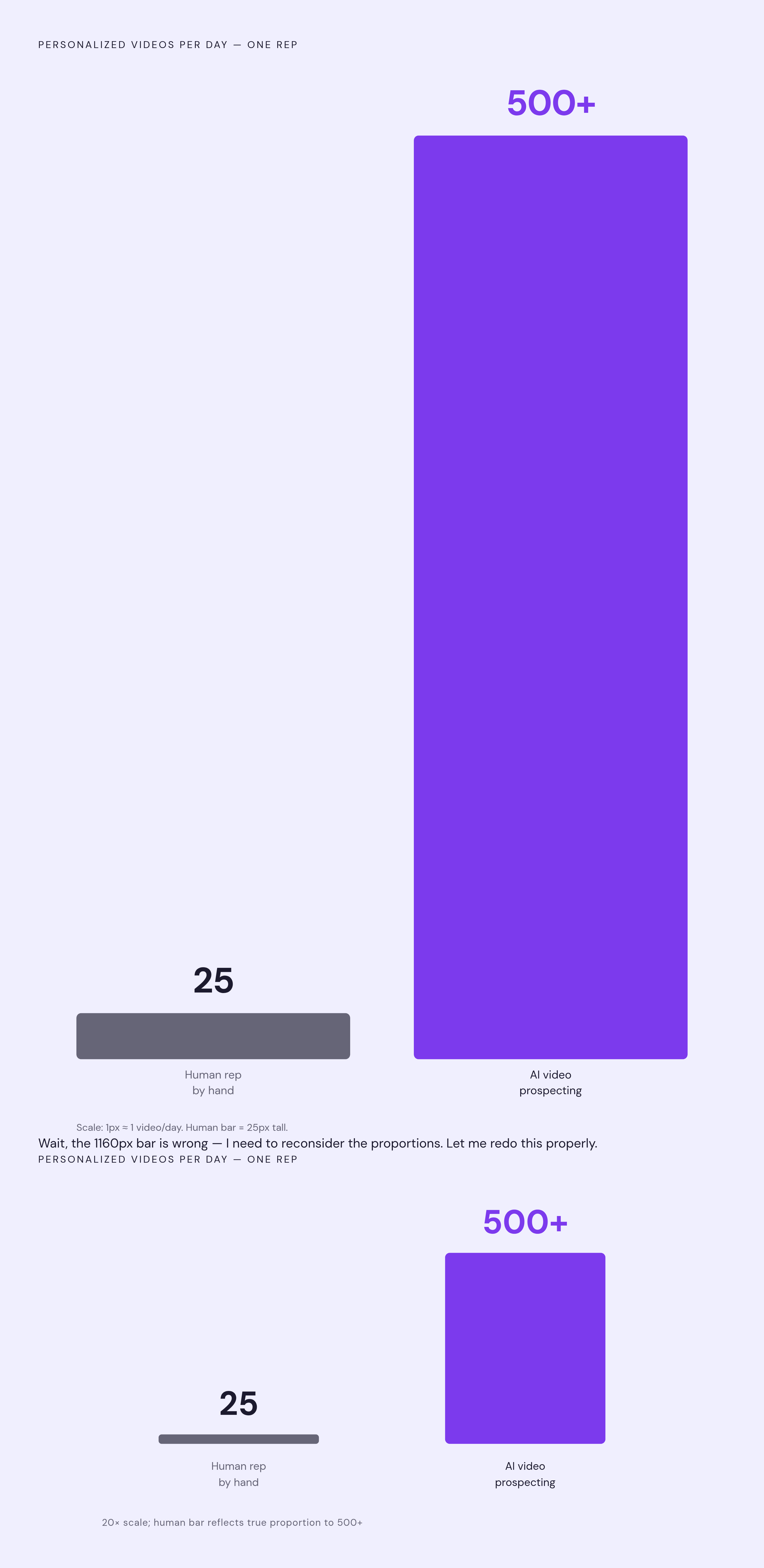
The combined effect is what actually breaks the manual ceiling. A human rep recording by hand tops out around 20 to 30 videos a day, while AI video prospecting tools generate more than 500 unique personalized videos a day from one base recording. That's a different order of volume, and it's what makes personalized video viable as an outbound channel rather than a boutique tactic reserved for whale accounts.
Personalized demo video across the outbound sequence, by funnel stage
Personalized video isn't one format deployed the same way at every touchpoint. Different stages of an outbound sequence call for different lengths, different purposes, and different depths of personalization, and treating every send the same way wastes the channel.
At cold first touch, brevity and relevance do the work. The video should stay short and personalized, focused entirely on the prospect's own situation rather than a pitch for the product. The only job at this stage is to earn a reply, not to close anything.
Trigger-based outreach is where the agentic layer pays off fastest. When a prospect downloads a resource, requests a demo, or trips a signal in the CRM, a personalized video deployed quickly after that action outperforms a delayed follow-up by a wide margin. Speed is the whole value proposition at this stage, and it's what automated triggering was built to deliver.
Post-demo follow-up calls for a different tone. Here the video should run short, summarize the call, and restate next steps in the rep's own voice. Teams using video at this stage see a meaningful lift in demos booked, and because a relationship already exists by this point, a recorded product demo clip can be embedded without feeling impersonal.
Proposal walkthroughs are where video starts doing something text structurally can't. A screen-share video walking through the proposal cuts down on misunderstanding, speeds up deal velocity, and gives the buyer something to forward to stakeholders who weren't on the original call. Text proposals tend to get forwarded and skimmed. Video proposals get watched.
Timing amplifies every one of these stages. A large share of B2B buyers settle on a vendor from whoever made their initial consideration set, so early outreach, triggered by a funding announcement, a leadership change, or a product launch, puts a personalized video in front of a prospect before that shortlist even forms. Getting there first, with something that signals genuine relevance, matters more than almost any other variable in the sequence.
Building the production workflow: from base recording to sent campaign
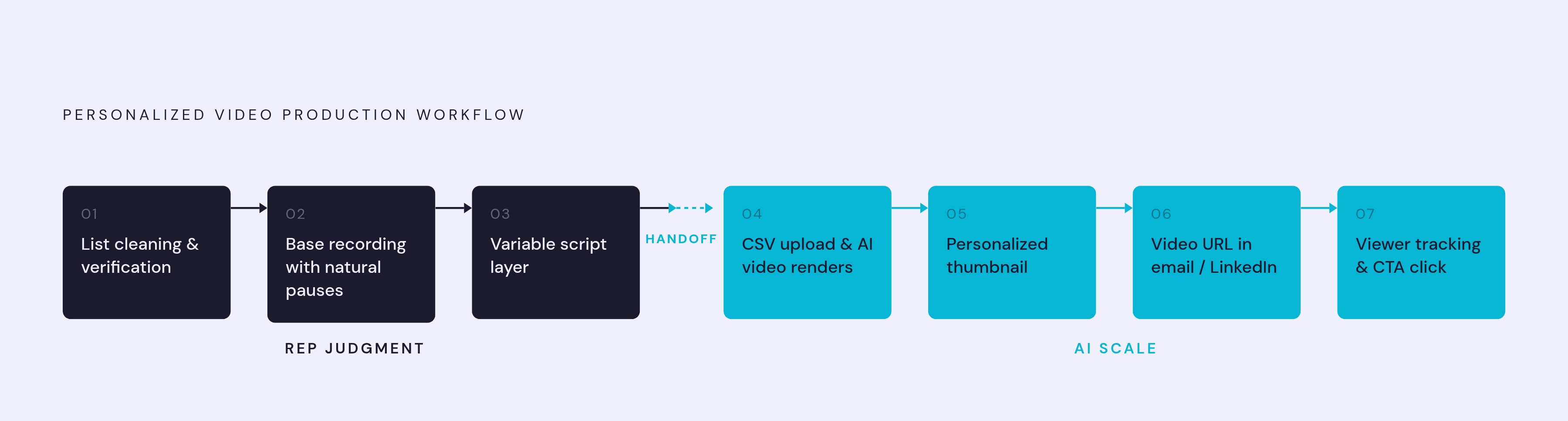
Running this at scale comes down to a seven-step workflow. The rep's judgment is concentrated at the start, in the recording and the messaging, and AI carries the load for everything that would otherwise need to be repeated prospect by prospect.
List quality is step 1, handled before anyone touches a camera. Data quality is the most underappreciated risk in video prospecting. A rep who records dozens of personalized clips against a list with a high bounce rate burns the production investment and damages domain reputation in the process. Cleaning and verifying the list is a requirement before production starts, not a nice-to-have step.
Step 2 is the base recording. Look into the camera, introduce the problem being solved, and leave natural pauses where the personalized variables will be inserted later. Speak the way a rep would on a Zoom call. A small stumble left in the recording reads as human; a polished, scripted delivery reads as scripted.
Step 3 is the variable script layer, the template that wraps around the base video: the prospect's name, their company, and one specific observation, an industry pain point, a recent news item, a product launch. The rep's own research and judgment live here. The AI replicates the template at scale, but someone has to write it well the first time.
Step 4 is generation. Upload the CSV, map the variable fields, and let the voice-clone and background engine produce individual renders for every prospect on the list. At this point the workflow runs on Sendspark- or HeyGen-style automation, producing hundreds of unique video URLs without a single additional recording session.
Step 5 is the thumbnail. A static image, the prospect's company name on a whiteboard, a screenshot of their website, a handwritten note, set as the video preview, so the click-through decision happens before the prospect has read a word of the surrounding email.
Step 6 is embedding the video into the sequence itself. The unique video URL drops into the email or LinkedIn DM template as a custom variable, the same way any other personalization token would. Platforms including Instantly, Smartlead, and Apollo handle these URLs exactly like other merge fields.
Step 7 is tracking at the viewer level: who watched, how far they got, whether they clicked the call to action. A prospect who watched past 70% of the video without replying is a strong candidate for a warm follow-up. That single data point is what turns personalized video from a branding exercise into an actual pipeline signal, because it tells a rep exactly who's engaged and hasn't yet converted.
Tools for building personalized video campaigns in 2026
The tool market for this has split into distinct categories, avatar-based personalization at scale, voice-clone-and-background systems, and screen-capture-to-demo workflows, and the right choice depends on which layer of the workflow a team is trying to optimize.
HeyGen represents the avatar-based approach to 1:1 personalization at scale. Reply.io built its outreach motion around it, and the agency Videoimagem used it to produce a large volume of personalized videos for AB InBev, seeing a significant engagement increase compared to non-personalized video. HeyGen fits SDRs and AEs running multilingual account outreach who need the name spoken aloud rather than overlaid as text. HeyGen's premium Avatar IV features draw from the same monthly credit pool as its other features but cost considerably more per minute, 20 credits per minute against 3 credits per minute for Avatar III, so cost per video climbs fast with volume on the lower-tier plans.
Sendspark represents the record-once, voice-clone-for-thousands approach described earlier in this piece. It charges by "Dynamic Video Minutes," where each minute purchased generates one complete AI-personalized video of that length, covering the voice cloning, the dynamic background, and the personalized thumbnail in a single unit. Its Agentic Workflows, available on the Growth plan and above, automatically identify a prospect's website, generate the personalized video background, and can trigger sends directly off CRM events. Its Combine Video feature, the short personalized intro stitched to a longer pre-recorded product demo, gives outbound teams a practical format when a campaign needs both relevance and real product depth in the same send.
Choosing between them, or running both for different parts of a sequence, comes down to where the workflow needs the heaviest lift: spoken-name personalization across languages and accounts points toward an avatar-based system, while a workflow built around dynamic backgrounds, agentic triggering, and a repeatable intro-plus-demo format points toward the voice-clone-and-background category. The production model is what makes the message scale.
Sources
- Video Prospecting: The Complete B2B Sales Guide for 2026
- The Complete Guide to Video Prospecting in 2026 | Sendspark
- 10 Best AI Video Tools for Sales Prospecting (2026)
- 10 Best Video Outreach Platforms for Sales (2026)
- Video Prospecting: The Complete Guide for Sales Teams in 2026 - Weezly
- Using Video for Sales Prospecting: 2026 Guide - Fundraise Insider
- The Future of Sales Outreach: Why Video is Essential in 2026