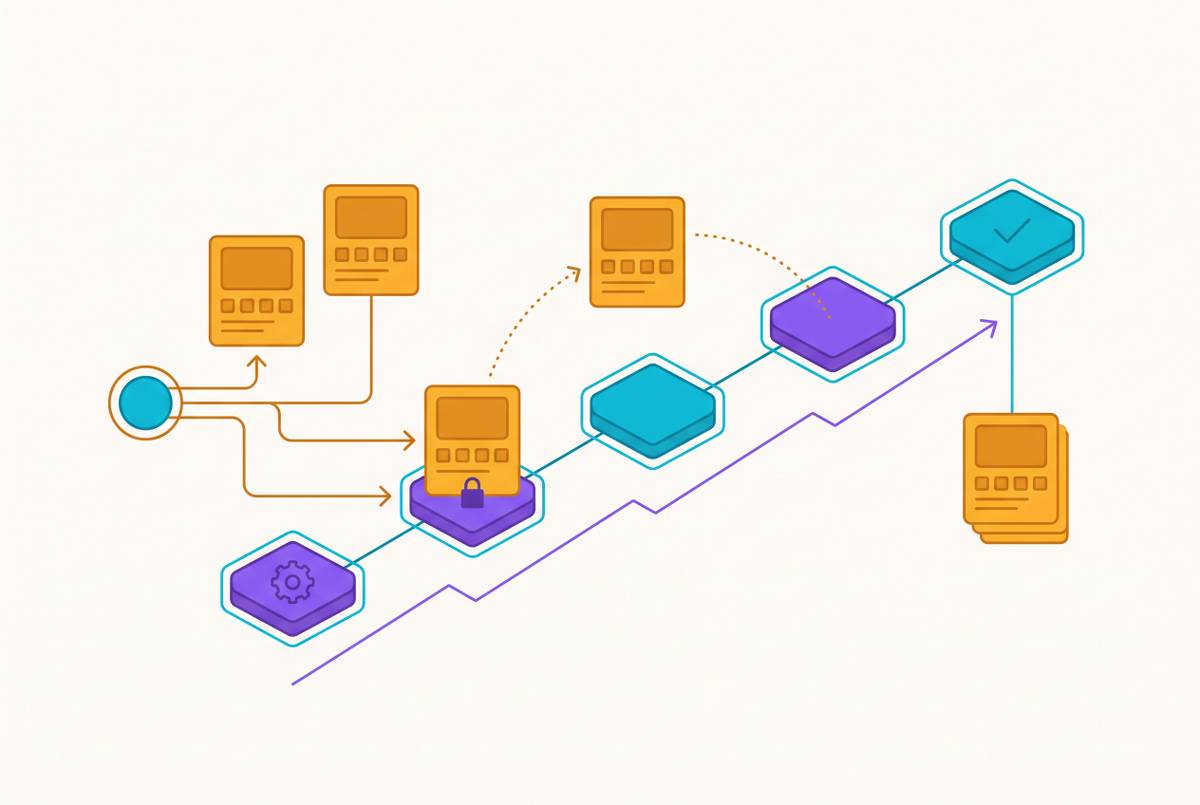
Expansion Revenue Triggers Through In-Product Demo Placement
In-product prompts catch expansion signals weeks before reps notice them.

Where expansion revenue leaks, and why it isn't a motivation problem
Expansion revenue is a plumbing problem. The signals that predict which accounts are ready to grow already exist inside the product. Most companies just aren't wired to catch them before the renewal date forces the conversation. The gap between when a customer's behavior signals they're ready to expand and when a rep actually notices is where a huge share of expansion revenue goes to die. Closing that gap means moving in-product education to where the signal actually fires, not where the calendar says to look for it.
Nobody on the team is short on hustle. Sales reps want the upsell. Customer success wants the renewal to grow, not just hold steady. So where's the breakdown? Look at where the signals actually live: usage data sits inside a product analytics tool that customer success doesn't have a login for. Renewal risk becomes visible only in a spreadsheet updated three weeks before contract end, a delay caused by systems that don't surface the signal earlier, leaving roughly three months too little time to act on it. The read on which accounts are ready to expand often lives in one rep's memory of a call from two months back, not in any system a second person can check.
That timing gap is the whole problem. Rising seat counts, a burst of feature adoption, a spike in support tickets: these signals appear in usage and support data weeks before renewal. Most teams don't look until renewal is already on the calendar, and by then the window to make an upgrade pitch has already closed. The customer decided, one way or the other, without anyone from the vendor in the room.
Buyers do the bulk of their research before they ever talk to a salesperson. They form the upgrade decision inside the product itself, often days or weeks before a rep even knows there's an opportunity on the table. Companies pulling ahead built growth around in-product signals, feature adoption, time to first value, instead of waiting for a quarterly business review to surface what already happened last quarter.
What behavioral triggers look like in practice
Forget the calendar. The best upgrade prompts don't fire because it's the first of the month. They fire because something changed in how a customer actually uses the product. A user who's spent two straight weeks building inside one feature is a fundamentally different prospect than someone who logged in twice and bounced. Treating them the same is how expansion opportunities get missed, quietly, month after month.
Good analytics catch these shifts before the customer says a word. Predictive modeling lets a team get ahead of churn risk and fire an upsell prompt before a customer ever files a support ticket or emails a rep. That's the real shift in product-led growth: from reactive, waiting for the ticket or the renewal call, to proactive, catching the signal while it's still happening.
Three trigger types do most of the work, and they're not interchangeable.
Usage-threshold triggers fire when a user closes in on a seat limit, a storage cap, or a feature ceiling. The product's own architecture is telling you they're ready. No guesswork required, no rep intuition needed.
Adoption-depth triggers fire when someone spends sustained time inside a feature cluster that sits right next to a premium tier. This is a behavioral signal that predicts intent far better than login frequency ever will.
Value-milestone triggers fire when a user hits a defined outcome, such as a first export, a first integration, or a first team invite. These moments track closely with readiness to expand, because they mark the point where the product stopped being new and started being useful.
The infrastructure to catch these triggers, event tracking, threshold alerts, in-app messaging, is baseline now, not a differentiator. Any team still running expansion off a quarterly spreadsheet review is operating well behind where the market has moved, and the accounts they're losing to slow detection aren't coming back to explain why.
The five in-product demo formats
Once a trigger fires, the format of what the customer sees next matters almost as much as the trigger itself. Five formats cover nearly every case, and each one has a job it's built for and a job it'll ruin if misapplied.
The modal takes over the whole screen, impossible to ignore. Save it for major feature launches or breaking changes, things a user genuinely needs to stop and read. Overuse it and people learn to click the X without reading a word, which kills the entire point of using one.
The slideout enters from the edge of the screen, gives room for more context, and doesn't yank the user out of what they were doing. Good fit for secondary feature announcements where a tooltip won't cover it but a modal would feel like overkill.
The tooltip is small and anchored to one specific element on screen. Low friction, high precision, and it's great for surfacing a minor enhancement or pointing out a button someone's scrolled past a hundred times without noticing.
The announcement banner sits at the top of the screen without blocking anything, and it works best for changes that touch every user at once, such as a pricing update, a new terms-of-service notice, or a platform-wide rollout.
The hotspot is a small pulsing marker that invites a click, ideal for passive discovery in a crowded interface. Power-user features tend to hide in plain sight in complex products, and a hotspot points at them quietly, without interrupting anyone's workflow.
Nudge Security shows what format matching actually looks like in practice: the company embeds interactive product demos directly inside its changelogs, so a user watches the new feature work instead of reading a paragraph describing it. Showing beats telling wherever the format allows for it, and a team that defaults to a wall of release notes over an embedded demo is picking the weaker option out of habit, not for any real advantage.
Sequencing matters just as much as the format. A trial user gets an onboarding quick-start demo on day zero. Support deflection demos live in the help center, linked from onboarding emails, ready the moment someone gets stuck. Further down the line, an expansion demo fires once a usage threshold gets crossed. Get the order wrong, showing an expansion demo to someone who hasn't reached first value yet, and it reads as noise. Get it right, and each demo meets the user exactly where the need sits that day.
How customer education embedded at trigger points compounds expansion over time
Formal customer education programs produce a measurable revenue line. Companies running them see adoption climb and see the return recorded in the books, and that pattern holds across the vast majority of organizations that build one out. It's a growth lever with numbers attached.
Lifetime value climbs for companies that run these programs consistently, and it compounds over the life of an account, quarter after quarter, the same way interest builds on a balance nobody's touching.
Timing is where this turns urgent. For a large share of products, most new users go inactive within two weeks of their first session. Two weeks is an unforgiving runway. That means the first fourteen days aren't just important for retention: they're the single highest-leverage window for planting the seeds of an expansion that might not land for another year. A user who never reaches value in week one isn't around in week twelve to hit an upgrade trigger, no matter how well-designed that trigger is.
Practically, this means building four pieces into the product experience, in order. An onboarding flow needs to get a new user to first value inside those first fourteen days. Adoption nudges need to push usage toward the features that actually matter. Product-qualified-lead routing needs to hand the hottest accounts to sales before they cool off. And customer-success-led expansion plays need to tie directly to value milestones a customer has already hit, not to a generic renewal calendar. If the first one is skipped, the other three have nothing to build on: onboarding is the foundation everything else sits on top of, and no amount of clever trigger design fixes a broken foundation.
Building the expansion demo itself, production standards that don't require a video team
Traditional video production eats hours per clip, because scripting, recording, editing, and re-recording once the feature changes underneath you each consume separate time that adds up across every clip produced. AI-assisted video tools have cut that timeline down hard, and teams that actually adopt the workflow instead of treating it as a side project report meaningful gains in support efficiency and onboarding speed.
Length affects completion rates more than most teams assume. Shorter videos tend to hold audience attention far more reliably than longer ones, and completion rates drop significantly as runtime grows. The goal for an expansion demo is to keep it concise: long enough to show the feature doing something real, short enough that nobody's finger is hovering over the skip button before the key point lands.
The efficiency gain comes from working in parallel instead of in sequence. Storyboard one shot while a second one renders and a third gets extended, and the total time from idea to finished demo drops hard, because the pipeline stops sitting idle waiting for one step to finish before the next can start.
Standardize a single source-of-truth screen capture for each feature. Every expansion demo for that feature should start from the same base recording, so when the feature gets a UI tweak, the voiceover, the motion graphics, and the call-to-action can all get regenerated without anyone re-shooting from scratch. Skipping this step turns every product update into a full reshoot, and that production drag makes teams quietly stop updating their demos until the library goes stale.
Measuring whether trigger-placed demos are driving expansion
The metrics that mattered a few years back, course completions, satisfaction scores, hours of content consumed, don't hold up in front of a CFO anymore. The shift now runs toward value metrics: churn reduction, faster time-to-value, dollars saved through deflected support tickets. These are the numbers that survive a budget review, and the ones that don't survive belong nowhere near the deck.
Three measurements do the heavy lifting. Time to first value: every day shaved off that number lowers churn risk and widens the window in which an expansion demo actually has a shot at landing. Support ticket deflection: customers who watch a contextual demo at the right trigger point open fewer tickets, and that's a cost line on a budget, not a vague sentiment buried in a survey. Renewal and expansion rates segmented by education engagement: did customers who saw an expansion demo at their trigger point renew at a higher rate, and did they expand contracts more often than the ones who never saw it?
Framing these numbers for a CFO means speaking to different priorities at once, and flattening them into one pitch is how measurement frameworks get ignored by the second meeting. A revenue-focused leader cares about upsell and cross-sell totals. A product-focused leader cares about adoption translating into renewals. A marketing-focused leader cares about educated, qualified leads converting at a higher clip than cold ones. The CFO cares about the revenue impact and the cost savings that adoption and renewal produce downstream. A framework that speaks to only one of those roles gets nodded at in a meeting and forgotten by the next quarter.
One project management SaaS company put the whole approach into motion at once: usage-based expansion triggers tied to seat and feature limits, CSM-led quarterly business reviews built around actual ROI proof instead of a relationship check-in, and in-app prompts surfacing add-on features right when a customer's usage pattern called for them. Within six months, net revenue retention climbed to 112%, and for the first time, new ARR from expansion outpaced new ARR from new customers. The revenue was already sitting inside the existing accounts. It just needed a system built to catch it before the moment passed.