Demo Content Handoff From Sales to Customer Success
Demo recordings carry the commitments and context that CS teams never receive when handoffs fail.
A customer signs a contract believing the team that takes over already knows why they bought. Then, three weeks into onboarding, they're explaining their own goals to a CSM who has never heard them before. That moment is the predictable result of a structural problem: the most important deal context lives in conversations, not in the CRM, and nobody owns the job of moving it across the boundary between sales and customer success. A signed order form tells the delivery team what was sold. Most early-churn surprises live in the space between those two documents.
That space breaks down into five specific gaps, not a vague sense of misalignment: missing commitments, missing reasons for the purchase, missing deal risks, missing stakeholder maps, and missing definitions of success.
The incentive structure behind this makes it worse. Account executives paid at close, who move immediately to the next deal, have every rational reason to over-promise during the sales cycle, since someone else will own the consequences. Timing compounds the damage: when contract signature is the trigger for handoff, the context has already started decaying by the time anyone acts on it. The AE's attention has moved to a new pipeline, and the customer's momentum, built over weeks of sales conversations, dissipates into silence while nobody updates them.
The cost of that silence is measurable. Asking a customer to repeat themselves before they've gotten any value from the product they just bought is a textbook high-effort experience, and high-effort experiences are what drive disloyalty. None of this is a process teams forgot to follow. It's a structure that produces the same failure even when every step on the checklist gets checked.
Why demo content is the specific artifact that carries the promises CS never receives
Every sales cycle generates a pile of artifacts: call notes, emails, CRM fields, proposal decks. Demo content sits apart from all of them because it encodes, more precisely than anything else produced during the cycle, what the customer was actually shown and actually agreed to buy. It's also one of the artifacts most routinely left out of the handoff.
A CRM field can log that a feature was discussed. Buried inside those same conversations are the integration discussions and configuration assumptions that often carry real commitments: SSO working before rollout, a custom go-live date, a specific report format promised to a stakeholder who asked a pointed question midway through the demo. None of that lives anywhere else.
A mid-market logistics company's experience shows how this plays out. Nobody caught the gap from a written artifact. It surfaced only because the handoff happened on a live call, where the customer mentioned it in passing and the CSM had the presence of mind to ask a follow-up question. Had that handoff been a form filled out asynchronously, the commitment would have stayed buried until week three arrived and the integration wasn't ready.
That case points to a pattern in sales conversations: integration discussions and configuration assumptions get made verbally, and when they aren't captured clearly, the delivery team discovers the gap during onboarding, often in the form of demo workflows that need extra configuration nobody confirmed with the customer's technical team. Most handoff templates are built to transfer information, meaning what the customer said, rather than commitments, meaning what was promised, by whom, and by when. Demo content is the primary record of commitments, so losing it is especially costly.
What the handoff needs to transfer, and where demo content fits in that structure
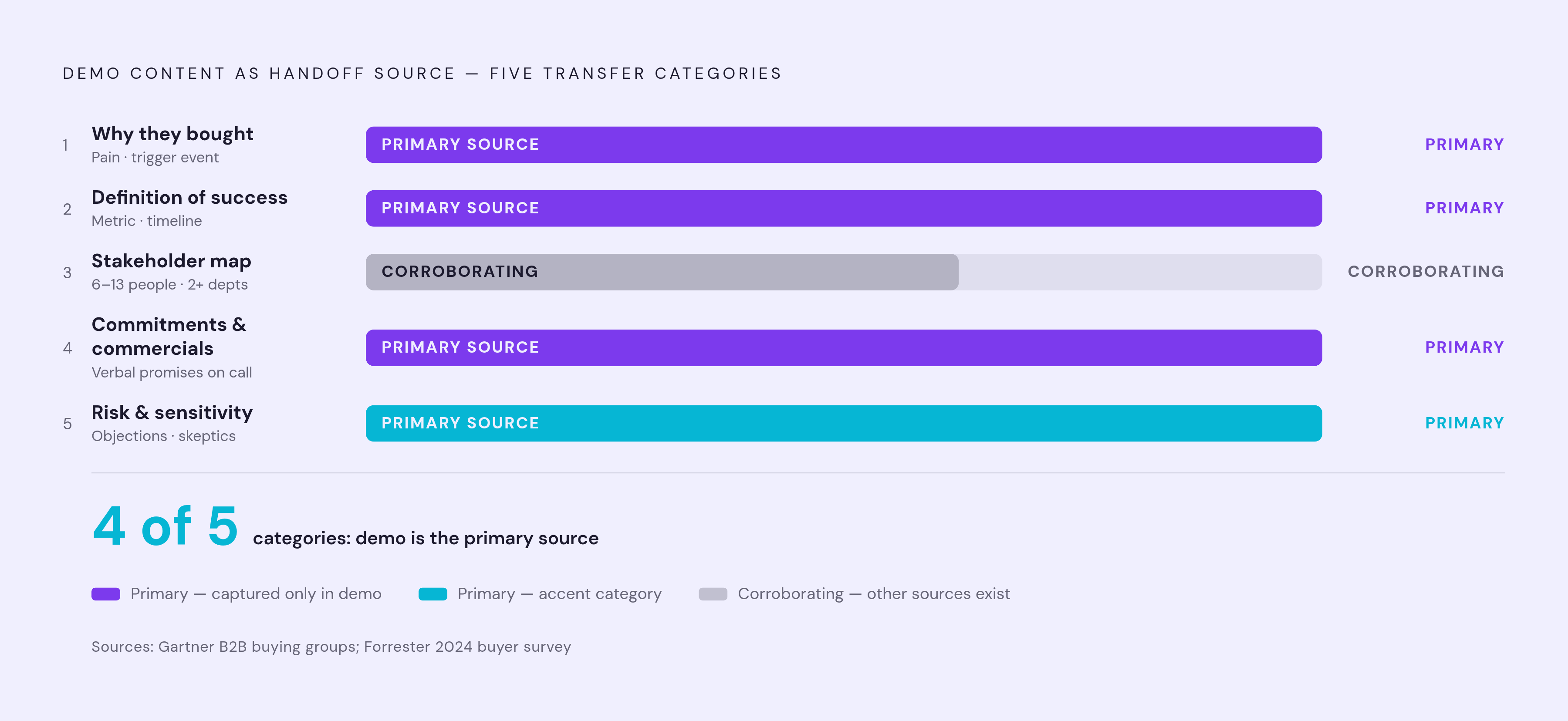
A handoff that actually works transfers understanding across five categories, and demo content turns out to be the primary or corroborating source behind most of them. Laying those categories out shows how central this one artifact class really is, and how much of the structure falls apart without it.
The first category is why the customer bought in the first place: the business pain and the trigger event that started the evaluation. Demo recordings capture the discovery questions an AE asked and how the customer answered them, which shaped the whole evaluation, and the demo itself reflects which pain the AE chose to address when designing the walkthrough. The second category is the customer's definition of success: the metric and the timeline they will use to judge whether the implementation worked. That definition is frequently stated out loud during a demo debrief or a walkthrough, and it almost never makes it into a CRM field.
The third category is the stakeholder map, and this one carries more weight than most teams assume. Gartner research puts a typical complex B2B buying group at six to ten decision makers, and Forrester's 2024 buyer research found the average purchase involves thirteen people spanning two or more departments. Demo recordings are often the only record of who actually attended those sessions, who asked which question, and who raised which objection, which makes them the clearest window into a buying committee that size produces. The fourth category is commitments and commercials: the verbal promises made during a demo are the single most dangerous class of undocumented commitment, and the fix is a commitments log that ties every promise back to the specific call or demo segment where it was made.
The fifth category is risk and sensitivity: the objections that nearly killed the deal, the skeptical IT lead who needed convincing, the competing internal priority that almost won out instead. That near-miss context tends to vanish at the exact moment of handoff and resurfaces in the first 90 days of the relationship, right when the CSM has no idea they should be watching for it. The quality standard that emerges is this: a CSM should be able to open a kickoff call and read back the customer's goals, commitments, and success metric accurately, without asking the discovery questions all over again, and demo content is what makes that read-back possible in the first place.
How the handoff fails when demo content is treated as an archive rather than a live artifact
Plenty of teams already record their demos. Most of those teams still fail the handoff, because having a recording and transferring its contents are two different things. The recordings sit in storage, nobody is required to watch them, and nobody has built a process that pulls their contents into the documents CS actually works from.
General-purpose tools don't close this gap on their own. A demo recording dropped into a storage folder shares the same fate: a CRM note captures a snapshot but isn't where onboarding happens, a spreadsheet goes stale the moment it's filled in, and a Slack message gets buried.
Quarter-end timing makes the failure worse in a predictable way. The deals closed under the most pressure at the end of a quarter are the ones that carry the most last-minute concessions and verbal promises, and those same deals get the thinnest notes, because everyone involved was moving fast to get the signature before the deadline. They're also the deals where demo content is least likely to get tagged, summarized, or formally handed to anyone, since the AE closing them has already moved on to the next quarter's targets.
The person who signs the contract is frequently not the person who has to implement the product, so the timing gap is compounded by a mismatch in who is actually involved. A VP signs off on the deal, and their team inherits the actual rollout despite never sitting in on a single sales conversation. Demo content shown to that VP during the evaluation doesn't automatically become visible to the implementation team that now needs to understand what was configured and promised.
What this looks like in practice is a recording link sitting in a CRM field: untranscribed, unsummarized, with no commitment log attached to it anywhere. To get anything useful out of it, the CSM would have to sit through hours of footage to extract what a properly structured handoff document should have captured for them automatically. If an AE is paid 100% at close, spending time reviewing a demo recording is admin work with zero payout attached to it, and without structural accountability, demo content stays in the archive. Without some structural reason to do it, demo content stays exactly where it started, in the archive, unused.
Making demo content the structured center of the handoff: the process and the artifacts
The fix starts with timing. The handoff shouldn't wait for a signature. It should start at Stage 4 or verbal commit, while the AE's memory of the deal is still sharp and they still have leverage with the buyer to clarify anything ambiguous. That means demo content gets reviewed and summarized before the contract is signed, while the details are still sharp.
What gets built from that review is a five-part checklist, and every field in it is sourced directly from demo content rather than invented from memory. The second field is why the customer bought, written in their own words and pulled straight from discovery call recordings rather than paraphrased secondhand. The third field is the objections, competing vendors, and internal blockers that show up in demo Q&A sessions and debrief recordings, which is what nearly killed the deal. The fifth field is what success means to the customer, including the measurable outcomes and target dates that often get stated out loud during a demo walkthrough and nowhere else.
Alongside that checklist sits a commitments log, built as a living document rather than a static field. It maps every promise to its source recording and timestamp, it's owned jointly by the AE and the CSM, and it stays visible to both teams for the entire length of onboarding instead of getting filled out once and left to go stale. The process is anchored by a 20-minute handoff call with a fixed agenda: the AE walks through everything that was promised, the customer describes what they expect to happen in the first 90 days, and the CSM confirms the success plan out loud. That call also carries the "read it back" mechanism: the kickoff opens with a "what we heard" slide listing the customer's goals, the commitments made to them, and the success metric, followed by one direct question asking what's missing or wrong.
AI conversation intelligence tools connected to platforms such as Gong or Chorus can take a real bite out of the manual labor this requires, by analyzing sales call recordings and surfacing pain points raised during discovery, success criteria mentioned during evaluation, and commitments made during demos. Tying a portion of AE compensation to the customer hitting a first defined success milestone turns demo content review into paid work instead of overhead nobody has time for.
The continuous-space model: removing the handoff cliff by keeping demo content in a shared customer environment
Every fix described so far improves how context gets transferred at a single moment in time. The stronger version of the argument removes that moment. Instead of building a better transfer process for the instant a deal closes, a continuous-space model keeps one shared record running from the first sales conversation straight through onboarding, so context stays unified from the start.
Applied to demo content specifically, this means the product walkthroughs, the custom configurations, and the workflow demonstrations shown during evaluation live in the same shared space the customer logs into during onboarding. The customer can go back and reference what they were shown, and CS can see what was demonstrated, without anyone needing to forward a recording, dig through a CRM field, or reconstruct a conversation from memory.
The payoff appears in the customer's experience of the relationship: never making a customer repeat themselves, referencing specific things they said back to them during the sales cycle, and showing them concretely that their context traveled along with them into the next phase does more for early retention than any onboarding playbook written after the fact. A well-executed handoff makes a customer 3.5 times more likely to continue their journey with a brand.
A shared space requires sales and CS to agree on common tooling and common workflow discipline, which is a genuine coordination cost. The alternative is the failure mode already on display throughout this piece: context lost at the boundary, customers forced into re-discovery conversations they shouldn't have to have, and a customer who quietly concludes that the company they just paid doesn't talk to itself.
How polished, reusable demo content extends the handoff artifact into onboarding and beyond
A raw recording solves the handoff problem and creates a new one immediately behind it. It closes the context gap at the moment of transfer, but it is not a format a customer or a new team member can actually learn from, and it only gets less useful as the product keeps changing underneath it.
The same workflow walkthrough has to serve different people at different points in the relationship. One raw recording, however well it was made, can't flex to serve all three of those needs at once.
That's the production gap most CS teams quietly accept rather than solve. Turning it into a step-by-step walkthrough or a polished how-to video is real production work, and most CS teams skip it because it looks expensive and slow compared to just forwarding the link.
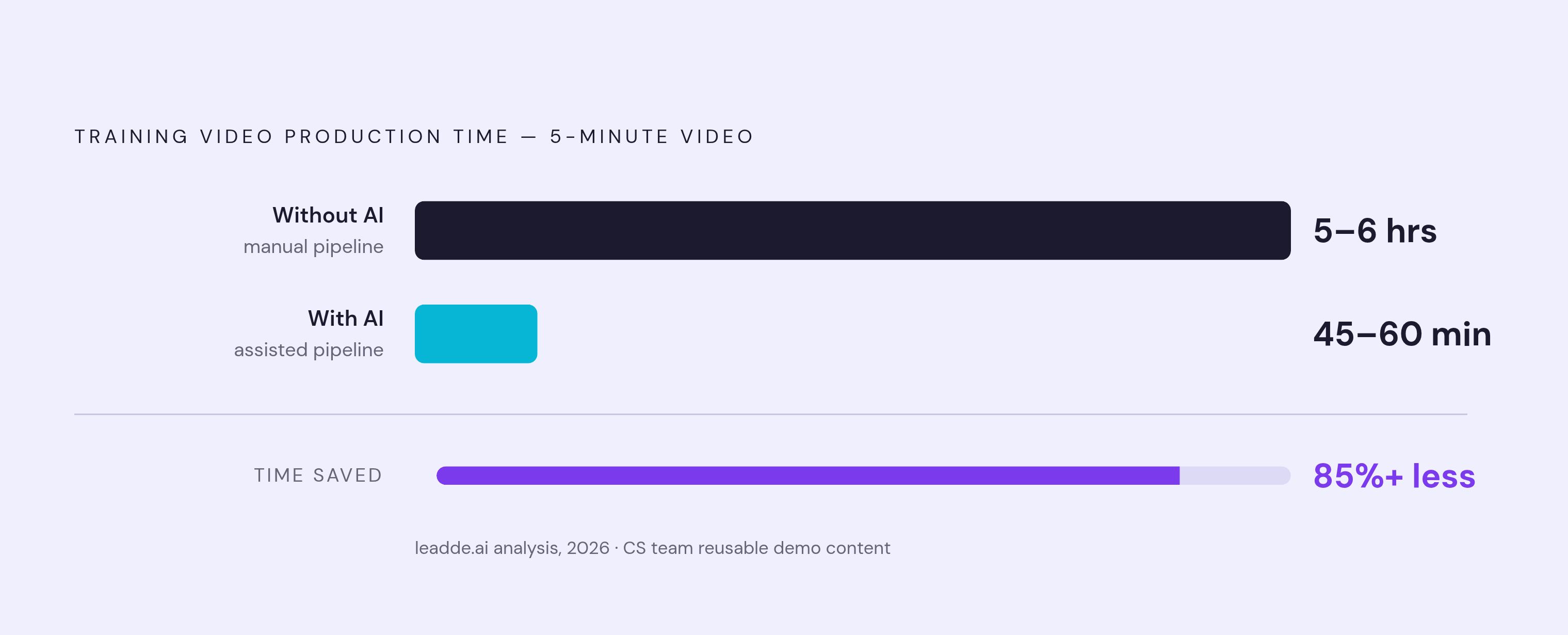
AI-assisted production is starting to close that gap. In one onboarding workflow analyzed by leadde.ai in 2026, a five-minute training video that previously took five to six hours to produce came down to roughly 45 to 60 minutes using AI-assisted production pipelines. Demo content becomes a resource that keeps paying off, long after the kickoff call that first put it to use.