Demo Approval Workflows for Regulated Industry SaaS Companies
Auditors need timestamped approval records, and email workflows can't deliver them.
When an auditor asks for proof that a demo asset was approved, they want one thing: a timestamped record showing who approved version 3.2 of that asset, and what that version actually contained. Most regulated SaaS teams can't produce that. They can produce an email thread, a Slack message, or a shared doc with comments scattered through the margins, but none of that counts as an audit trail. The gap between those two things is a tooling problem that needs to be solved at the infrastructure level before it becomes a finding.
Demo approval in regulated SaaS as a compliance infrastructure problem
Teams that fail audits over demo approval usually have reviewers who read carefully, managers who sign off in good faith, and compliance officers who take their job seriously. The failure sits somewhere else: the tools carrying that work, email, shared docs, Slack threads, were never built to produce the kind of record a regulator can act on. Email creates a paper trail, but the wrong kind. Approvals get buried three replies deep in a thread. Reviewers work off attachments that got replaced two versions ago without knowing it. Nothing stops a junior reviewer from approving before the required senior sign-off even happens, and nothing flags it when that happens.
The cost appears twice. First, before every inspection, someone spends hours digging through inboxes and forwarded messages trying to rebuild an approval history that should have existed automatically. Second, every hole in that reconstruction becomes a finding. Compliance failures cost organizations an average of $4 million per incident, and no auditor accepts "we used email" as a substitute for a real record. The fix is a system that produces the evidence as a byproduct of doing the work, not something assembled afterward under deadline pressure.
Approval record requirements from FDA 21 CFR Part 11 to SOX
Teams working under FDA 21 CFR Part 11, SOX, or HIPAA don't get to design approval workflows however they like. These frameworks set specific, testable requirements for what counts as a valid approval record, and understanding those requirements is the starting point for building anything that will hold up.
Every one of these frameworks expects a clear assignment of reviewers by role, so there's no ambiguity about who had the authority to approve a given piece of content. They expect version locking at the moment of review, so the record reflects what the approver actually looked at and locks out later edits made after sign-off. FDA 21 CFR Part 11 and EU Annex 11 both call for tamper-evident records, and version locking is what makes that possible in practice. They expect timestamped status transitions, capturing the exact moment a review moved from pending to approved or rejected, tied to a specific, identifiable user session. And they expect a path for rejection and re-review, because a compliant process has to account for what happens when feedback sends a document back for changes, not just the clean case where everyone signs off on the first pass.
Two layers run through all of this, and both need to exist, and both need to connect to each other. One is a review layer: comments anchored to a specific spot in the document, inline discussion, a record of what changed between drafts. The other is an approval layer: explicit states (pending, approved, rejected), routing that assigns the right people, and a timestamped record tying each decision to a named, authorized user working from a known version. A system that has one layer but not the other doesn't satisfy regulators. Compliance isn't a box checked once a year during audit season either. Regulators increasingly expect continuous monitoring instead of a snapshot taken right before the inspection, so the underlying workflow has to write these records in real time, as the work happens.
Version locking as the linchpin requirement most ad-hoc workflows fail
Of everything a compliant approval record needs, version locking is the one ad-hoc workflows get wrong most often, and getting it wrong quietly undermines every other control in the system.
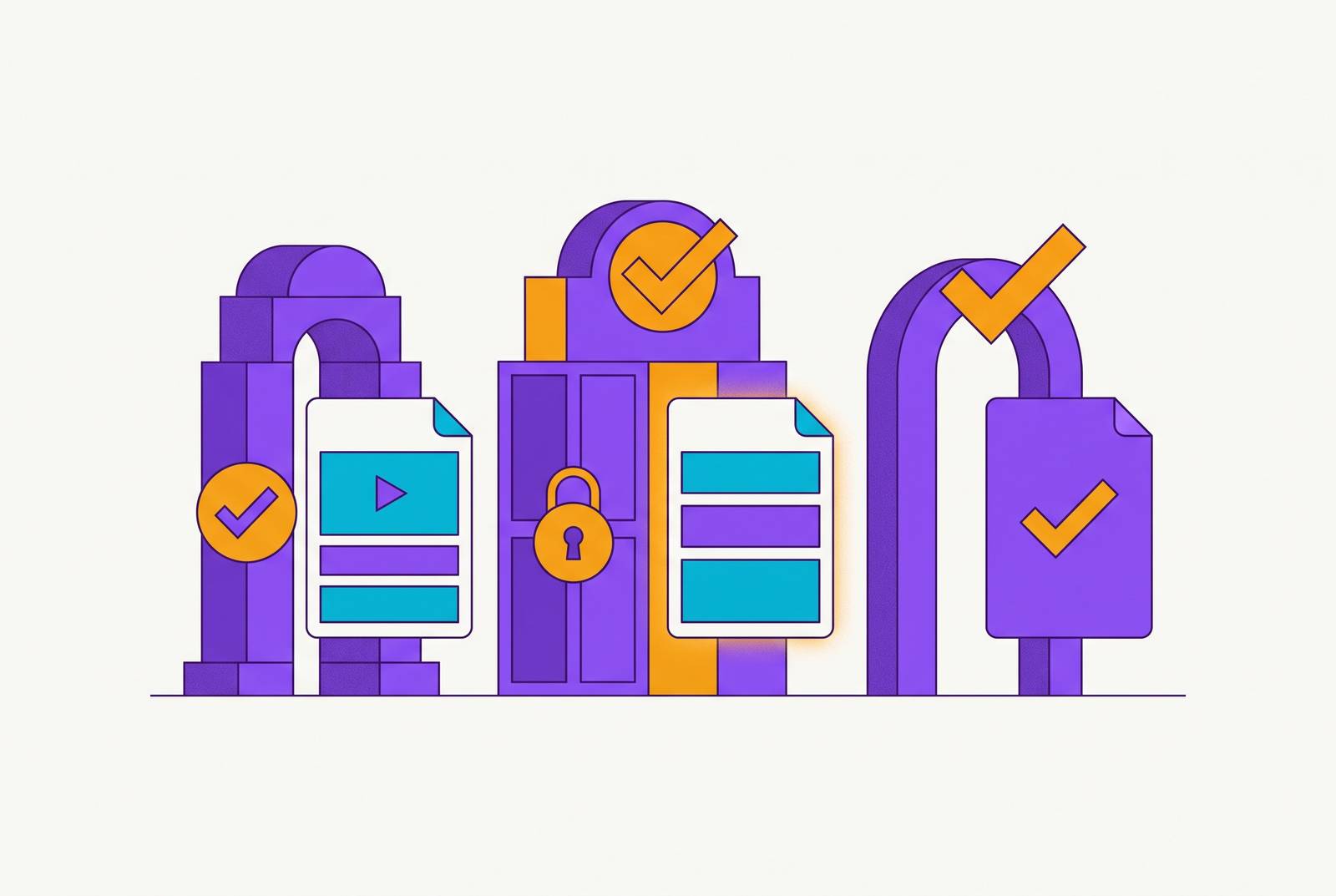
Without version locking, someone can edit a document after it's already been approved, and the audit trail still shows a clean approval event. It just can't prove what was actually inside the version that got approved. Tamper-evident record requirements exist to close that gap: the record has to reflect precisely what the approver saw, not whatever the document happened to look like a week later. Part 11 addresses this through tamper-evident audit trails, immutable binding between a signature and the record it applies to, and record integrity requirements that treat any after-the-fact change as a red flag.
Email-based workflows run into this constantly. Reviewers end up working from attachments that have already been superseded, so two people hand back feedback on two different drafts at the same time, and nobody notices because there's no system-level link tying an approval action to the specific version that triggered it. Once version locking is gone, role-based access controls and timestamps stop being enough on their own. They can prove someone approved something. They can't prove the something on record is the same thing that made it into production.
Demo content runs into this problem with particular force. A sales demo or product walkthrough often goes through several rounds: messaging gets revised, legal checks the claims, brand updates the look. Each of those rounds has to tie back to the exact version the relevant approver actually reviewed, or the chain of custody breaks somewhere in the middle, and nobody can say with confidence which version shipped.
The five structural components of a demo approval workflow that holds up to audit
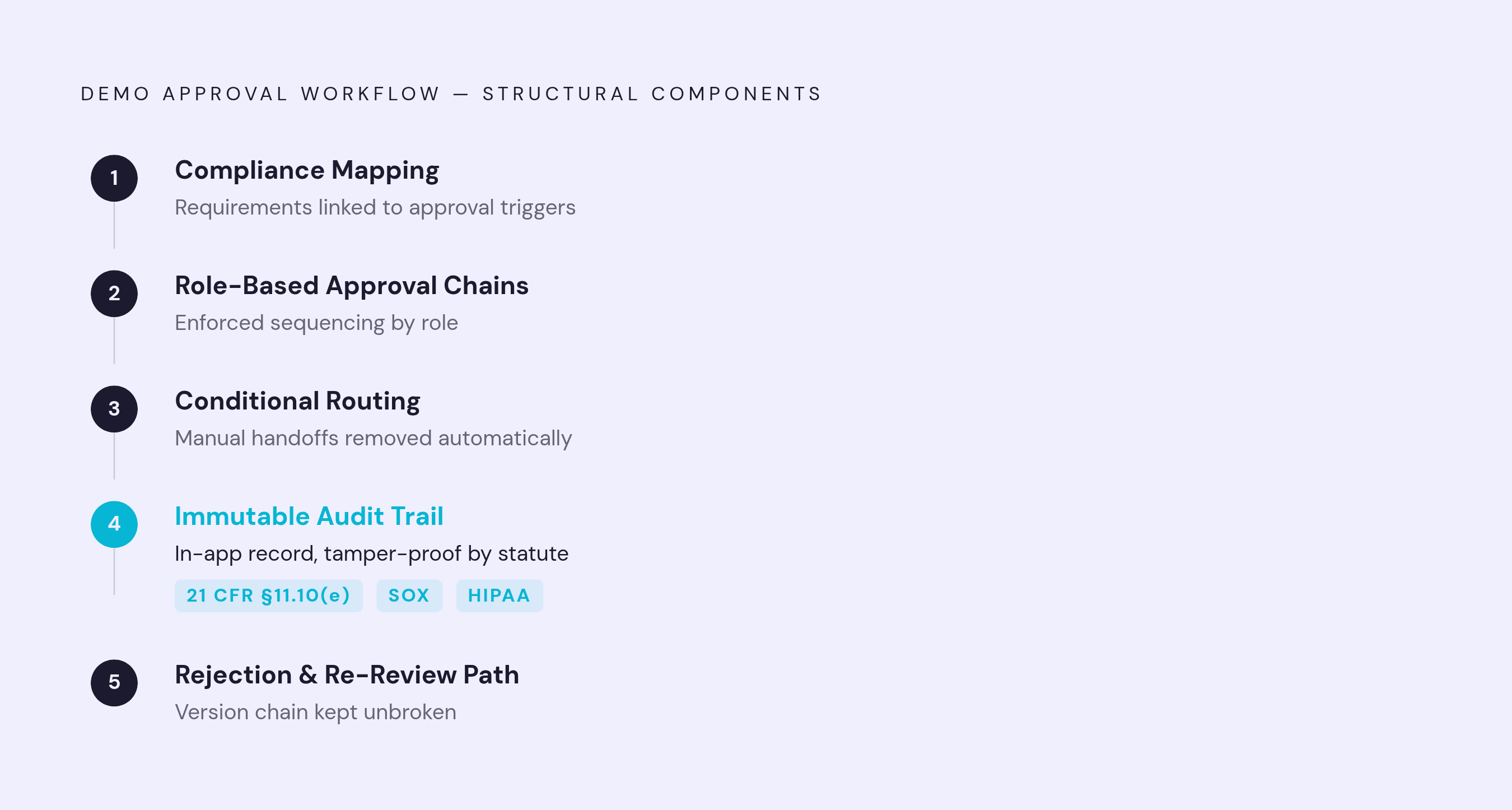
A workflow that satisfies auditors in a regulated industry is built from five distinct components, each one answering a specific audit requirement.
The first is mapping compliance requirements to approval triggers before anyone sketches out a workflow diagram. This means listing the exact obligations a team faces and translating dense regulatory language into plain "if this, then require that" rules, the rulebook the workflow will enforce going forward. For demo content, that means identifying which asset types fall under regulatory scope (product walkthroughs, feature announcements, sales decks that make regulatory claims), tagging them accordingly, and defining what has to happen to each one before it can move to approved status.
The second is designing role-based approval chains that enforce sequencing. Some chains run in sequence (a manager approves, then a compliance officer), and some run in parallel (two reviewers at once), but the chain should use the fewest steps that still satisfy the compliance requirement, since every extra hop adds delay without adding safety. Role-based access controls decide who can comment, who can approve, and who holds final sign-off, and those controls double as a defensible log showing that only the right people acted on a given asset. Without enforced sequencing, a junior reviewer can approve something before the required senior sign-off happens, and the system won't catch it or flag it.
The third is conditional routing that removes manual handoffs. Fields like department, risk level, or regulation tag can trigger different approval paths automatically. A demo asset tagged as containing a regulatory claim can route straight to legal, bypassing the standard manager step. The same logic handles escalation: a demo built for a high-risk market segment, or one making a new product claim, should trigger a tougher review chain than a routine update to a UI walkthrough.
The fourth is an immutable, in-app audit trail that doesn't need to be reconstructed by hand. A workflow built inside a single application writes every action to a permanent log the moment it happens, which is what FDA 21 CFR Part 11, SOX, and HIPAA all expect in different ways. Part 11 §11.10(e) states this most directly as a statutory requirement; SOX and HIPAA get there through their broader data-integrity and audit-control provisions. That log needs to timestamp every status change and tie it to a specific user session, and any approval that happens outside the system, over email, say, needs to be pulled back into the formal record. When an auditor asks for proof, the record should appear on demand in the system, not after a day spent digging through inboxes.
The fifth is a rejection and re-review path that keeps the version chain unbroken. A real workflow has to handle the full cycle, not just the clean approvals. When feedback sends something back for revision, that revised version needs to enter the approval chain as its own distinct version, with the rejection and the reasoning behind it preserved, before the updated asset can move forward, because skipping this lets a rejected-then-revised asset show up in the audit trail looking like a simple, one-step approval, with no trace of what was wrong the first time or what changed.
Where AI fits into a governed demo approval workflow
AI can speed up both the production of demo content and the first pass of reviewing it, but only if its role has clear limits and every action it takes lands in the same audit trail as the human decisions around it.
Used well, AI does two things in this kind of workflow. First, it handles first-pass review: flagging possible compliance issues, checking regulatory language, suggesting edits before an asset ever reaches a human reviewer, which cuts down what people need to catch and shortens the review cycle. Second, it handles production: turning a raw screen recording into a clean first draft, complete with a cleaned-up script, voiceover, and supporting documentation, so the asset entering the formal approval chain is already close to final, not a rough cut that still needs hours of editing.
There's a hard line, though, specific to anything buyer-facing. When AI surfaces content for a sales demo or enablement asset, that output needs to be grounded in material the organization has already approved, not pulled from a general-purpose model drawing on whatever it happens to know. Every claim needs to trace back to something vetted. And no matter how good the first pass is, AI doesn't get approval authority. Source selection, claim review, legal sign-off, and the decision to publish stay with human operators. The audit trail needs to capture both the AI's flag and the human decision made in response, so what you end up with is a review chain where AI and people both show up, and every step either one takes is logged and attributable.
An AI assistant will happily surface a two-year-old demo deck if nobody ever told the system to retire it, a lifecycle risk worth watching closely. The fix is content lifecycle governance, where every asset has a named owner, a scheduled review date, and a status that's actually kept current. That matters most in regulated industries, where product claims, safety language, and disclosures change almost every time the product or the regulation does.
Running demo content production and compliance approval as one workflow
Most regulated SaaS teams keep making the same structural mistake: content gets produced in one tool, then exported and handed off to a separate approval system. That handoff, that break between the two systems, is exactly where version locking falls apart and audit trails stop being continuous.
A unified workflow solves this by keeping production and approval in the same environment. When content is produced and reviewed in one place, the version entering review gets locked at the moment of submission. There's no export step, no re-upload, no window where someone can quietly make an edit between production and approval. Comments, revision requests, and approval decisions all anchor to a specific version of the asset instead of scattering across email threads that reference an attachment someone may have already changed. The audit trail runs continuously from the first draft to the final approval, instead of getting stitched together after the fact from two separate systems that were never designed to talk to each other.
For demo content built from screen recordings specifically, this is already how newer production tools work. A platform that takes one recording and generates a polished video alongside step-by-step documentation, an AI-cleaned script, a natural-sounding voiceover, smart zoom, captions, an SOP article, produces a reviewable, version-identifiable asset right at the point it's created. That asset can move straight into a structured approval chain instead of sitting through a separate production cycle first. This is the model that makes compliant demo production realistic at scale. A training video or product walkthrough that takes a team days to build won't get updated the next time a procedure changes. One that can be rebuilt in minutes will actually stay current, which is the whole point when a product ships new features every sprint.
Clueso's workflow follows this pattern: record or upload a screen capture, let AI rewrite the script, apply voiceover and zoom, and generate the documentation alongside it, turning a raw recording into a polished, reviewable asset within minutes. That's a meaningfully different starting point for a compliance review than a rough screen capture that still needs a production pass before anyone can evaluate it fairly.
None of this is a one-time setup. Compliance workflows need regular review, on a quarterly cadence makes sense for most teams, to stay aligned with regulations that keep shifting, and the workflow itself should be treated as a versioned asset subject to the same governance rules as the content running through it. The most practical way to start is small: roll the workflow out to one low-risk team, run real assets through it for two weeks, and watch closely for bottlenecks or approvals that get stuck. The goal is finding where the process breaks before an auditor does.